
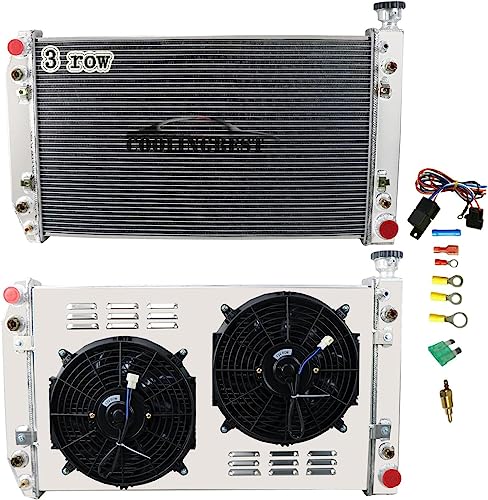
Three-Row Aluminum Core for Heavy-Duty Cooling Performance
The radiator features a three-row aluminum core with a listed thickness of 1.73 inches.
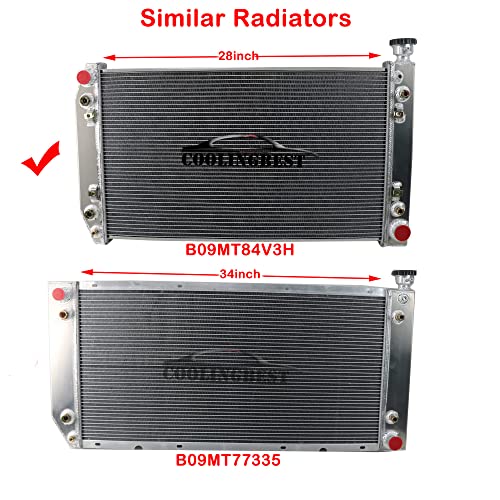
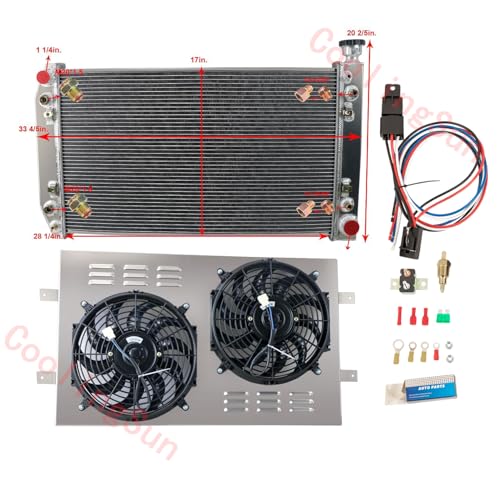
Its core dimensions are approximately 28.26 × 17.24 inches, with the measurements supplied using the manufacturer’s stated core orientation.
The three-row design is intended to provide substantial coolant-to-air heat transfer capacity within a radiator sized for compatible full-size Chevrolet and GMC trucks.
Why a Three-Row Radiator Can Be Useful
A radiator transfers heat from engine coolant into the surrounding airflow.
Its effectiveness depends on several factors, including:
- Coolant flow through the radiator tubes.
- Radiator core thickness and tube design.
- Aluminum fin density.
- Airflow through the radiator.
- Cooling fan operation.
- Ambient temperature and engine load.
A three-row radiator can provide additional cooling surface area, depending on its construction.
However, row count alone does not guarantee better performance. Tube dimensions, fin density, and airflow are equally important.
For an explanation of how radiator design affects engine cooling, visit our Complete Car Cooling System Guide.
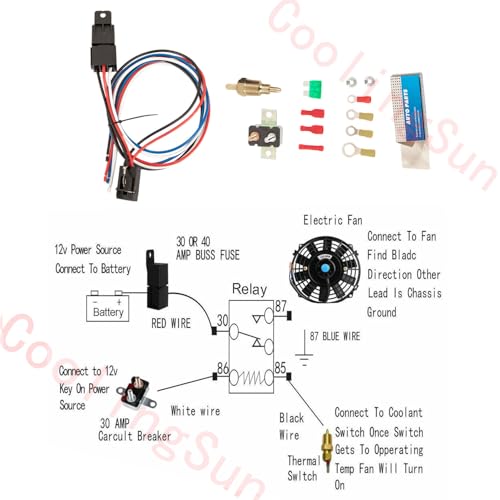
Electric Fan Shroud and Thermostat Kit for Consistent Airflow
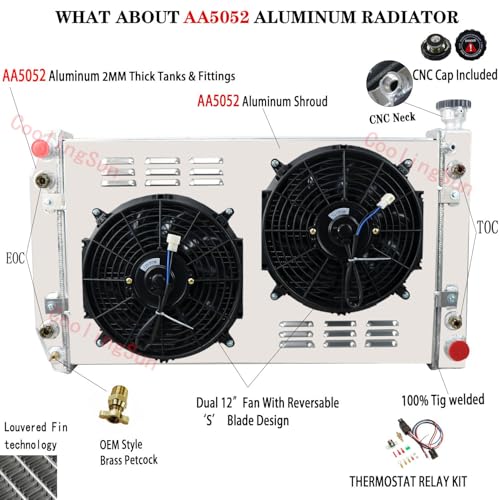
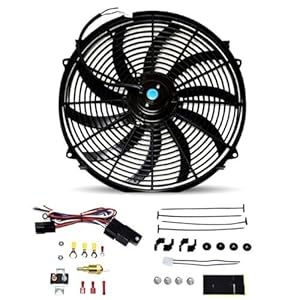
One of the key advantages of this radiator package is its included electric fan shroud and thermostat kit.
Factory mechanical cooling fans rely on engine-driven components to move air through the radiator.
Electric fans can provide airflow independently of engine RPM when connected to an appropriate temperature-control system.
This can be particularly useful during idling, low-speed driving, and stop-and-go traffic.
Benefits of Electric Cooling Fans
Improved Low-Speed Airflow: Electric fans can move air through the radiator when vehicle speed is insufficient to provide adequate natural airflow.
Temperature-Based Operation: A thermostat controller can activate the fans according to the cooling system’s temperature.
Flexible Installation: Electric fans may provide additional packaging flexibility for certain engine configurations.
Cooling System Modernization: Replacing an aging mechanical fan arrangement can be part of a broader OBS Chevy restoration or performance upgrade.
Why the Fan Shroud Matters
The radiator shroud helps guide airflow through the radiator core.
Without an effective shroud, some air may bypass the radiator fins, reducing cooling effectiveness.
A properly fitted shroud helps the electric fans draw air through a larger portion of the radiator surface.
Important: The supplied listing does not specify fan quantity, fan diameter, airflow rating, thermostat switching temperatures, or relay amperage. Verify these specifications before installation or publication of additional performance claims.
Dual Oil Cooling – Transmission and Engine Oil Cooler Provisions
Many Chevrolet and GMC C/K trucks were equipped with factory transmission cooling systems, engine oil coolers, or both.
These systems help manage fluid temperatures during demanding operation.
The radiator includes two integrated fluid-cooling provisions.
Automatic Transmission Oil Cooler
The listed transmission cooler connection uses a 1/2-20 UNF thread specification.
Automatic transmissions generate heat during normal operation, especially when towing, hauling, or repeatedly accelerating under load.
An integrated transmission cooler helps manage transmission fluid temperature when correctly connected to the vehicle’s cooling circuit.
Engine Oil Cooler
The listed engine oil cooler connection uses an M20 × 1.5 thread specification.
Engine oil helps lubricate and cool internal engine components.
For trucks equipped with compatible factory engine oil cooling systems, the radiator’s integrated cooler provisions can help preserve the intended cooling arrangement.
Why Proper Cooler Connections Matter
Before installation, verify the radiator’s fitting dimensions against the original transmission and engine oil cooler lines.
Incorrect fittings can cause fluid leaks, damage threaded connections, or compromise cooling system reliability.
The presence of cooler connections does not guarantee compatibility with every Chevrolet or GMC factory plumbing configuration.
3-Row Aluminum Radiator Technical Specifications
| Specification | Details |
|---|---|
| Product Type | Aluminum Radiator with Electric Fan Shroud and Thermostat Kit |
| Advertised Vehicle Fitment | 1988–1999 Chevrolet / GMC C/K Series |
| Engine Applications | Selected 5.0L and 5.7L V8 |
| Radiator Core | 3-Row |
| Radiator Material | Aluminum |
| Core Dimensions | 28.26 × 17.24 × 1.73 inches |
| Overall Dimensions | 33.85 × 20.47 × 5.51 inches |
| Inlet Diameter | 1.26 inches |
| Outlet Diameter | 1.57 inches |
| Engine Oil Cooler | Integrated |
| Engine Oil Cooler Connection | M20 × 1.5 |
| Transmission Oil Cooler | Integrated |
| Transmission Cooler Connection | 1/2-20 UNF |
| Electric Fan Shroud | Included, per listing |
| Thermostat Kit | Included, per listing |
| Installation Design | Advertised Direct OE Replacement |
Measurement note: The supplier’s core dimensions use an unconventional height/width orientation. Compare the physical radiator against the original unit using consistent length, height, and thickness measurements before purchasing.
Vehicle Fitment – Chevy Silverado, GMC Sierra and Suburban
This radiator package is advertised for selected 1988–1999 Chevrolet and GMC C/K Series trucks equipped with 5.0L and 5.7L V8 engines.
| Vehicle | Advertised Years |
|---|---|
| Chevrolet C1500 | 1988–1999 |
| Chevrolet C2500 | 1988–1999 |
| Chevrolet C3500 | 1988–1999 |
| Chevrolet K1500 | 1988–1999 |
| Chevrolet K2500 | 1988–1999 |
| Chevrolet K3500 | 1988–1999 |
| GMC C1500 | 1988–1999 |
| GMC C2500 | 1988–1999 |
| GMC C3500 | 1988–1999 |
| GMC K1500 | 1988–1999 |
| GMC K2500 | 1988–1999 |
| GMC K3500 | 1988–1999 |
| Chevrolet / GMC Suburban | Selected C/K Series applications |
Important Fitment Information
Not every truck within the advertised year range uses the same radiator.
Cooling system configurations can vary based on:
- Engine displacement.
- Transmission type.
- Air-conditioning equipment.
- Towing package.
- Engine oil cooler configuration.
- Factory radiator dimensions.
- Model year and chassis generation.
Some 1999 Chevrolet and GMC trucks were produced on different chassis generations, making accurate vehicle identification particularly important.
Before ordering, verify the original radiator dimensions, mounting points, hose connections, and cooler fittings.
Designed for Chevy 305 and 350 Small-Block V8 Engines
The Chevrolet 5.0L and 5.7L V8 engines remain popular among classic truck enthusiasts.
The 5.0L 305 and 5.7L 350 small-block engines powered countless Chevrolet and GMC pickups throughout the 1980s and 1990s.
Known for their durability and broad aftermarket support, these engines are commonly found in restoration projects and modified trucks.
Chevrolet 5.0L V8 Cooling
The 5.0L small-block V8 depends on adequate coolant circulation and radiator airflow to maintain stable operating temperatures.
An aging radiator may become less effective due to corrosion, restricted passages, or coolant leaks.
Replacing a deteriorated factory radiator with a properly sized aluminum unit can help restore cooling reliability.
Chevrolet 5.7L V8 Cooling
The 5.7L small-block V8 is widely used in OBS Chevrolet and GMC trucks.
Whether the engine is equipped with throttle-body injection or later Vortec fuel injection, proper cooling system maintenance remains essential.
A three-row radiator and appropriately controlled electric fans may provide additional cooling capability when correctly matched to the vehicle.
Modified Small-Block and Engine-Swap Applications
Performance camshafts, increased compression, forced induction, and engine swaps can change an engine’s cooling requirements.
Although this radiator package may be useful for selected modified applications, custom engine builds require careful evaluation of radiator capacity, fan clearance, hose routing, and electrical controls.
A direct-fit claim for a factory truck does not guarantee compatibility with every engine swap.
Cooling Performance for Towing, Hauling and Daily Driving
Chevrolet and GMC C/K trucks are frequently used for towing trailers, carrying equipment, and performing demanding work.
These activities increase engine load and can place additional demands on the cooling system.
Heavy Loads and Engine Heat
During towing or hauling, the engine generates additional heat that must be transferred into the coolant and released through the radiator.
A properly sized radiator can help maintain stable temperatures under these conditions.
Hot Weather Operation
Higher ambient temperatures reduce the temperature difference between the radiator and surrounding air.
This makes effective airflow and heat transfer especially important.
Low-Speed Driving
When the truck is moving slowly, the radiator receives less natural airflow.
The included electric fan system can help maintain airflow through the radiator when properly wired and controlled.
Transmission Cooling
Automatic transmissions also generate heat under load.
The integrated transmission cooler provides a connection point for compatible factory cooling systems.
However, installing an upgraded radiator does not increase the vehicle’s factory towing capacity or eliminate the need for appropriate transmission cooling.
How to Install a 3-Row Aluminum Radiator on a Chevy C1500 or GMC Sierra
Replacing a radiator in an OBS Chevy or GMC truck can be a manageable DIY project for experienced mechanics.
Installing an electric fan conversion adds electrical and temperature-control requirements that must be addressed carefully.
Step 1: Drain the Cooling System
Allow the engine to cool completely.
Never remove the radiator cap while the system is hot or pressurized.
Drain the coolant into a suitable container according to the factory service procedure.
Inspect the coolant for corrosion, contamination, and other signs of cooling system deterioration.
Step 2: Remove the Factory Radiator
Disconnect the upper and lower radiator hoses.
Remove the original fan shroud and any components obstructing radiator removal.
Disconnect transmission and engine oil cooler lines if equipped.
Carefully remove the original radiator from the engine compartment.
Step 3: Position the Aluminum Radiator
Lower the replacement radiator into the mounting area.
Confirm that the radiator fits securely and that the mounting points align.
Verify clearance around the engine, cooling fans, hoses, and surrounding components.
Do not force the radiator into position if mounting points or hose connections do not match.
Step 4: Connect the Transmission and Engine Oil Coolers
Reconnect compatible transmission and engine oil cooler lines using the appropriate fittings and seals.
Verify that the thread specifications match the vehicle’s original connections.
Do not force incompatible fittings into the radiator.
Step 5: Install the Electric Fan Shroud
Mount the electric fan shroud assembly according to the manufacturer’s instructions.
Confirm that the fan assembly has sufficient clearance from engine accessories, belts, pulleys, and other moving components.
Route electrical wiring away from exhaust manifolds and sharp metal edges.
Step 6: Connect the Thermostat and Fan Controls
Install the thermostat sensor in an appropriate coolant sensing location.
Connect the electric fans using properly rated relays, fuses, and wiring.
Verify that the electrical components can handle the combined fan current, including startup demand.
Confirm correct fan rotation and airflow direction.
Step 7: Refill and Bleed the Cooling System
Refill the system using coolant appropriate for the engine and cooling system materials.
Follow the applicable factory coolant bleeding procedure.
Trapped air can cause unstable temperature readings and overheating.
Our Complete Car Cooling System Guide explains the importance of coolant circulation and proper cooling system maintenance.
Step 8: Test for Leaks and Verify Fan Operation
Start the engine and monitor coolant temperature.
Verify that the thermostat opens and that the electric fans activate at the intended temperature.
Inspect all radiator hose connections and fluid cooler fittings for leaks.
After the engine cools, recheck coolant level and mounting hardware.
Common Chevy GMC C/K Overheating Problems
A performance radiator can help restore cooling capability, but it is important to identify the actual cause of overheating before replacing components.
Clogged Radiator
Internal corrosion and mineral deposits can restrict coolant flow and reduce heat transfer.
Failing Thermostat
A thermostat that fails to open can prevent proper coolant circulation.
Weak Water Pump
A failing water pump may reduce coolant flow or develop leaks.
Cooling Fan Problems
A malfunctioning fan clutch, electric fan motor, relay, or thermostat controller can cause overheating during low-speed driving.
Damaged Radiator Hoses
Cracked or collapsed hoses can cause coolant loss or restrict circulation.
Trapped Air
Air pockets can interfere with coolant circulation after cooling system repairs.
Head Gasket Problems
Combustion gases entering the cooling system can cause overheating and excessive pressure.
Before replacing expensive components, inspect the complete cooling system and diagnose the underlying problem.
For additional troubleshooting information, visit our Complete Car Cooling System Guide.
Complete Your Chevy GMC Cooling System Upgrade
When replacing the radiator, consider inspecting related components.
Radiator Hoses: Replace hoses showing cracks, swelling, or deterioration.
Thermostat: Verify correct operation and replace it when necessary.
Water Pump: Inspect for coolant leaks, bearing noise, and other signs of failure.
Cooling Fans: Confirm proper operation and airflow through the radiator.
Radiator Cap: Use the correct pressure rating and compatible cap design.
Coolant: Use the appropriate coolant formulation for the engine.
Transmission Cooler Lines: Inspect fittings and hoses for leaks or damage.
Engine Oil Cooler Lines: Verify that the oil cooler connections are secure and compatible.
Explore additional aluminum radiators, cooling fans, engine components, and Chevrolet performance upgrades at Pro Street Online.
Is This 3-Row Aluminum Radiator Kit Worth It?
For Chevrolet and GMC truck enthusiasts who want to replace aging cooling components, this three-row radiator package offers several practical advantages.
Its aluminum construction, integrated oil cooler provisions, electric fan shroud, and thermostat kit make it an appealing option for compatible OBS trucks.
This radiator may be particularly useful for owners who:
- Are restoring a 1988–1999 Chevrolet or GMC pickup.
- Want to replace a leaking factory radiator.
- Are upgrading a 5.0L or 5.7L small-block cooling system.
- Want to convert to electric cooling fans.
- Regularly tow or haul heavy loads.
- Prefer a complete radiator and fan-control package.
The most important consideration remains proper fitment.
Verify the radiator dimensions, mounting locations, hose connections, oil cooler fittings, and electrical requirements before purchasing.
Upgrade Your Chevy GMC Cooling System at Pro Street Online
Whether you’re restoring a classic OBS Silverado, maintaining a GMC Sierra, or upgrading a Chevrolet 350-powered truck, dependable engine cooling is essential.
The 3-Row Aluminum Radiator with Electric Fan Shroud and Thermostat Kit combines a performance-oriented radiator core, integrated fluid cooler provisions, and electric fan control in one comprehensive cooling package.
Designed for selected 1988–1999 Chevrolet and GMC C/K Series trucks, this radiator offers an upgrade path for owners seeking improved cooling system reliability and modern electric fan functionality.
Shop Chevy GMC aluminum radiators, electric cooling fans, radiator shrouds, and performance cooling components at www.ProStreetOnline.com.







There are no reviews yet.