



Vehicle Compatibility – Chevrolet, GMC and Cadillac
This AFM/DFM disabler is advertised for select GM vehicles equipped with factory cylinder-deactivation technology.
| Make | Vehicle model | Engine applications to verify |
|---|---|---|
| Chevrolet | Silverado 1500 | 4.3L V6, 5.3L V8, 6.2L V8 |
| Chevrolet | Tahoe | 5.3L V8, 6.2L V8 |
| Chevrolet | Suburban | 5.3L V8, 6.0L V8, 6.2L V8 |
| Chevrolet | Avalanche | 5.3L V8 |
| GMC | Sierra 1500 | 4.3L V6, 5.3L V8, 6.2L V8 |
| GMC | Yukon | 5.3L V8, 6.2L V8 |
| GMC | Yukon XL | 5.3L V8, 6.0L V8, 6.2L V8 |
| Cadillac | Escalade | Select 6.2L V8 applications |
Important fitment exclusions: According to the supplied product information, this module does not support GM vehicles equipped with 10-speed automatic transmissions or 2022-and-newer refreshed models.
The engine sizes and vehicles above are potential applications, not confirmed exact-fit combinations. Not every GM engine has AFM or DFM, and a matching displacement alone does not establish compatibility. Verify the year, engine, transmission, and manufacturer compatibility information before purchasing.
What Is GM Active Fuel Management?
General Motors developed Active Fuel Management to improve fuel efficiency by temporarily deactivating selected cylinders when full engine output is unnecessary.
For example, a compatible 5.3L V8 with traditional AFM can switch between eight-cylinder and four-cylinder operation during certain light-load driving conditions.
The system uses electronically controlled oil-pressure components and specialized valve lifters to deactivate selected cylinders.
Although AFM can reduce fuel consumption under appropriate conditions, some drivers dislike the changes in engine sound, throttle behavior, and cylinder activation during everyday driving.
AFM vs. DFM: What’s the Difference?
| Feature | Active Fuel Management (AFM) | Dynamic Fuel Management (DFM) |
|---|---|---|
| Primary purpose | Reduce fuel consumption | Reduce fuel consumption |
| Cylinder operation | Predetermined reduced-cylinder modes | Multiple cylinder activation combinations |
| Common applications | Earlier GM V8 engines | Select newer GM engines |
| Control method | ECM-controlled cylinder deactivation | More flexible ECM-controlled cylinder deactivation |
| Disabler compatibility | Device-specific | Device-specific |
Because AFM and DFM use different control strategies, not every AFM disabler supports DFM-equipped vehicles.
Why Install an AFM/DFM Disabler?
Consistent V6 or V8 Operation
One of the primary reasons GM truck and SUV owners install AFM disablers is to maintain full-cylinder operation during everyday driving.
By preventing supported cylinder-deactivation modes, the device can reduce the transitions between operating modes that some drivers find distracting.
This may be particularly noticeable when accelerating gently, cruising at highway speeds, or driving through rolling terrain.
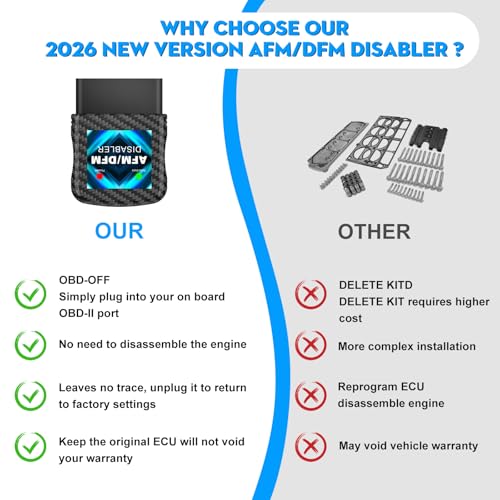
No Permanent ECM Flash Required
Unlike conventional handheld performance tuners, this plug-in disabler is intended to operate without rewriting the factory engine calibration.
That makes it convenient for drivers who want a removable electronic module rather than a permanent calibration change.
However, removing the device does not guarantee that its prior use is undetectable or that warranty coverage cannot be affected.
Does an AFM Disabler Add Horsepower?
An AFM disabler does not inherently increase an engine’s maximum horsepower or torque.
Its purpose is to prevent supported cylinder-deactivation modes, not to modify ignition timing, fueling tables, or maximum engine output.
Drivers may experience more consistent throttle behavior, but this should not be confused with a dyno-proven horsepower increase.
Can an AFM Disabler Prevent Lifter Failure?
GM AFM-equipped engines have been associated with certain valve-lifter and cylinder-deactivation system failures.
However, an electronic AFM disabler does not physically remove AFM lifters or eliminate their mechanical failure risk.
The specialized lifters, oil-control components, and related hardware remain installed inside the engine.
A complete mechanical AFM delete is a different procedure that may require replacement engine components and calibration changes.
For owners experiencing misfires, rough running, or engine trouble codes, proper diagnosis is essential before installing any performance or cylinder-deactivation module.
Explore the My Pro Street Online OBD-II Powertrain Diagnostic Library for detailed troubleshooting information.
AFM Disabler Installation Instructions
Installation is designed to be straightforward on a supported vehicle.
-
Turn the ignition off and park the vehicle safely.
-
Locate the factory OBD-II diagnostic port beneath the driver’s side dashboard.
-
Connect the AFM/DFM disabler securely to the diagnostic connector.
-
Start the vehicle and follow the manufacturer’s instructions to verify operation.
-
Leave the device connected while using its cylinder-deactivation control feature.
To restore normal factory operation, switch off the ignition and remove the module according to the manufacturer’s instructions.
Do not assume compatibility simply because the vehicle has a standard 16-pin OBD-II connector.
AFM/DFM Disabler and OBD-II Diagnostics
Although this device connects to the OBD-II port, it is not a conventional diagnostic scanner.
Its primary function is to control supported cylinder-deactivation behavior, not to read detailed live data or perform comprehensive diagnostic testing.
If your GM engine is experiencing a misfire, hesitation, rough idle, or Check Engine Light, diagnose the problem before attempting to change engine operating modes.
Related My Pro Street Online technical resources include:
-
P0171 System Too Lean – Bank 1 — Common causes of lean fuel mixtures and engine hesitation.
-
P0172 System Too Rich – Bank 1 — Understanding excessive fuel delivery and rich operating conditions.
-
P0313 Misfire Detected With Low Fuel — Troubleshooting fuel-related misfires.
-
P0324 Knock Control System Error — Diagnosing knock-control faults and ignition timing concerns.
Fuel trims, misfire counts, and related engine data should be checked using a compatible diagnostic scanner rather than assuming an AFM disabler will correct underlying mechanical or fuel-system problems.
Technical Specifications
| Specification | Details |
|---|---|
| Product | AFM/DFM Disabler |
| Version | Advertised 2026 upgraded version |
| Device type | OBD-II plug-in cylinder-deactivation control module |
| Vehicle brands | Select Chevrolet, GMC, Cadillac |
| Engine applications | Select 4.3L V6, 5.3L V8, 6.0L V8, 6.2L V8 |
| Primary function | Disable supported AFM/DFM operation |
| Connection | Factory OBD-II port |
| Installation | Plug-and-play on confirmed applications |
| Permanent ECU flash | Not required, per product description |
| Removable | Yes |
| 10-speed transmissions | Not supported |
| 2022+ refreshed models | Not supported |
| Design patent reference | U.S. Design Patent D1,068,623 S, as claimed by supplier |
| Warranty | Seller-advertised return or exchange support; terms require confirmation |
Upgrade Your GM Truck’s Driving Experience
If you prefer the feel of consistent full-cylinder operation, the 2026 upgraded AFM/DFM Disabler provides a convenient, removable solution for compatible GM vehicles.
Designed for select Chevrolet Silverado, GMC Sierra, Tahoe, Yukon, and Cadillac Escalade applications, this compact OBD-II module offers simple installation without conventional ECU flashing.
Choose the AFM/DFM Disabler for your compatible GM V6 or V8 and enjoy greater consistency in everyday engine operation.
Emissions and warranty notice: Disabling factory cylinder-deactivation functionality can affect emissions compliance, fuel consumption, and warranty coverage. This product’s California CARB approval has not been established. Do not advertise it as street-legal or 50-state compliant without verified authorization for the exact application.




There are no reviews yet.