


Mega Cab models are excluded from all advertised applications.
Fitment should be verified against the exact vehicle configuration and hitch manufacturer’s installation chart before purchasing.
Advertised 30,000 lb Gross Trailer Weight Rating
The hitch assembly carries a manufacturer-advertised maximum gross trailer weight rating of 30,000 pounds.
This rating describes the hitch’s claimed structural towing capacity under the manufacturer’s specified conditions.
Actual towing limits depend on the truck’s configuration, including engine, drivetrain, axle ratio, suspension, tires, and gross combined weight rating.
A truck equipped with a 30,000 lb-rated hitch is not automatically approved to tow a 30,000 lb trailer.
The maximum permitted trailer weight is always determined by the lowest-rated component in the complete towing system.
Advertised 7,500 lb Vertical Tongue Weight Rating
The manufacturer also advertises a maximum vertical tongue weight rating of 7,500 pounds.
For a gooseneck trailer, vertical load is transferred through the hitch ball into the truck bed and frame structure.
This downward load counts against the truck’s available payload capacity and applicable axle and tire ratings.
Before towing, verify the trailer’s actual loaded pin weight and confirm that the truck can safely support it.
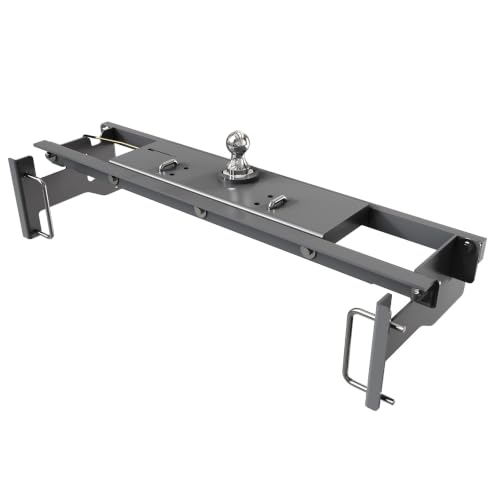
Solid Machined 2-5/16-Inch Gooseneck Ball
The hitch features a solid, one-piece machined 2-5/16-inch trailer ball.
This ball size is commonly used on heavy-duty gooseneck trailers, including livestock trailers, flatbed equipment trailers, and agricultural trailers.
The square ball base is designed to prevent unwanted ball rotation during coupling and uncoupling.
This helps maintain the ball’s position when connecting a compatible trailer coupler.
Always verify that the trailer coupler is designed for a 2-5/16-inch gooseneck ball.
Flip-Over Ball for a More Usable Truck Bed
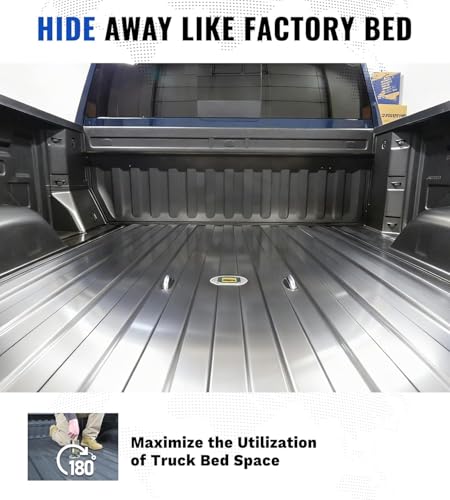
One of the main advantages of an underbed gooseneck hitch is its ability to keep the truck bed clear when towing equipment is not attached.
The reversible ball design allows the operator to remove the ball, flip it over, and store it in the hitch assembly beneath the bed surface.
This eliminates the need to leave a fixed hitch ball protruding above the bed when the truck is being used for other hauling tasks.
Benefits include:
- Reduced obstruction in the truck bed.
- Convenient on-vehicle ball storage.
- No separate storage container required for the hitch ball.
- Easier use of the bed for appropriate cargo.
- Quick conversion between towing and storage configurations.
The bed will still contain the hitch opening and any installed safety-chain attachment hardware.
Spring-Loaded Ball Retention System
The hitch incorporates a spring-loaded latch pin designed to secure the gooseneck ball in its operating position.
The latch mechanism allows the operator to release the ball for removal or reversal.
Before towing, confirm that the ball is fully seated and that the retention pin is completely engaged.
Never tow with a partially engaged locking mechanism.
No-Drill Frame Mounting
The supplied hitch is designed to attach to compatible factory frame mounting holes.
According to the manufacturer, installation does not require drilling new holes into the truck frame or welding.
However, a 4-inch opening must be cut through the truck bed to provide access to the gooseneck ball.
This distinction is important:
- No new frame drilling is advertised.
- No welding is advertised.
- A 4-inch bed opening is required.
- Vehicle-specific installation instructions must be followed.
Professional installation is recommended because the system carries substantial trailer loads and requires precise positioning.
Heavy-Duty Powder-Coated Steel Construction
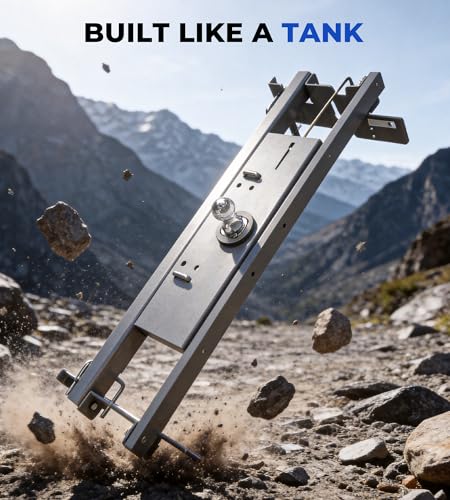
The hitch assembly is manufactured from steel and protected by a black powder-coated finish.
The coating is intended to help resist corrosion caused by road spray, moisture, and environmental exposure.
Routine maintenance remains important, especially around the ball socket, latch mechanism, safety-chain attachments, and mounting hardware.
Manufacturer-Advertised Two-Year Limited Warranty
The supplied product description states that the hitch is backed by a two-year limited warranty.
Warranty coverage, exclusions, and claim procedures should be confirmed with the seller or manufacturer before purchase.
Heavy-Duty Dodge Ram Gooseneck Hitch Specifications
| Specification | Details |
|---|---|
| Product type | Underbed gooseneck trailer hitch |
| Vehicle application | Select Dodge Ram / Ram 2500 and 3500 |
| Advertised year range | 2003–2013, configuration dependent |
| Maximum advertised GTW | 30,000 lbs |
| Maximum advertised vertical tongue weight | 7,500 lbs |
| Hitch ball diameter | 2-5/16 inches |
| Ball construction | Solid, one-piece machined steel |
| Ball base | Square anti-rotation design |
| Ball storage | Reversible flip-over configuration |
| Ball retention | Spring-loaded latch pin |
| Hitch construction | Heavy-duty steel |
| Finish | Black powder coat |
| Frame installation | Bolt-on using compatible factory holes |
| Frame drilling | Not required according to seller |
| Welding | Not required according to seller |
| Truck bed modification | 4-inch hole required |
| Included mounting hardware | Advertised as included |
| Excluded cab configuration | Mega Cab |
| Advertised warranty | 2-year limited warranty |
| Manufacturer part number | Not supplied |
Specifications are based on the supplied product listing. Verify load ratings, fitment, installation requirements, and warranty coverage against the exact hitch model before use.
Dodge Ram 2500 and 3500 Gooseneck Hitch Fitment Guide
| Vehicle | Engine / Bed Requirements | Advertised Fitment |
|---|---|---|
| 2003–2009 Dodge Ram 2500 | 6.5-ft or 8-ft bed; excluding Mega Cab | Yes |
| 2003–2009 Dodge Ram 3500 | 6.5-ft or 8-ft bed; excluding Mega Cab | Yes |
| 2010–2012 Ram 2500 | Diesel; 6.5-ft or 8-ft bed; excluding Mega Cab | Yes |
| 2010–2012 Ram 3500 | Diesel; 6.5-ft or 8-ft bed; excluding Mega Cab | Yes |
| 2013 Ram 2500 | Diesel; 6.5-ft or 8-ft bed; excluding Mega Cab | Yes |
| 2013 Ram 3500 | Not specified in supplied fitment | Not confirmed |
| Mega Cab configurations | All listed years | Excluded |
| Gasoline-powered 2010–2013 trucks | Not specified | Not confirmed |
| Ram 1500 | Not listed | Not confirmed |
Fitment verification: The manufacturer’s 6.5-foot bed description should be matched against the truck’s actual factory bed length and mounting configuration. Do not rely solely on a rounded bed-length measurement.
Why Choose an Underbed Gooseneck Hitch?
A gooseneck hitch mounts the trailer connection inside the pickup bed rather than behind the rear bumper.
This positions the trailer’s vertical load closer to the truck’s rear axle.
For properly equipped trucks and trailers, this arrangement can provide favorable load distribution and handling characteristics compared with some bumper-pull configurations.
An underbed design offers the additional advantage of keeping much of the hitch structure beneath the cargo floor.
When the reversible ball is stored, the truck bed can be used for many ordinary cargo-carrying tasks without a fixed ball projecting upward.
Gooseneck Hitch vs. Conventional Bumper-Pull Hitch
| Feature | Underbed Gooseneck Hitch | Conventional Receiver Hitch |
|---|---|---|
| Trailer connection location | Inside truck bed | Behind rear bumper |
| Typical trailer coupler | Gooseneck coupler | Conventional ball coupler |
| Vertical load location | Near rear axle | Behind rear axle |
| Trailer types | Gooseneck livestock, equipment and utility trailers | Utility, recreational and bumper-pull trailers |
| Bed modification | Usually required | Usually not required |
| Cargo bed access | Reversible ball helps reduce obstruction | No hitch ball inside bed |
| Advertised rating for this product | 30,000 lb GTW | Varies by hitch |
| Vehicle towing limit | Determined by truck manufacturer | Determined by truck manufacturer |
The higher advertised rating of a gooseneck hitch does not automatically increase a truck’s factory towing or payload limits.
Common Applications
Livestock and Horse Trailers
Gooseneck hitches are commonly used with livestock and horse trailers because the trailer connection sits inside the truck bed.
The hitch must be matched to the loaded trailer weight and actual vertical load.
Heavy Equipment Trailers
Flatbed and equipment trailers frequently use gooseneck couplers for transporting tractors, construction equipment, and other machinery.
Confirm that the truck, hitch, trailer, and braking system are all rated for the intended load.
Agricultural and Ranch Equipment
An underbed gooseneck hitch can be useful for agricultural trailers and other compatible farm equipment.
The reversible ball design also allows the truck bed to remain more usable when the trailer is disconnected.
Commercial and Utility Hauling
For properly equipped work trucks, a gooseneck hitch can provide a dedicated connection for compatible heavy-duty trailers.
Always comply with applicable vehicle ratings, commercial towing requirements, and local regulations.
Gooseneck Hitch Installation Overview
Installation requires correct alignment of the underbed mounting structure and the truck bed opening.
Professional installation is recommended.
- Verify the truck’s model year, engine, cab, bed length, and frame configuration.
- Review the complete manufacturer installation manual and inventory all hardware.
- Position the truck safely on level ground.
- Identify the factory frame mounting holes specified for the hitch.
- Install the vehicle-specific brackets using the approved hardware.
- Locate and cut the required 4-inch truck bed opening using the manufacturer’s measurements.
- Install and align the underbed hitch assembly.
- Tighten all fasteners to the exact manufacturer’s torque specifications.
- Install and test the reversible gooseneck ball.
- Verify full engagement of the spring-loaded latch pin.
- Install and inspect the required safety-chain attachment points.
- Confirm clearance from fuel lines, brake lines, wiring, exhaust components, and suspension parts.
Do not cut the truck bed until the correct hole location has been established using the hitch manufacturer’s installation instructions.
How to Use the Flip-Over Gooseneck Ball
Towing Position
Release the latch mechanism and install the hitch ball with the 2-5/16-inch ball facing upward.
Ensure that the square base is correctly seated.
Release the latch and confirm that the locking pin fully engages.
Connect the trailer coupler and follow the trailer manufacturer’s coupling and safety-chain procedures.
Storage Position
Disconnect the trailer and ensure the hitch is unloaded.
Release the ball retention mechanism.
Remove the ball, reverse its orientation, and reinstall it in the designated storage position.
Secure the latch according to the manufacturer’s instructions.
Keep the ball socket and locking mechanism clean to prevent corrosion and binding.
Understanding the 30,000 lb Hitch Rating
The manufacturer advertises:
- 30,000 lbs maximum gross trailer weight.
- 7,500 lbs maximum vertical tongue weight.
These values describe the hitch assembly’s claimed ratings.
They do not establish the truck’s permitted towing capacity.
Before towing, verify the truck’s:
- Gross vehicle weight rating (GVWR).
- Gross combined weight rating (GCWR).
- Rear gross axle weight rating (GAWR).
- Available payload capacity.
- Tire load ratings.
- Maximum gooseneck trailer weight.
- Maximum allowable trailer vertical load.
The complete towing combination must remain within every applicable rating.
Frequently Asked Questions
Does this gooseneck hitch fit a 2006 Dodge Ram 2500?
The manufacturer advertises fitment for 2003–2009 Dodge Ram 2500 trucks with the specified bed configurations, excluding Mega Cab models.
Will it fit a 2012 Ram 3500 diesel?
The supplied fitment list includes 2010–2012 Ram 3500 diesel trucks with compatible 6.5-foot or 8-foot beds, excluding Mega Cab configurations.
Does this hitch fit a 2013 Ram 2500 diesel?
Yes, the 2013 Ram 2500 diesel is included in the advertised application range, subject to exact configuration verification.
Does it fit a 2013 Ram 3500?
The supplied description does not confirm 2013 Ram 3500 compatibility. Verify the exact manufacturer part number before ordering.
Will it fit a Mega Cab?
No. Mega Cab models are explicitly excluded.
What size gooseneck ball is included?
The hitch includes a 2-5/16-inch machined gooseneck ball.
What is the maximum trailer weight rating?
The manufacturer advertises a 30,000 lb GTW rating for the hitch assembly. The truck’s actual towing capacity may be lower.
What is the vertical tongue weight rating?
The advertised vertical load rating is 7,500 pounds. Actual allowable trailer pin weight is limited by the truck’s payload, axle, tire, and towing specifications.
Does installation require drilling the frame?
The manufacturer states that the hitch mounts using existing factory frame holes without new frame drilling.
Does installation require cutting the truck bed?
Yes. The supplied installation description specifies a 4-inch opening in the truck bed.
Can I store the hitch ball when not towing?
Yes. The flip-over ball design allows the ball to be reversed and stored in the underbed hitch assembly.
Is mounting hardware included?
The manufacturer advertises the required mounting hardware as included.
What warranty is offered?
The supplied listing advertises a two-year limited warranty, subject to the manufacturer’s terms.
Upgrade Your Dodge Ram with a Heavy-Duty Gooseneck Hitch
This 30,000 lb Heavy-Duty Gooseneck Trailer Hitch for Dodge Ram 2500 and 3500 trucks combines vehicle-specific underbed mounting, a machined 2-5/16-inch ball, and convenient flip-over storage.
Its bolt-on frame mounting design is intended to simplify installation on compatible trucks, while the black powder-coated steel construction provides corrosion protection for regular towing use.
Whether you’re preparing a work truck for an equipment trailer or adding a gooseneck connection for compatible agricultural and livestock trailers, this hitch provides a heavy-duty towing solution.
Add a reversible underbed gooseneck hitch to your compatible Dodge Ram and maintain greater flexibility for both trailer towing and everyday truck-bed use.






There are no reviews yet.