

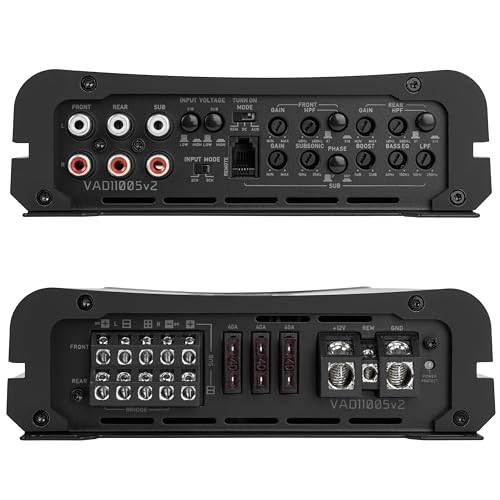
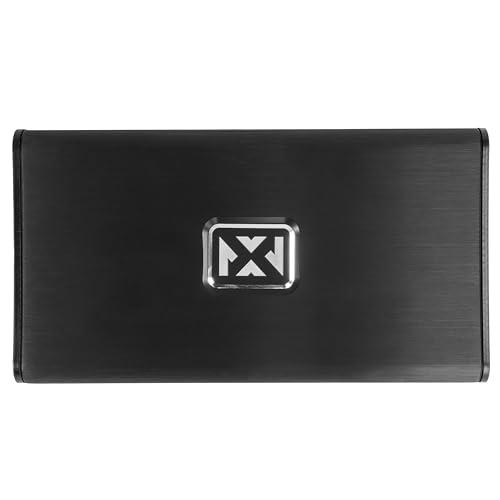
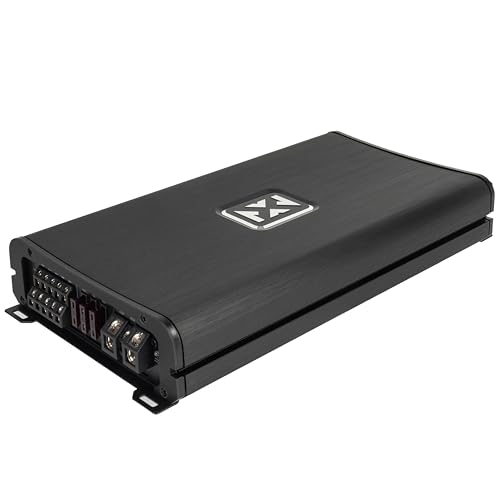
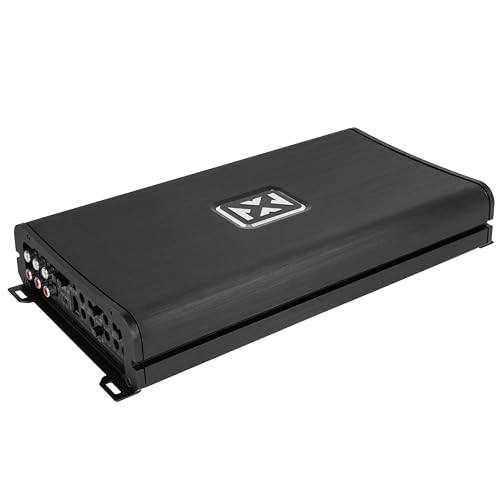
Five Channels for Speakers and a Subwoofer
A 5-channel amplifier combines the jobs normally handled by separate full-range and mono amplifiers.
A conventional installation could use:
Channels 1–2: Front speakers
Channels 3–4: Rear speakers
Channel 5: Subwoofer
This configuration provides dedicated amplification for an entire system from one chassis.
Using a single amplifier can also simplify:
- Power wiring
- Ground wiring
- Signal routing
- Remote wiring
- Fuse distribution
- Amplifier mounting
- System tuning
- Installation space
For daily-driven street cars, trucks and powersports vehicles, that simplicity can be a significant advantage.
80W x 4 Plus 350W at 4 Ohms
With compatible 4-ohm speakers, the VAD11005 v2 provides 80 watts RMS to each of its four primary channels plus 350 watts RMS to the dedicated subwoofer channel.
This configuration is well suited to many aftermarket coaxial and component speaker systems.
Eighty watts RMS per speaker provides significantly more available power than most head-unit amplifier sections, while 350 watts RMS gives a compatible subwoofer enough power to add meaningful low-frequency output.
The result can be a well-balanced system without requiring extreme speaker loads or complicated wiring.
125W x 4 Plus 600W at 2 Ohms
With compatible 2-ohm loads, output increases substantially.
The amplifier is rated for:
125 watts RMS x 4 + 600 watts RMS x 1 at 2 ohms
That provides up to 500 watts RMS across the four primary speaker channels and another 600 watts RMS for bass.
For systems built around compatible 2-ohm speakers and subwoofers, this configuration allows the VAD11005 v2 to make full use of its stated 1,100-watt RMS capability.
Always verify individual speaker and subwoofer impedance before wiring the amplifier.
Efficient Class D Amplification
The NVX VAD11005 v2 uses Class D amplifier architecture.
Class D technology allows substantial output to be produced from a relatively compact chassis while reducing wasted electrical energy and heat compared with less efficient amplifier designs.
Efficiency becomes increasingly important as amplifier power rises.
A system capable of producing more than 1,000 watts RMS places significant demand on the vehicle’s electrical system, so reducing unnecessary power loss helps both performance and thermal management.
The vehicle still needs an adequate battery, alternator and properly sized amplifier wiring. Class D is efficient—not sorcery.
Marine-Grade Conformal-Coated Circuit Board
One of the VAD11005 v2’s most distinctive features is its conformal-coated marine-grade circuit board.
Conformal coating places a protective layer over sensitive electronic circuitry to help resist moisture and environmental contamination.
That makes the amplifier suitable for a broader range of applications than a conventional interior-only automotive amplifier.
Potential installations include:
- Cars
- Pickup trucks
- SUVs
- Marine vessels
- UTVs
- ATVs
- Motorcycles
- Powersports vehicles
- Custom audio systems
Installation should still follow NVX requirements regarding mounting location, ventilation and environmental exposure.
Marine-grade protection improves durability. It does not mean the amplifier wants to go swimming.
Variable High-Pass Filter
The NVX VAD11005 v2 incorporates a variable high-pass filter for system tuning.
High-pass filtering prevents lower frequencies from reaching speakers that aren’t designed to reproduce deep bass.
This is especially useful for door speakers and smaller full-range drivers.
Correctly setting the high-pass filter can help:
- Reduce excessive speaker excursion
- Lower distortion
- Improve usable output
- Increase midrange clarity
- Improve integration with a subwoofer
Once a dedicated subwoofer handles deep bass, there’s little reason to force smaller door speakers to attempt the same job.
Variable Low-Pass Filter
A variable low-pass filter provides corresponding control over low-frequency channels.
Low-pass filtering removes higher frequencies from the signal being sent to a subwoofer.
Correct LPF adjustment helps the subwoofer blend with the rest of the system rather than producing unwanted vocals and midrange frequencies from the trunk.
Combined HPF and LPF controls allow installers to divide the frequency spectrum according to what each speaker is designed to reproduce.
Variable Subsonic Filter
The VAD11005 v2 also incorporates a variable subsonic filter.
A subsonic filter limits extremely low frequencies below the useful operating range of the subwoofer system.
This can be particularly valuable with certain ported subwoofer enclosures, where frequencies substantially below the enclosure’s tuning frequency can create excessive cone movement without producing useful acoustic output.
Correct subsonic-filter adjustment can help improve subwoofer control and protect against unnecessary low-frequency excursion.
Adjustable Bass Boost
The amplifier includes variable bass boost from 0 to +18 dB at 45 Hz.
Bass boost allows additional emphasis around the specified low-frequency region.
This can be useful for compensating for system response or personal listening preferences, but it should be used carefully.
Large amounts of boost require substantially more amplifier output and can cause clipping or excessive subwoofer excursion when used aggressively.
Start conservatively and make adjustments after the amplifier gain and crossover settings have been properly configured.
Eighteen decibels of bass boost isn’t a personality setting. Use restraint.
Flexible 5/4/2-Channel Operation
The NVX VAD11005 v2 supports 5-, 4- and 2-channel operating configurations, giving installers additional flexibility when designing a system.
A traditional five-channel configuration makes sense for four speakers and a subwoofer, while alternate configurations can accommodate different speaker layouts and custom installations.
This flexibility also makes the amplifier easier to reuse if the audio system changes later.
Instead of locking the amplifier into one narrowly defined configuration, NVX provides several ways to integrate it into a larger system.
Platinum-Plated RCA Inputs
The VAD11005 v2 features platinum-plated RCA-level inputs for signal connections.
RCA inputs provide conventional connectivity with compatible aftermarket head units, digital signal processors and other line-level audio sources.
Clean, secure signal connections are important in any amplified system because noise introduced before the amplifier gets amplified along with everything else.
Signal wiring should be routed carefully and kept away from major electrical noise sources whenever possible.
Heavy-Duty Screw Terminals
The amplifier uses heavy-duty screw terminals to create secure electrical connections.
Solid connections are particularly important for power and ground wiring because high-current circuits are sensitive to resistance.
Loose or poorly terminated wiring can lead to:
- Voltage drop
- Excessive heat
- Intermittent operation
- Amplifier protection mode
- Reduced output
- Electrical damage
Use properly sized wiring and terminals appropriate for the amplifier’s current requirements.
Aluminum Alloy Heat Sink
An aluminum alloy heat sink helps dissipate heat generated during amplifier operation.
Even an efficient Class D amplifier generates heat when producing substantial power.
Proper heat management helps maintain stable performance and component longevity.
The amplifier should be installed where air can circulate around the chassis rather than being buried under insulation, carpeting or other materials that trap heat.
An amplifier can’t dissipate heat if it’s installed like a forgotten burrito wrapped in trunk carpet.
Three-Way Protection Circuitry
The VAD11005 v2 includes protection circuitry designed to guard against several common electrical problems.
Protection functions include:
- Thermal protection
- Overload protection
- Speaker short-circuit protection
The amplifier also incorporates LED power and protection indicators, providing a visual reference when diagnosing operating conditions.
Protection circuitry is valuable, but it shouldn’t be treated as a substitute for correct wiring, impedance matching and system setup.
Excellent Choice for a Four-Speaker and Subwoofer Upgrade
One of the strongest applications for the VAD11005 v2 is a complete aftermarket system using four speakers and a subwoofer.
At 4 ohms, the amplifier can supply 80 watts RMS per speaker plus 350 watts RMS for bass.
At 2 ohms, those figures rise to 125 watts RMS per speaker plus 600 watts RMS for the subwoofer.
That means one amplifier can replace the need for both a four-channel speaker amplifier and a separate mono subwoofer amplifier in many systems.
For installations where trunk or cabin space matters, that’s a major advantage.
RMS Power Matters More Than Peak Power
The VAD11005 v2 carries a 2,200-watt peak rating, but its RMS output should drive system design decisions.
RMS specifications provide a more meaningful representation of continuous amplifier capability.
When matching speakers, compare their RMS power handling with:
- 80W per channel at 4 ohms
- 125W per channel at 2 ohms
- 350W subwoofer output at 4 ohms
- 600W subwoofer output at 2 ohms
This creates a much more useful picture of system compatibility than simply matching products based on their largest advertised number.
Electrical System Health Matters
An amplifier capable of producing 1,100 watts RMS can place considerable demand on the vehicle electrical system.
Before installation, verify that the battery and charging system are operating correctly.
If the battery warning light is already illuminated, diagnose the charging-system fault before adding another significant electrical load.
Similarly, if the battery repeatedly goes dead, determine whether the cause is battery condition, parasitic draw, charging-system performance or another electrical problem.
Adding a 1,100-watt amplifier to an already struggling electrical system is less “audio upgrade” and more “alternator stress test.”
Proper Power and Ground Wiring Is Essential
The VAD11005 v2 requires appropriately sized power and ground wiring to produce its rated performance safely.
A proper installation should include:
- Correctly sized battery power cable
- Matching ground cable
- Proper main fuse
- Quality fuse holder
- Secure battery connection
- Properly terminated amplifier connections
- Suitable speaker wiring
- Quality signal cables
The main power cable should be fused close to the battery according to accepted installation practices and NVX requirements.
Ground wiring should be short and connected to an appropriate low-resistance grounding point.
Diagnose Voltage Drop Under Load
High-powered audio systems can expose weaknesses in vehicle wiring that aren’t obvious during normal driving.
Poor grounds, undersized cables and loose connections can create substantial voltage loss when amplifier current demand increases.
Our automotive voltage-drop testing guide explains how measuring voltage while a circuit is operating can expose resistance that a simple continuity test may miss.
The same principles apply to amplifier power circuits.
If voltage remains healthy at the battery but drops excessively at the amplifier during high output, inspect the wiring and connections before blaming the amplifier.
Set Gain Before Adding Bass Boost
Proper tuning order matters.
Start by establishing appropriate crossover settings and amplifier gain before applying significant bass boost.
A basic setup sequence should include:
- Verify speaker and subwoofer impedance.
- Configure high-pass and low-pass filters.
- Set the subsonic filter appropriately for the subwoofer system.
- Keep bass boost at minimum during initial gain setup.
- Match amplifier gain to source output.
- Check for clipping or audible distortion.
- Add bass boost conservatively if required.
Correct tuning can provide more usable output and better sound quality while reducing the risk of speaker damage.
Key Features
- NVX VAD11005 v2
- Five-channel Class D amplifier
- 1,100 watts RMS maximum rated system output
- 2,200 watts peak power
- 80W RMS x 4 + 350W RMS x 1 at 4 ohms
- 125W RMS x 4 + 600W RMS x 1 at 2 ohms
- Four full-range speaker channels
- Dedicated subwoofer channel
- 5/4/2-channel operation
- Marine-grade conformal-coated circuit board
- Suitable for automotive, powersports and compatible marine applications
- Variable high-pass filter
- Variable low-pass filter
- Variable subsonic filter
- Variable bass boost
- 0 to +18 dB bass boost at 45 Hz
- Platinum-plated RCA-level inputs
- Heavy-duty screw terminals
- Aluminum alloy heat sink
- Thermal protection
- Overload protection
- Speaker short-circuit protection
- LED power indicator
- LED protection indicator
- Efficient Class D design
One 1100W RMS Amplifier for a Complete Audio System
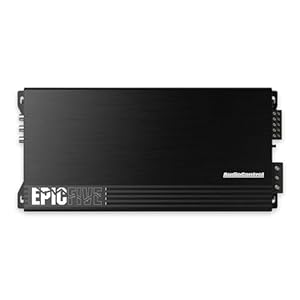
The NVX VAD11005 v2 5-Channel Class D Amplifier provides an impressive amount of system flexibility from a single chassis.
Four primary channels can power front and rear speakers while the dedicated fifth channel handles subwoofer duties. At 4 ohms, that means 80 watts RMS x 4 plus 350 watts RMS for bass. At 2 ohms, output rises to 125 watts RMS x 4 plus a substantial 600 watts RMS for the subwoofer.
Variable HPF, LPF and subsonic filtering provide extensive system-tuning control, while the conformal-coated circuit board expands its usefulness into powersports and compatible marine installations. Three-way protection circuitry and a heavy-duty aluminum heat sink help manage the demands of higher-output operation.
For an enthusiast looking to build a powerful four-speaker-plus-subwoofer system without installing separate amplifiers, the VAD11005 v2 puts a lot of useful RMS power into one package.
One amp, five channels, 1,100 watts RMS—and considerably fewer opportunities to spend Saturday afternoon wondering which of your three amplifier grounds is causing the noise.









There are no reviews yet.