


Compact Class D Amplifier Design
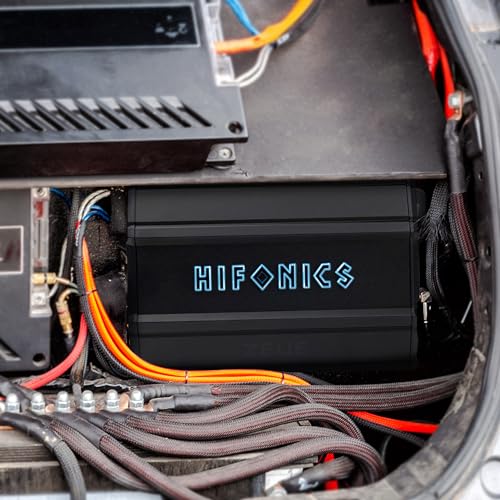
The Zeus Delta uses Class D amplifier technology to deliver substantial output from a relatively compact chassis.
Class D designs are popular in modern car audio because they reduce the amount of incoming electrical energy wasted as heat.
Higher efficiency can provide several practical benefits:
- Reduced heat generation
- Smaller amplifier dimensions
- Lower electrical demand for a given output
- Easier mounting
- Greater installation flexibility
- Better suitability for tight spaces
That becomes particularly useful with a five-channel amplifier because one chassis is performing the work that might otherwise require two separate amplifiers.
PWM MOSFET Power Supply
At the heart of the Hifonics Zeus Delta is a PWM MOSFET power supply.
Pulse-width-modulated power supplies are commonly used in high-output automotive amplifiers to convert the vehicle’s electrical supply into the internal voltages required by the amplifier circuitry.
MOSFET switching allows this conversion to happen efficiently while supporting rapid changes in audio demand.
That’s especially important in a five-channel system where four channels may be driving full-range speakers while the fifth channel handles bass transients from a subwoofer.
The amplifier needs a stable electrical foundation if all five channels are going to perform properly.
Full-System Speaker and Subwoofer Control
Five-channel operation gives installers considerable freedom when configuring a system.
A conventional installation might use the amplifier to power:
Front channels: Component speakers
Rear channels: Coaxial speakers
Fifth channel: Subwoofer
This creates a complete amplified system without relying on the relatively low output available directly from many head units.
The result can provide better speaker control, improved dynamic range and substantially greater output when the speakers and amplifier are correctly matched.
Dedicated Bass Capability
The fifth channel is intended to support the low-frequency portion of the audio system.
This allows a compatible subwoofer to receive dedicated amplifier power while the remaining four channels concentrate on cabin speakers.
Separating the bass load from the main speaker channels allows the system to be tuned around the requirements of each speaker type.
Door speakers don’t need to spend their lives desperately attempting to reproduce 35 Hz bass just because nobody bothered to set the system up correctly.
DC Signal Sense Automatic Turn-On
One of the most useful features of the Hifonics Zeus Delta is DC SIGNAL SENSE automatic turn-on.
Traditional aftermarket amplifier installations typically use a dedicated remote turn-on wire from the head unit.
That isn’t always convenient when retaining a modern factory stereo.
DC signal sensing allows the amplifier to detect an appropriate signal and automatically turn on without requiring a conventional remote turn-on lead in supported installations.
This can simplify integration with factory audio systems where a traditional amplifier remote wire may not be readily available.
Useful for Factory Stereo Integration
Factory audio systems have become increasingly integrated with vehicle electronics.
Replacing the entire source unit isn’t always practical, particularly when the factory display also controls climate functions, vehicle settings, cameras or other systems.
The Zeus Delta’s automatic turn-on capability makes it more attractive for installations where the original source unit is retained.
Depending on the vehicle, additional signal-interface equipment may still be required.
Factory systems vary widely, especially when premium factory amplifiers are involved.
If you’re working with an amplified factory system, don’t assume every wire behind the radio behaves like an old-school aftermarket head unit. Modern cars occasionally enjoy reminding us that simplicity was apparently a design flaw.
RCA Inputs
The amplifier incorporates RCA inputs for connection to compatible aftermarket head units, processors and signal-interface equipment.
RCA-level connections provide a conventional method of routing low-level audio signals to the amplifier.
Proper signal routing is important for minimizing unwanted noise.
Whenever practical, signal cables should be routed away from high-current power wiring and other potential sources of electrical interference.
Accessible Angled Connections
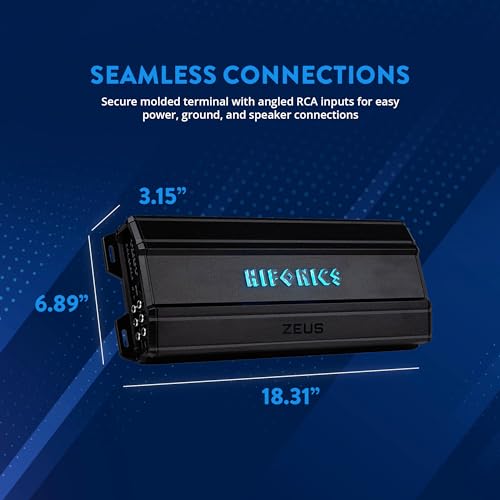
Hifonics uses angled connection terminals intended to improve installation access.
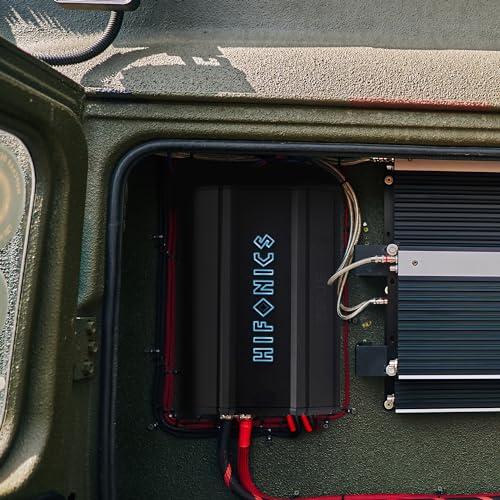
This can make a meaningful difference when mounting an amplifier in a confined location.
An amplifier’s physical dimensions are only part of the fitment equation.
Installers also need room for:
- Power cable
- Ground cable
- Speaker wiring
- RCA cables
- Signal connections
- Adjustment access
- Cooling airflow
A compact amplifier isn’t very compact anymore when it needs six inches of empty space around one end just to bend the cables into position.
Molded Connection Terminals
The Zeus Delta uses secure molded connection terminals designed to keep power, ground and speaker connections organized.
Solid electrical connections are critical in a high-current amplifier installation.
Loose connections can cause:
- Voltage loss
- Intermittent operation
- Excessive resistance
- Heat
- Noise
- Protection-mode activation
- Reduced amplifier output
Proper cable preparation and secure termination are essential regardless of how much protection circuitry the amplifier contains.
Nickel-Plated Connections
The amplifier also uses nickel-plated connection hardware.
Plated electrical connections can help provide durable contact surfaces while resisting oxidation and environmental deterioration.
That is particularly useful in automotive installations where temperature changes, humidity and vibration are unavoidable.
Connections should still be inspected periodically in higher-output systems, especially after the initial installation has experienced several heat cycles.
Aluminum Heat Sink
The Hifonics Zeus Delta uses an aluminum heat sink to help dissipate heat generated during operation.
Even efficient Class D amplifiers produce heat.
The heat-sink structure transfers thermal energy away from internal components and into the surrounding air.
Proper mounting remains important.
The amplifier should have adequate airflow and shouldn’t be buried beneath carpeting, insulation or cargo where heat cannot escape.
If your amplifier repeatedly becomes excessively hot or enters protection mode, our guide explaining why a car amplifier overheats covers common causes including incorrect impedance, poor airflow, excessive gain, weak grounds and unstable supply voltage.
LED System Diagnostics
The Zeus Delta incorporates LED system diagnostic indicators on the amplifier end panel.
These indicators can help identify abnormal operating conditions instead of leaving the installer guessing when the amplifier enters protection.
Diagnostic circuitry monitors conditions including:
- Amplifier overload
- Speaker shorts
- Protection status
Visual indicators can significantly shorten troubleshooting time when a system suddenly stops producing sound.
They’re considerably more useful than the traditional diagnostic method of staring at the amplifier and asking it what its problem is.
Overload Protection
Integrated protection circuitry helps protect the amplifier when operating conditions exceed safe limits.
Overload conditions can result from several causes, including:
- Incorrect speaker impedance
- Wiring problems
- Excessive heat
- Electrical-system problems
- Improper configuration
Protection circuitry provides an additional safeguard, but it should never be treated as a substitute for correctly matching speakers and wiring the system properly.
Speaker Short Protection
Speaker wiring can become pinched, damaged or accidentally grounded during installation.
The Zeus Delta includes circuitry designed to detect speaker-short conditions and protect the amplifier.
Careful wiring remains essential.
Speaker wires should be routed away from sharp sheet metal, seat tracks and moving interior components that could damage insulation.
Grommets or protective loom should be used wherever wiring passes through metal.
Heat Management Matters
Amplifier temperature depends on more than the heat sink.
An amplifier can run excessively hot because of:
- Restricted airflow
- Low speaker impedance
- Excessive gain
- Bass boost
- Clipping
- Poor power wiring
- Weak ground connections
- Low system voltage
Class D efficiency helps, but it cannot compensate for a fundamentally bad installation.
If the amplifier repeatedly enters thermal protection, fix the cause rather than simply finding a bigger fan to point at it.
Proper Gain Adjustment
Amplifier gain should be adjusted to match the output level of the source unit.
It isn’t a second volume control.
Excessive gain can cause the amplifier to clip before the source unit reaches its intended listening level.
Clipping can produce:
- Audible distortion
- Excessive heat
- Reduced sound quality
- Speaker stress
- Subwoofer damage
Begin with conservative settings and establish clean output before increasing gain.
If the system sounds harsh at high volume, turning the gain farther clockwise is generally not the breakthrough engineering solution.
Match RMS Power and Speaker Impedance
When building a system around the Zeus Delta, match speakers according to their RMS power handling and impedance.
Don’t rely exclusively on peak or maximum wattage ratings.
Before installation, determine:
- Speaker RMS rating
- Speaker impedance
- Subwoofer RMS rating
- Subwoofer final wired impedance
- Amplifier RMS output at those impedances
Subwoofer voice-coil wiring is particularly important because changing series or parallel configurations changes the impedance presented to the amplifier.
Electrical System Condition Matters
A higher-powered five-channel amplifier places additional demand on the vehicle’s charging system.
Before installation, verify that the battery and alternator are healthy.
A system suffering from unstable voltage may experience:
- Early clipping
- Amplifier shutdown
- Reduced output
- Excessive heat
- Headlight dimming
- Distortion
Adding an amplifier doesn’t cause a weak charging system to become healthy. It mostly gives the existing problem a louder way to introduce itself.
Use Proper Power and Ground Wiring
Amplifier wiring should be sized according to current demand and cable length.
A proper installation includes:
- Correct power-wire gauge
- Matching ground-wire gauge
- Main fuse near the battery
- Quality fuse holder
- Secure battery connection
- Properly terminated amplifier connections
- Appropriate speaker wiring
- Quality signal cables
The ground should be short and attached to an appropriate low-resistance chassis point prepared according to accepted installation practices.
Voltage Drop Can Cause Amplifier Problems
An amplifier may receive less voltage than the battery is producing if excessive resistance exists in the power or ground circuit.
Potential causes include:
- Undersized power cable
- Poor chassis ground
- Corroded terminals
- Loose fuse holders
- Damaged wiring
- Poor battery connections
Our automotive voltage-drop testing guide explains how testing a circuit while current is flowing can identify resistance that may be invisible during a simple continuity test.
The same principle applies to an amplifier circuit: measure the voltage loss while the amplifier is actually under load.
Plan the Entire Audio System First
Before buying speakers and subwoofers solely because their advertised wattage looks impressive, plan how the complete system will work together.
Consider:
- Available amplifier channels
- Speaker impedance
- RMS power handling
- Crossover requirements
- Factory stereo integration
- Electrical-system capacity
- Mounting space
- Wiring requirements
- Future upgrades
The Best Car Amplifier Setup for Bigger Sound covers these considerations in more detail and explains why a properly matched system generally performs better than a collection of individually impressive parts.
Key Features
- Hifonics Zeus Delta 5-Channel Amplifier
- Up to 1,750 watts advertised power
- Five-channel audio configuration
- Compact Class D amplifier design
- Four full-range speaker channels
- Dedicated fifth channel for bass applications
- PWM MOSFET power supply
- DC SIGNAL SENSE automatic turn-on
- RCA inputs
- Angled connection layout
- Molded connection terminals
- Nickel-plated connections
- Aluminum heat sink
- LED system diagnostics
- Overload monitoring
- Speaker-short protection
- Compact full-system amplifier architecture
- Suitable for aftermarket head-unit installations
- Useful for compatible factory-radio integration
- Designed for car, truck and custom audio systems
One Amplifier for a Complete Car Audio Upgrade
The Hifonics Zeus Delta 1750W Compact 5-Channel Class D Car Audio Amplifier provides a straightforward way to build a complete amplified audio system around a single chassis.
Four channels can handle the front and rear speakers while the fifth channel supplies dedicated power for bass. The compact Class D architecture reduces installation space, while the PWM MOSFET power supply supports stable operation under changing audio loads.
Features such as DC signal-sensing automatic turn-on also make the Zeus Delta useful when integrating amplification with compatible factory audio systems. Nickel-plated connections, accessible terminals, an aluminum heat sink and onboard LED protection diagnostics round out a package designed for practical installation as much as outright output.
For an enthusiast who wants amplified front speakers, rear speakers and a subwoofer without installing separate amplifiers everywhere, the Zeus Delta makes a lot of sense.
Five channels, one chassis, fewer wires and fewer opportunities to discover at 11:47 p.m. that you forgot another distribution block.









There are no reviews yet.