
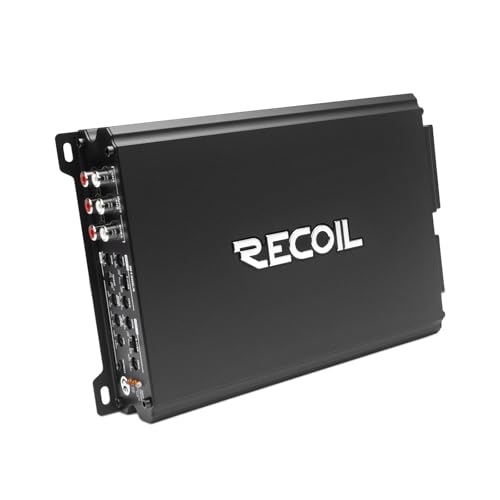
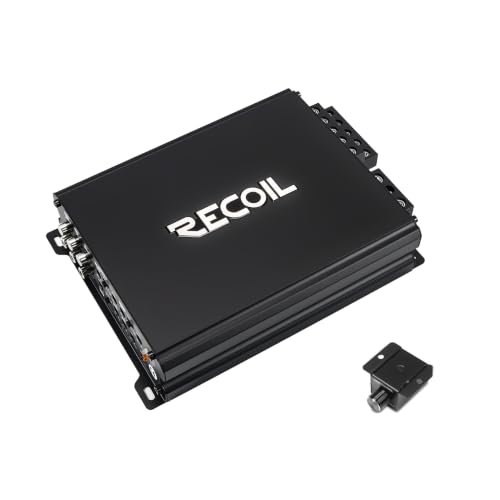
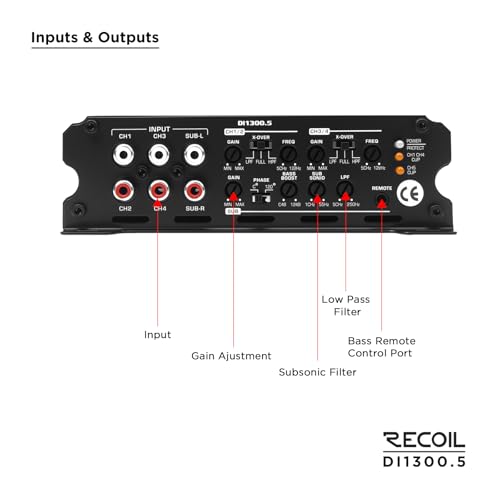
770-Watt RMS 1-Ohm Subwoofer Channel
The biggest attraction of the DI1300.5 is its dedicated 1-ohm stable subwoofer channel.
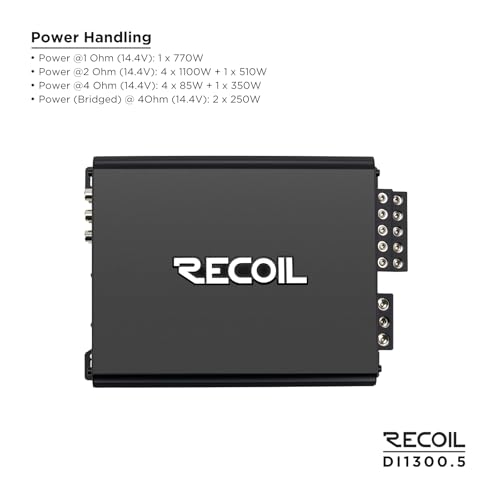
At 1 ohm, RECOIL rates the fifth channel for up to 770 watts RMS.
That’s considerably more subwoofer output than many moderate five-channel amplifiers provide and makes the DI1300.5 suitable for enthusiasts who want a stronger bass stage without adding a second amplifier.
A properly matched 1-ohm subwoofer configuration can make full use of the channel’s available output.
Why a 1-Ohm Stable Subwoofer Channel Matters
Subwoofer impedance directly affects how much power the amplifier must deliver.
A 1-ohm stable channel provides additional flexibility when wiring:
- Dual-voice-coil subwoofers
- Multiple subwoofers
- High-output bass systems
The final impedance depends on the voice-coil configuration and whether the coils or subwoofers are wired in series or parallel.
Don’t assume a subwoofer’s advertised impedance automatically represents what the amplifier will see.
Plan the final load before purchasing the subwoofer.
One Amplifier Instead of Two
A high-output five-channel amplifier can replace a more complicated two-amplifier installation.
Instead of using:
4-channel amplifier + monoblock amplifier
the DI1300.5 can provide both functions from one chassis.
That can reduce:
- Mounting-space requirements
- Power distribution hardware
- Ground connections
- RCA wiring
- Remote wiring
- Installation complexity
For daily-driven performance cars and trucks, a powerful five-channel amplifier can provide a cleaner installation without giving up a serious subwoofer channel.
The My Pro Street car audio system guide explains how full-range and subwoofer amplification should be matched to speaker RMS handling and final impedance.
Efficient Class D Architecture
The RECOIL DI1300.5 uses Class D amplification.
Class D designs are particularly useful for multi-channel automotive amplifiers because they can produce substantial power with relatively high efficiency.
That can provide:
- Lower heat generation
- Smaller amplifier dimensions
- Reduced electrical losses
- High output from a compact chassis
- Greater installation flexibility
Efficiency becomes especially important when one amplifier is simultaneously driving four full-range speakers and a high-output subwoofer.
HPF, Full-Range and LPF Crossover Control
The DI1300.5 provides flexible HPF, full-range and LPF crossover settings.
These controls determine which frequencies reach the connected speakers.
Correct crossover configuration is one of the most important parts of building a clean, reliable car audio system.
The amplifier can be configured so that:
- Door speakers receive appropriate mids and highs
- Component speakers aren’t forced to reproduce extreme bass
- Subwoofers concentrate on low frequencies
- Different drivers blend together more naturally
Crossovers aren’t merely sound-quality controls. They also help prevent speakers from wasting power reproducing frequencies they aren’t designed to handle.
High-Pass Filtering for Door Speakers
Using the high-pass filter on front and rear speakers prevents deep bass from reaching drivers that aren’t designed to reproduce it.
That can improve:
- Midrange clarity
- Speaker output
- Speaker reliability
- System efficiency
- Integration with the subwoofer
Door speakers trying to reproduce 30 Hz aren’t being ambitious. They’re being abused.
Let the dedicated 770-watt subwoofer channel handle the heavy lifting.
Low-Pass Filtering for Bass
The low-pass filter allows the subwoofer channel to concentrate on lower frequencies.
Without proper LPF adjustment, higher-frequency content can become audible through the subwoofer and make bass localization more obvious.
The ideal crossover setting depends on the speakers, subwoofer, enclosure and vehicle.
The goal is a smooth transition where the subwoofer extends the main speaker system rather than sounding like a completely separate source.
Full-Range Operation Adds Flexibility
Full-range crossover operation provides additional flexibility for systems using external processors or crossover networks.
This can be useful in more advanced installations where frequency management is handled elsewhere in the signal chain.
Always make sure the connected speakers receive appropriate frequency protection regardless of where crossover duties are performed.
Variable Bass Controls
The DI1300.5 provides variable bass adjustment for tuning the subwoofer stage.
Bass enhancement can help compensate for the acoustic characteristics of a vehicle or tailor the system to listener preference.
Use bass boost conservatively.
Increasing output at a specific bass frequency can dramatically increase amplifier and subwoofer demand.
Excessive boost can contribute to:
- Clipping
- Distortion
- Heat
- Reduced amplifier headroom
- Excessive subwoofer excursion
Set the crossover and gain structure correctly before adding significant bass boost.
Built-In CLIP Indicator
One particularly useful feature of the RECOIL DI1300.5 is its CLIP indicator.
Clipping occurs when the amplifier is asked to produce more voltage than its power supply can cleanly provide.
Instead of continuing to reproduce the waveform correctly, the peaks become flattened.
The result is increased distortion and additional stress on both the amplifier and speakers.
A clip indicator gives installers a useful visual reference when configuring amplifier gain.
Gain Is Not a Volume Control
Amplifier gain exists to match input sensitivity with the source unit’s output voltage.
Turning gain higher doesn’t create free amplifier power.
Instead, excessive gain can cause the amplifier to reach clipping at a lower head-unit volume.
That can produce:
- Harsh distortion
- Excessive heat
- Speaker damage
- Subwoofer voice-coil damage
- Protection-mode operation
The DI1300.5’s clipping indicator can help establish a cleaner gain structure, but the rest of the system still needs to be configured properly.
Why Clipping Is Especially Important at 770 Watts
A powerful subwoofer channel can generate substantial output when correctly configured.
It can also generate substantial heat in a voice coil when driven into clipping.
The combination of:
- Correct final impedance
- Proper gain adjustment
- Sensible bass boost
- Appropriate enclosure
- Correct crossover settings
is what allows the 770-watt channel to produce useful bass reliably.
A giant amplifier connected to a poorly configured subwoofer system simply creates a more powerful way to make bad decisions.
Match the Subwoofer Enclosure to the System
Subwoofer performance depends on more than amplifier wattage.
The enclosure has a major effect on:
- Frequency response
- Output
- Cone control
- Low-frequency extension
- Power handling
Sealed and ported enclosures behave differently and should be selected according to the subwoofer manufacturer’s specifications and the intended system goals.
The My Pro Street subwoofer enclosure guide explains why enclosure design, gain setup and subsonic filtering all matter when building a reliable bass system.
Advanced Protection Circuitry
The DI1300.5 incorporates protection circuitry designed to safeguard the amplifier against abnormal operating conditions.
The supplied specifications include protection for:
- Overheating
- Short circuits
- Overload conditions
These protections are particularly important in a high-output five-channel amplifier because several speaker loads may be operating simultaneously.
Protection mode is still a warning rather than an operating feature.
If the amplifier repeatedly shuts down, determine why.
Avoid Amplifier Overheating
Class D architecture helps control heat, but installation conditions still matter.
An amplifier can overheat because of:
- Incorrect speaker impedance
- Restricted ventilation
- Excessive gain
- Clipping
- Poor power wiring
- Low vehicle voltage
- Weak grounding
- Sustained high-output operation
Our guide to car amplifier overheating explains how impedance, gain, airflow and electrical-system problems can drive amplifier temperatures upward.
Electrical Supply Matters at 1,300 Watts RMS
A high-output amplifier needs a healthy electrical foundation.
Before expecting full performance from the DI1300.5, inspect:
- Battery condition
- Alternator output
- Battery terminals
- Power wiring
- Ground connections
- Fuse holder
- Charging-system wiring
A powerful amplifier cannot compensate for unstable supply voltage.
As amplifier output rises, current demand rises with it.
Use Properly Sized Power and Ground Wiring
Power cable should be sized according to the amplifier’s current requirements and cable length.
The ground cable should be appropriately sized as well.
A complete installation should include:
- Quality power cable
- Proper ground cable
- Main fuse near the battery
- Quality fuse holder
- Secure terminals
- Proper speaker wiring
- Correct signal cables
Undersized wiring can cause resistance and voltage loss under heavy load.
Voltage Drop Can Steal Amplifier Performance
If the DI1300.5 works normally at moderate volume but begins clipping, shutting down or losing bass at higher output, check supply voltage directly at the amplifier.
Potential sources of resistance include:
- Battery terminals
- Fuse connections
- Power cables
- Ground points
- Crimp terminals
- Distribution hardware
Our automotive voltage-drop testing guide explains how checking a circuit while current is flowing can reveal resistance that a basic continuity test may miss.
That principle is especially important in high-current car audio systems.
Plan for Charging-System Demand
A 1,300-watt RMS amplifier can place meaningful demand on the vehicle charging system when driven hard.
Whether the factory electrical system is sufficient depends on:
- Vehicle alternator capacity
- Battery condition
- Existing electrical loads
- Listening volume
- System efficiency
- Duration of high-output use
Don’t automatically start buying alternators and batteries based solely on amplifier wattage.
Measure voltage first and diagnose the system you actually have.
A Strong Single-Amp Daily-Driver Setup
A practical DI1300.5 system could combine:
- Two front component speakers
- Two rear coaxial speakers
- One high-output subwoofer
- One RECOIL DI1300.5
This creates a complete amplified sound system without requiring separate speaker and subwoofer amplifiers.
The four primary channels provide enough power for serious aftermarket speakers while the 770-watt fifth channel gives the bass system significantly more authority.
Ideal for Space-Conscious Performance Builds
The single-amplifier architecture can be especially useful in:
- Sport compact cars
- Performance sedans
- Coupes
- Trucks
- SUVs
- Custom street builds
- Show cars
A cleaner installation preserves more cargo and interior space while reducing wiring complexity.
Because yes, occasionally the trunk should still be capable of carrying something besides amplifiers and a subwoofer enclosure the size of a studio apartment.
Key Features
- RECOIL DI1300.5
- Five-channel car audio amplifier
- Class D architecture
- 1,300 watts RMS total rated output
- 2,600 watts maximum power
- 125W RMS x 4 at 2 ohms
- Dedicated fifth subwoofer channel
- 770W RMS subwoofer output at 1 ohm
- 1-ohm stable subwoofer channel
- HPF crossover mode
- Full-range crossover mode
- LPF crossover mode
- Variable bass controls
- Built-in CLIP indicator
- Thermal protection
- Short-circuit protection
- Overload protection
- Compact multi-channel design
- Designed to power four speakers and a high-output subwoofer
- Suitable for complete single-amplifier systems
High-Power 5-Channel Audio Without a Separate Monoblock
The RECOIL DI1300.5 5-Channel Class D Amplifier stands out because it combines substantial full-range speaker power with a genuinely powerful dedicated subwoofer channel.
With 125 watts RMS x 4 at 2 ohms, the primary channels can handle a serious set of aftermarket speakers. The dedicated fifth channel takes the system considerably further with up to 770 watts RMS at 1 ohm for compatible subwoofer configurations.
Adjustable HPF, full-range and LPF crossover settings provide system-tuning flexibility, while variable bass controls allow additional low-frequency adjustment. The built-in clipping indicator is particularly useful when establishing gain settings, and protection circuitry provides safeguards against overheating, shorts and overload conditions.
For enthusiasts who want a powerful speaker stage and serious bass without installing separate full-range and monoblock amplifiers, the DI1300.5 offers an attractive all-in-one approach.
One amplifier, five channels, 1,300 watts RMS—and fewer power cables wandering through the car like somebody wired it during an earthquake.







There are no reviews yet.