
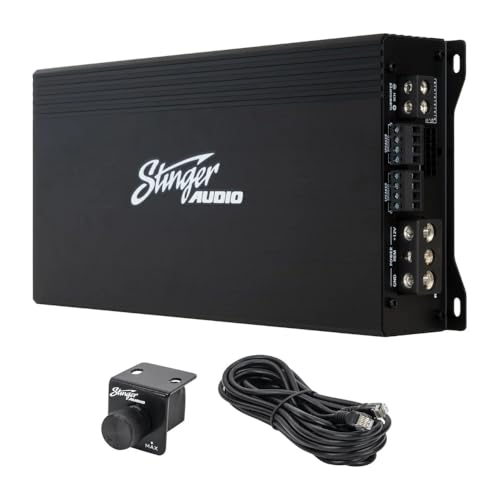


150 Watts RMS x 4 at 2 Ohms
At a 2-ohm load, the MT-1000.5 can deliver up to 150 watts RMS per full-range channel.
That provides substantially more output for compatible lower-impedance speakers.
A properly designed system could use this power for:
- High-output component speakers
- Performance coaxial speakers
- Custom front and rear stages
- Multi-driver configurations
Before connecting any speakers, verify their nominal impedance and RMS power handling.
Lower impedance allows the amplifier to produce more power, but it also increases electrical and thermal demand.
Dedicated 700-Watt RMS 1-Ohm Subwoofer Channel
One of the most important features of the MT-1000.5 is its dedicated fifth channel.
Stinger rates channel 5 for up to 700 watts RMS at 1 ohm.
That gives the amplifier enough dedicated bass power for a serious single-subwoofer setup or another compatible subwoofer configuration without requiring a separate monoblock amplifier.
The 1-ohm capability also creates more options when selecting dual-voice-coil subwoofers.
Why 1-Ohm Stability Matters
The final impedance presented to an amplifier depends on the subwoofer’s voice coils and how those coils are wired.
With compatible equipment, a 1-ohm stable subwoofer channel can provide additional flexibility for:
- Dual-voice-coil subwoofers
- Multiple subwoofers
- Parallel voice-coil wiring
- High-output bass installations
Always calculate final impedance before connecting the system.
A subwoofer described as dual 2-ohm, for example, can present a very different final load depending on how its voice coils are connected.
500 Watts RMS for the Subwoofer at 2 Ohms
Running the subwoofer channel at 1 ohm isn’t mandatory.
At 2 ohms, the MT-1000.5 can provide up to 500 watts RMS to the fifth channel.
That can be an excellent match for many moderate-power aftermarket subwoofers while placing less demand on the amplifier than a 1-ohm configuration.
The best impedance depends on the subwoofer, desired output and complete system design.
More wattage isn’t automatically better if the connected equipment doesn’t need or tolerate it.
300-Watt RMS Subwoofer Output at 4 Ohms
At 4 ohms, the fifth channel provides up to 300 watts RMS.
This creates a broad operating range across common subwoofer impedances.
It also means the MT-1000.5 can be adapted to systems ranging from modest daily-driver upgrades to considerably more aggressive bass installations.
Bridgeable Full-Range Channels
The MT-1000.5 also supports up to 300 watts RMS x 2 when bridged at a minimum 4-ohm load.
Bridging combines two amplifier channels to provide greater output to a compatible load.
This can be useful in specialized installations where fewer speakers require more power.
Always observe the specified minimum bridged impedance.
A load that’s safe on an individual channel may not be safe when the channels are bridged.
One Amplifier Can Run the Whole System
A five-channel amplifier can dramatically simplify an aftermarket audio installation.
Instead of installing:
One four-channel speaker amplifier
plus
One monoblock subwoofer amplifier
the MT-1000.5 can perform both jobs from a single chassis.
That can mean:
- Less mounting space
- Simpler power distribution
- Fewer ground connections
- Fewer signal cables
- Cleaner wiring
- Easier troubleshooting
- More usable cargo space
For street cars and daily drivers, that consolidation can be every bit as useful as the amplifier’s raw output.
Our car audio system guide covers how amplifier power, speaker impedance and subwoofer selection work together when planning a complete system.
Compact Class D Design
Stinger packages the MT-1000.5 into a chassis measuring approximately:
6.10 inches long
13.23 inches wide
2.09 inches high
That compact footprint creates more installation possibilities than a pair of traditional amplifiers.
Depending on the vehicle, potential mounting locations can include:
- Beneath a seat
- Behind rear seats
- Inside a trunk panel
- Under a cargo floor
- Within a custom amplifier rack
Always leave adequate room for wiring and cooling.
“Technically it fits if I wedge it against the carpet” is not an approved thermal-management strategy.
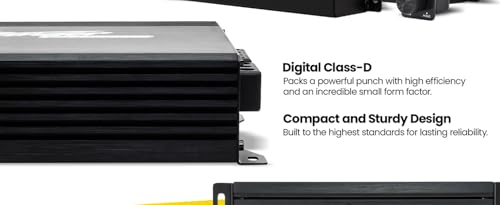
Efficient Digital Class D Architecture
The Stinger MT-1000.5 uses digital Class D amplifier technology.
Class D designs are particularly useful for compact multi-channel amplifiers because they can produce substantial output while minimizing wasted electrical energy.
Greater efficiency can result in:
- Reduced heat
- Smaller chassis dimensions
- Lower electrical losses
- High output relative to amplifier size
- Greater mounting flexibility
This becomes particularly valuable when a single amplifier is responsible for four full-range channels plus a high-output subwoofer.
Advanced HEXFET Power MOSFET Technology
Stinger equips the MT-1000.5 with HEXFET power MOSFET technology.
According to the supplied specifications, the design emphasizes low on-resistance and rapid switching.
MOSFET devices are central to the amplifier’s power-conversion architecture, where efficient switching helps transform the vehicle’s DC electrical supply into the power needed by the amplifier circuitry.
Stinger also specifies a Class X2 aluminum-zinc high-frequency capacitor designed to provide additional MOSFET protection against AC peak surge over-current conditions.
PWM Power Supply
The amplifier uses advanced pulse-width modulation, or PWM, integrated circuitry within its power supply.
The power supply plays a critical role in amplifier performance because a vehicle’s nominal 12-volt electrical system must support the internal voltages necessary to drive the speakers.
Stable power conversion becomes increasingly important as amplifier output and current demand rise.
Direct-Insert Power and Speaker Terminals
Stinger uses direct-insert power and speaker terminals designed to reduce unnecessary connection resistance.
Low-resistance electrical connections are important in high-power audio systems because resistance creates voltage loss and heat.
Proper installation still requires:
- Correctly sized power cable
- Proper ground cable
- Secure terminals
- Appropriate fusing
- Quality speaker wire
- Clean electrical connections
Even the fanciest amplifier terminal cannot rescue a power wire crimped with the emotional commitment of a wet paperclip.
Works with OEM Audio Systems
Another important feature of the MT-1000.5 is support for high-level input.
This allows the amplifier to receive speaker-level signals from compatible factory audio systems.
For an OEM-style installation, the specified connection method allows the RCA connectors to be removed and the wiring connected to speaker-level outputs as directed by Stinger.
This can make the MT-1000.5 useful for vehicles where the factory radio remains installed.
Always verify the specific factory audio architecture before installation, especially in vehicles with factory amplifiers or digitally controlled audio systems.
Works with Aftermarket Head Units
The amplifier can also accept conventional low-level preamp signals from an aftermarket head unit.
In this configuration, RCA signal cables run from the source unit’s preamp outputs to the amplifier.
This provides flexibility for both:
- Factory-radio integration
- Aftermarket head-unit installations
That versatility makes the MT-1000.5 useful for both subtle OEM-style upgrades and completely redesigned car audio systems.
Adjustable Bass Boost Q
The MT-1000.5 provides Bass Boost Q adjustment from 0 dB to 12 dB.
Bass boost allows selected low frequencies to be emphasized according to the vehicle and listening preference.
Use this feature conservatively.
Boosting low frequencies increases the amount of amplifier power required at those frequencies and can reduce available headroom.
Excessive bass boost can contribute to:
- Amplifier clipping
- Distortion
- Excessive subwoofer excursion
- Voice-coil heat
- Thermal stress
Establish the correct gain and crossover configuration before adding significant boost.
Remote Bass Knob Included
Stinger includes a remote bass knob controller with the MT-1000.5.
The controller can be mounted within reach of the driver’s seat using the supplied bracket or incorporated into a custom dash or console installation.
This allows the subwoofer level to be adjusted according to:
- Music genre
- Recording quality
- Passenger preference
- Driving conditions
The remote controller provides convenient adjustment without requiring access to the amplifier itself.
Proper Gain Setup Still Matters
Gain should be configured to match the amplifier’s input sensitivity to the source signal.
It is not a second volume control.
Setting amplifier gain too high can cause clipping before the head unit reaches its normal maximum clean output.
Clipping can lead to:
- Audible distortion
- Reduced sound quality
- Excessive amplifier heat
- Speaker damage
- Subwoofer damage
Set the source level, amplifier gain and crossover network methodically before using bass boost to fine-tune the system.
Match Speakers Using RMS Power
The MT-1000.5 offers several useful output configurations, so speaker selection should be based on the actual impedance being used.
At 4 ohms:
75W RMS x 4 + 300W RMS x 1
At 2 ohms:
150W RMS x 4 + 500W RMS x 1
At 1 ohm on channel 5:
Up to 700W RMS x 1
Match those continuous ratings against the speakers’ and subwoofer’s RMS power-handling specifications.
Ignore the temptation to design the system around whichever box has the largest number printed in the largest font.
Match the Subwoofer to the Fifth Channel
Before choosing a subwoofer, consider:
- RMS power handling
- Voice-coil configuration
- Nominal impedance
- Final wired impedance
- Enclosure requirements
- Desired bass output
A dual-voice-coil subwoofer can often be wired for different final impedances, making voice-coil selection particularly important with a 1-ohm capable amplifier.
Subwoofer Enclosure Design Matters
Amplifier power is only one component of bass performance.
The enclosure affects:
- Frequency response
- Output
- Low-frequency extension
- Cone excursion
- Power handling
- Overall sound character
A properly designed enclosure can make better use of the MT-1000.5’s available subwoofer power than simply throwing a high-wattage driver into whatever box fits in the trunk.
Our sealed versus ported subwoofer guide explains how the two common enclosure styles affect bass response and system behavior.
Make Sure the Electrical System Can Support It
A 1,200-watt RMS amplifier can place meaningful demand on a vehicle’s electrical system when operated at high output.
Before blaming the amplifier for poor performance, inspect:
- Battery condition
- Alternator charging voltage
- Battery terminals
- Main power cable
- Fuse holder
- Amplifier ground
- Electrical connections
Low voltage at the amplifier can reduce output and contribute to distortion or shutdown.
Check Voltage Drop Under Load
Voltage should be measured at the amplifier while the system is actually operating under load.
Resistance can hide in:
- Battery terminals
- Fuse holders
- Power cables
- Ground points
- Crimp connections
- Distribution blocks
Our automotive voltage-drop testing guide explains how measuring a circuit while current is flowing can expose resistance that may be invisible during a basic continuity test.
The same diagnostic approach works extremely well with high-current audio systems.
Prevent Amplifier Overheating
Class D efficiency helps control heat, but mounting and system configuration still matter.
Amplifier overheating can be caused by:
- Restricted airflow
- Incorrect speaker impedance
- Excessive gain
- Clipping
- Low supply voltage
- Poor grounding
- Sustained high-output operation
If an amplifier repeatedly enters thermal protection, diagnose the problem rather than simply moving it somewhere else and hoping physics gets bored.
Our guide explaining why car amplifiers overheat covers common electrical, impedance and installation causes.
Excellent for OEM-Style Audio Upgrades
Because the MT-1000.5 supports high-level input, it can be particularly useful for modern vehicles where replacing the factory source unit isn’t desirable.
A properly planned installation can retain the factory dashboard while adding:
- Amplified front speakers
- Amplified rear speakers
- Dedicated subwoofer
- Remote bass adjustment
That makes the amplifier useful for stealth installations where the audio performance changes dramatically but the interior appearance does not.
Strong Choice for Performance Cars
The compact dimensions also make the MT-1000.5 appealing for performance vehicles where cargo space and weight distribution matter.
A single amplifier can replace separate full-range and subwoofer amplifiers while still providing up to 700 watts RMS for the bass stage.
For coupes, sport compacts, performance sedans and smaller trucks, that can make packaging the audio system considerably easier.
Key Features
- Stinger Audio MT-1000.5
- Five-channel digital Class D amplifier
- Up to 1,200 watts RMS
- 75W RMS x 4 + 300W x 1 at 4 ohms
- 150W RMS x 4 + 500W x 1 at 2 ohms
- 700W RMS x 1 at 1 ohm on channel 5
- 1-ohm stable dedicated subwoofer channel
- Up to 300W RMS x 2 bridged at 4 ohms minimum
- OEM high-level input compatibility
- Aftermarket low-level RCA compatibility
- HEXFET power MOSFET technology
- PWM power-supply circuitry
- Class X2 aluminum-zinc high-frequency capacitor
- Direct-insert power terminals
- Direct-insert speaker terminals
- Variable 0–12 dB Bass Boost Q
- Remote bass controller included
- Dash-mount or flush-mount bass controller options
- Compact Class D architecture
- 6.10 x 13.23 x 2.09-inch chassis
- Designed for complete speaker and subwoofer systems
High-Power 5-Channel Audio in One Compact Amplifier
The Stinger Audio MT-1000.5 Compact 5-Channel Class D Amplifier provides a strong combination of full-range output, subwoofer power and installation flexibility.
At 4 ohms, it can provide 75 watts RMS x 4 plus 300 watts RMS for the subwoofer. At 2 ohms, output rises to 150 watts RMS x 4 plus 500 watts RMS, while the dedicated fifth channel can produce up to 700 watts RMS at 1 ohm.
That range makes the MT-1000.5 useful for everything from a straightforward four-speaker-and-subwoofer daily-driver setup to considerably more aggressive aftermarket systems.
Support for both high-level and low-level inputs adds OEM and aftermarket integration flexibility, while HEXFET MOSFET technology, PWM power circuitry, direct-insert terminals and compact Class D construction address efficiency and installation requirements.
Add the included remote bass controller and adjustable 0–12 dB bass boost, and the MT-1000.5 becomes a capable single-amplifier foundation for a complete car audio upgrade.
One amplifier, five channels and up to 1,200 watts RMS. Your trunk gets to remain a trunk instead of becoming a small electrical substation.




There are no reviews yet.