
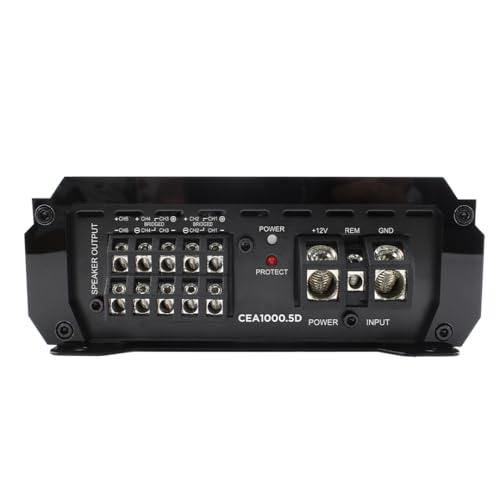
75 Watts RMS x 4 at 4 Ohms
The CEA1000.5D provides 75 watts RMS to each of its four primary channels at 4 ohms.
That’s a useful power range for many aftermarket component and coaxial speakers.
Compared with relying solely on head-unit power, a properly matched external amplifier provides additional headroom and can help upgraded speakers maintain cleaner output as volume increases.
When selecting speakers, compare the amplifier’s RMS output with the speaker’s RMS power-handling specification at the correct impedance.
Peak numbers look exciting on packaging. RMS ratings are the numbers that actually need to live together after installation.
125 Watts RMS x 4 at 2 Ohms
At a 2-ohm load, the CEA1000.5D delivers 125 watts RMS x 4.
This gives installers the option of using compatible lower-impedance speakers when additional output is required.
Dropping impedance increases the electrical load on the amplifier, however, so speaker impedance should always remain within ORION’s specifications.
Never wire speakers to a lower impedance simply because it produces a larger wattage number.
Dedicated 300W to 500W RMS Subwoofer Channel
The fifth channel is dedicated to low-frequency reproduction.
ORION rates the subwoofer channel at:
300 watts RMS x 1 at 4 ohms
or
500 watts RMS x 1 at 2 ohms
That provides enough output for many single-subwoofer daily-driver systems without requiring a separate monoblock amplifier.
The subwoofer should be selected according to RMS power handling and final impedance rather than peak wattage.
Match the Subwoofer’s Final Impedance
Final impedance becomes especially important with dual-voice-coil subwoofers.
Depending on voice-coil impedance and whether the coils are wired in series or parallel, the amplifier can see very different loads.
Before choosing a subwoofer, determine:
- Subwoofer RMS power handling
- Voice-coil configuration
- Final wired impedance
- CEA1000.5D output at that impedance
- Enclosure requirements
Planning these variables together avoids buying a 500-watt subwoofer that can only be wired into a configuration where the amplifier produces significantly less—or presents a load the amplifier wasn’t designed to handle.
Class D Amplifier Efficiency
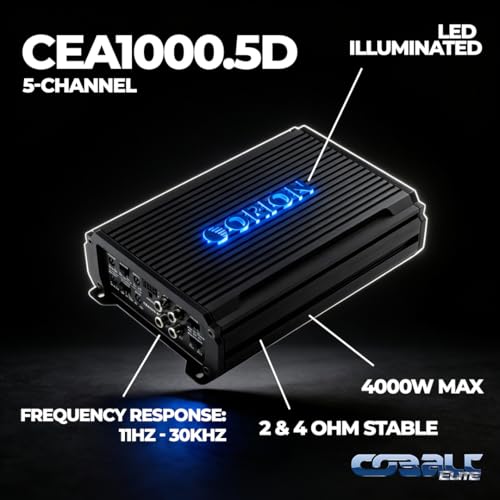
The ORION Cobalt Elite CEA1000.5D uses Class D amplifier architecture.
Class D designs are popular for multi-channel automotive amplifiers because they provide high efficiency while producing less waste heat than many traditional amplifier designs.
That matters when five amplifier channels share a compact chassis.
Benefits include:
- Efficient electrical operation
- Reduced heat generation
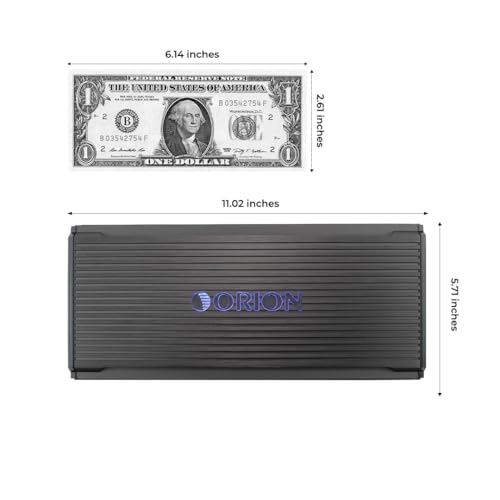
- Compact physical dimensions
- Lower current demand relative to output
- Easier installation in tight spaces
Efficiency becomes even more important when the amplifier is simultaneously driving four speakers and a subwoofer.
Full-Range Five-Channel Design
The first four channels are designed for full-range audio reproduction, making them suitable for compatible:
- Coaxial speakers
- Component speaker systems
- Midrange drivers
- Front and rear speaker stages
The dedicated fifth channel handles the subwoofer.
This gives the CEA1000.5D the flexibility to operate as the central amplifier for a complete aftermarket audio system.
Our Car Audio System Guide for Better Sound Builds covers how RMS ratings, impedance, speaker selection, wiring and subwoofer design work together when planning a complete system.
Independent Channel Tuning
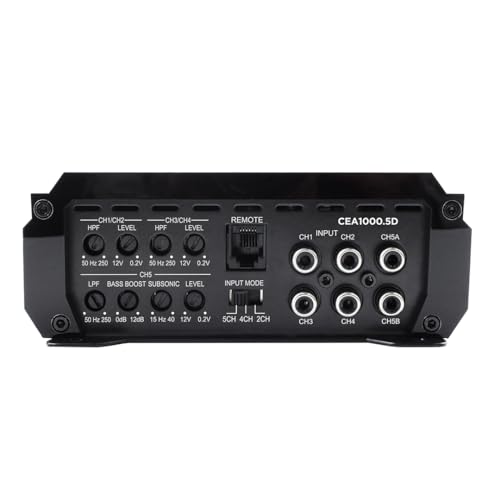
The CEA1000.5D includes dedicated crossover controls for its speaker and subwoofer sections.
That allows the amplifier to divide the audio spectrum between the speakers best suited to reproduce it.
Instead of forcing every speaker to reproduce every frequency, crossovers allow the system to operate more efficiently.
High-Pass Filtering for Door Speakers
A high-pass filter prevents frequencies below the selected crossover point from reaching the connected speakers.
This is particularly useful for door speakers.
Small component and coaxial speakers generally aren’t designed to reproduce the deepest bass frequencies handled by a dedicated subwoofer.
Filtering those frequencies can reduce unnecessary cone excursion and help the speakers play cleaner at higher levels.
Low-Pass Filtering for the Subwoofer
The dedicated subwoofer channel incorporates a variable low-pass filter.
A low-pass filter does the opposite of the high-pass filter: it prevents higher frequencies from reaching the subwoofer.
Proper crossover adjustment helps the subwoofer blend naturally with the rest of the system instead of sounding like the bass is coming from a separate box in the trunk.
Why Crossover Settings Matter
Correct crossover settings can improve:
- Speaker clarity
- Bass integration
- Available headroom
- Speaker protection
- Amplifier efficiency
- Overall system balance
There isn’t one universal crossover frequency for every system.
Speaker capability, subwoofer design, enclosure, vehicle acoustics and personal preference all influence the final setting.
Choose the Right Car Speakers
A five-channel amplifier is only as useful as the speakers connected to it.
For the CEA1000.5D, look for speakers whose RMS handling and impedance complement the amplifier’s output.
Our guide to choosing the best car speaker upgrades explains why speaker sensitivity, RMS power handling, impedance and physical fitment should all be considered before choosing an amplifier-speaker combination.
For many daily drivers, the 75W x 4 output available at 4 ohms provides a practical match for quality aftermarket component or coaxial speakers.
Choosing a Subwoofer Enclosure
The amplifier is only one part of the bass system.
Subwoofer enclosure design affects:
- Frequency response
- Low-frequency extension
- Output
- Cone control
- Required cargo space
A sealed enclosure typically provides compact packaging and controlled response, while a properly designed ported enclosure can produce greater output around its tuning frequency.
The Pro Street subwoofer enclosure guide covers enclosure volume, subwoofer matching and installation considerations in greater detail.
Sealed vs Ported with the CEA1000.5D
With up to 500 watts RMS at 2 ohms, the ORION amplifier can work with either enclosure style when paired with a compatible subwoofer.
A sealed setup may make sense for a compact daily driver where trunk space and controlled bass are priorities.
A ported enclosure may be preferable when stronger low-frequency output is the goal and additional enclosure space is available.
Our sealed vs ported subwoofer comparison breaks down the practical differences between the two designs.
Built-In Protection Circuitry
The CEA1000.5D incorporates protection circuitry designed to guard against conditions including:
- Thermal overload
- Short circuits
- Voltage irregularities
Protection circuitry is an important safeguard, but it shouldn’t substitute for proper installation.
If the amplifier repeatedly enters protection mode, diagnose the cause rather than repeatedly cycling the power and hoping the electronics have reconsidered their life choices.
Keep the Amplifier Cool
Class D efficiency reduces heat, but the amplifier still needs adequate ventilation.
Install it where air can circulate around the chassis.
Avoid completely covering the amplifier with carpeting, insulation or cargo.
Repeated overheating can also indicate an electrical or speaker-load problem rather than simply poor airflow.
Our guide on why car amplifiers overheat explains how incorrect impedance, weak power delivery, poor grounding and excessive gain can contribute to amplifier heat and protection-mode shutdowns.
Power Wiring Matters
A 1,000-watt RMS amplifier needs a properly designed power circuit.
Use appropriately sized automotive power and ground wiring based on the amplifier manufacturer’s recommendations.
The installation should include:
- Correct power-wire gauge
- Correct ground-wire gauge
- Main fuse near the battery
- Quality fuse holder
- Short chassis ground
- Clean bare-metal grounding point
- Properly crimped or terminated connections
Cheap undersized wiring can create resistance, voltage drop and heat.
That’s not the kind of “warm sound” audio enthusiasts are looking for.
Don’t Ignore the Charging System
The vehicle’s battery and alternator ultimately supply the energy used by the amplifier.
For a moderate daily-driver installation, a healthy factory charging system may be sufficient, depending on the vehicle and how the system is used.
If voltage drops significantly at higher output levels, inspect the charging system and amplifier wiring before blaming the amplifier.
Headlight dimming, premature clipping and amplifier shutdown can all point toward inadequate power delivery.
Gain Is Not a Volume Control
Proper amplifier tuning matters just as much as power.
Gain adjusts input sensitivity to match the output signal from the head unit or signal processor.
Turning gain to maximum does not magically transform the CEA1000.5D into a more powerful amplifier.
It simply makes it easier to drive the amplifier into clipping.
Correctly set gain provides clean output and usable headroom while reducing unnecessary distortion.
Works with Aftermarket Car Audio Systems
The CEA1000.5D is designed for complete aftermarket systems in vehicles such as:
- Cars
- Trucks
- SUVs
- Performance vehicles
- Daily drivers
- Custom audio builds
Modern factory premium-audio systems may require additional integration equipment depending on the vehicle.
Always determine how the factory source unit and amplifier are configured before installing an aftermarket amplifier.
Compact All-in-One Installation
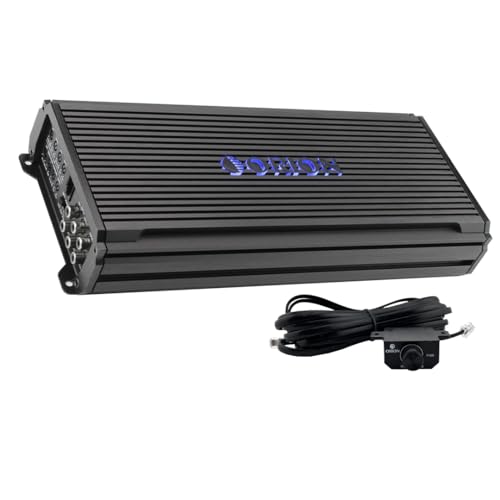
The primary appeal of the CEA1000.5D is that it consolidates a complete amplified system into one chassis.
Instead of installing:
One four-channel speaker amplifier + one mono subwoofer amplifier
you can potentially install:
One ORION CEA1000.5D
That can simplify mounting, wiring and troubleshooting while leaving more room for the things the vehicle was originally designed to carry.
Ideal Daily-Driver Configuration
A balanced CEA1000.5D system could consist of:
Front: 4-ohm component speakers
Rear: 4-ohm coaxial speakers
Subwoofer: Compatible 2- or 4-ohm subwoofer
Amplifier: ORION CEA1000.5D
At 4 ohms, the speakers receive up to 75 watts RMS each, while the subwoofer channel provides up to 300 watts RMS.
A compatible 2-ohm system can increase output to 125 watts RMS x 4 plus 500 watts RMS x 1.
Key Features
- ORION Cobalt Elite CEA1000.5D
- Five-channel Class D amplifier
- Up to 1,000 watts RMS
- 75W RMS x 4 at 4 ohms
- 125W RMS x 4 at 2 ohms
- 300W RMS x 1 subwoofer output at 4 ohms
- 500W RMS x 1 subwoofer output at 2 ohms
- Four full-range speaker channels
- Dedicated mono subwoofer channel
- High-pass filtering
- Low-pass filtering
- Variable subwoofer low-pass filter
- Independent channel tuning
- High-efficiency Class D architecture
- Integrated thermal protection
- Short-circuit protection
- Voltage protection
- Compact single-chassis design
- Designed for complete speaker and subwoofer systems
A Balanced 5-Channel Amplifier for Complete Systems
The ORION CEA1000.5D Cobalt Elite is designed for enthusiasts who want to amplify an entire car audio system without installing multiple amplifiers.
Its four full-range channels provide 75 watts RMS each at 4 ohms or 125 watts RMS each at 2 ohms, while the dedicated fifth channel supplies 300 watts RMS at 4 ohms or 500 watts RMS at 2 ohms for a compatible subwoofer.
Independent crossover controls provide useful tuning flexibility, while Class D architecture helps keep the chassis compact and electrically efficient.
For daily drivers, trucks and SUVs where installation space matters, the CEA1000.5D provides a straightforward way to power front speakers, rear speakers and a subwoofer from one amplifier while still using meaningful RMS power ratings instead of relying on wattage numbers apparently calculated somewhere near the moon.









There are no reviews yet.