

Nine-Stage Smart Charging
Rather than applying a fixed current throughout the entire charging cycle, the COREBOX uses a nine-stage smart charging process designed to adjust charging behavior as battery conditions change.
Multi-stage charging can help manage the transition between recovery, bulk charging, finishing and maintenance functions without requiring constant manual adjustment.
This approach is particularly useful when maintaining vehicles that spend extended periods parked.
Your weekend car can therefore spend another month sitting in the garage without adding “mysteriously dead battery” to its existing list of project-car personality traits.
Dynamic Temperature Compensation
Battery charging requirements change with ambient temperature.
The COREBOX incorporates dynamic temperature compensation, or T-comp technology, designed to adjust charging behavior according to environmental conditions.
Dedicated Winter and Summer modes help compensate for temperature extremes.
In colder weather, charging parameters can be adjusted to address reduced battery activity and potential undercharging. During warmer conditions, charging behavior can be moderated to reduce the risk of excessive charging voltage.
The charger has a stated operating-temperature range of approximately -20°C to 50°C (-4°F to 122°F).
Smart Trickle Charging and Battery Maintenance
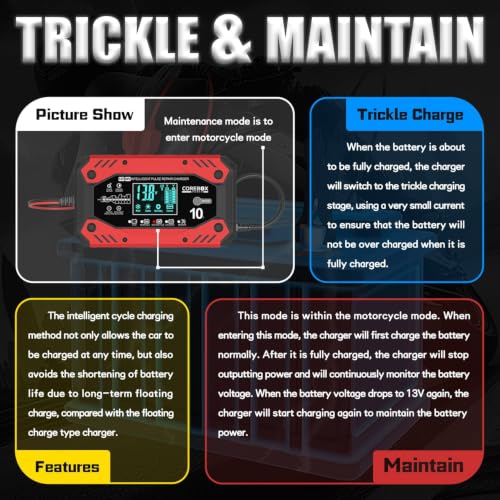
After the primary charging cycle is complete, the COREBOX can operate as a battery maintainer for compatible batteries.
Its low-current maintenance strategy is intended to keep the battery at an appropriate state of charge without continuously applying the charger’s maximum output.
This makes it particularly useful for:
- Classic cars
- Project cars
- Seasonal vehicles
- Motorcycles
- Boats
- RVs
- ATVs
- Snowmobiles
- Lawn equipment
- Vehicles stored during winter
A battery maintainer is especially valuable when normal self-discharge and small standby electrical loads would otherwise slowly drain a stored battery.
If the car battery keeps dying, however, don’t assume permanent connection to a charger is the only answer. Battery deterioration, parasitic draw and charging-system problems can all cause recurring discharge.
Pulse Repair for Sulfated Lead-Acid Batteries
The COREBOX includes a dedicated REPAIR mode intended for compatible sulfated or long-idle lead-acid batteries.
Its slow-pulse charging strategy is designed to address certain sulfation conditions that can develop when lead-acid batteries remain partially or fully discharged for extended periods.
This function may help recover performance from some serviceable batteries, but battery repair modes cannot reverse every form of deterioration.
A battery with damaged internal plates, a shorted cell, physical damage or severe permanent capacity loss will generally require replacement.
The charger also cannot recover a completely depleted 0V battery.
Forced Output for Deeply Discharged Batteries
Automatic smart chargers sometimes refuse to begin charging when battery voltage is too low for the electronics to recognize the battery normally.
The COREBOX includes a Forced Output mode intended for certain deeply discharged batteries that still retain recoverable voltage.
Because this function can override aspects of normal automatic battery detection, it should be used carefully and only according to the supplied instructions.
Before forcing charging current into a battery, inspect it for swelling, cracks, leakage, excessive heat or other physical damage.
Never attempt to recover a physically damaged battery simply because the charger has a button that says it can try.
Real-Time Diagnostic LCD Display
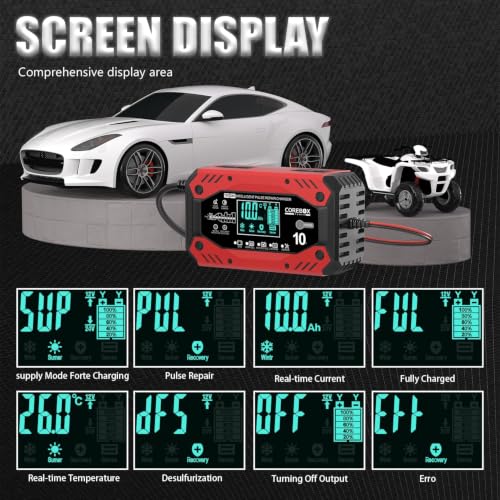
The integrated LCD provides real-time charging and diagnostic information.
Depending on the selected mode, the display can show information including:
- Battery voltage
- Charging current
- Charging power
- Charging status
- Battery-system voltage
- Connection or operating information
The diagnostic display can also help identify certain connection problems, reducing the amount of guesswork involved when the charger doesn’t begin operating normally.
Battery Charging vs. Starting-System Diagnosis
Charging a battery is only one part of solving a starting problem.
If the battery reaches full charge but the vehicle still cranks slowly, clicks or refuses to start, investigate the rest of the starting circuit.
For example, rapid clicking while attempting to start a vehicle can indicate insufficient available voltage, but poor battery terminals, cables and ground connections can produce similar symptoms.
If the vehicle has electrical power but still won’t start, the fault may involve the starter, relay, ignition system, immobilizer or another component rather than battery state of charge.
Voltage-Drop Testing Can Find Hidden Resistance
A battery cable can look perfectly healthy from the outside while excessive resistance inside the connection prevents sufficient current from reaching the starter.
That’s why checking battery voltage alone doesn’t always identify starting-system problems.
Our guide to automotive voltage-drop testing explains how to test battery cables, grounds and starter connections while the circuit is under load.
Starting diagnosis with a properly charged battery and then checking voltage loss through the circuit can save considerable time compared with replacing parts based on guesses.
Monitor the Vehicle Charging System
If the battery accepts a charge normally but repeatedly becomes discharged while the vehicle is being driven, inspect the charging system.
Alternator output, wiring, grounds and belt-drive problems can all prevent the battery from being properly replenished.
An illuminated battery warning lamp is another reason to investigate. Our guide explaining why the battery light comes on covers common charging-system conditions that can trigger the warning.
A smart charger can restore battery charge. It can’t make a dead alternator suddenly reconsider its career choices.
Compact Charger Design
At approximately 3.3 × 1.3 × 2.4 inches according to the supplied specifications, the COREBOX is designed to provide its charging and maintenance functions in a compact package.
Its small footprint makes it easier to store in a garage cabinet, toolbox, RV or other equipment-storage area when not in use.
Despite its compact dimensions, the charger combines high-current charging, maintenance charging, battery-recovery functions and real-time monitoring in one device.
Integrated Charging Protection
The COREBOX incorporates multiple safety systems for routine battery charging.
Stated protections include:
- Reverse-polarity protection
- Short-circuit protection
- Overload protection
- Spark-resistant charging technology
- Temperature-managed charging
- Fire-resistant housing
These safeguards help protect the charger and battery from common operating errors, but correct battery identification and connection procedures remain essential.
Always inspect the battery and cables before charging and follow both the charger manufacturer’s instructions and the battery manufacturer’s charging requirements.
Key Features
- Up to 10A charging current
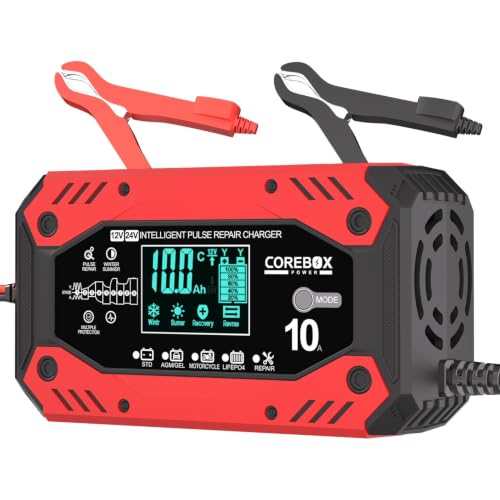
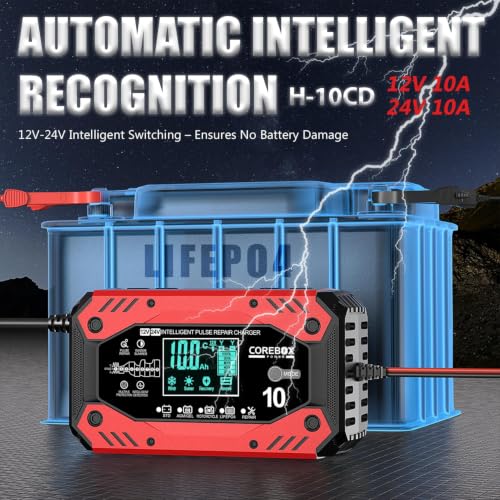
- Automatic 12V/24V detection
- Nine-stage smart charging
- AGM battery support
- GEL battery support
- SLA battery support
- Flooded/Wet battery support
- Compatible LiFePO4 charging
- Supports specified 12.8V–14.6V LiFePO4 batteries
- Dynamic temperature compensation
- Winter charging mode
- Summer charging mode
- Operating range approximately -20°C to 50°C
- Automatic battery maintenance
- Low-current trickle charging
- Dedicated REPAIR mode
- Pulse-recovery charging for compatible lead-acid batteries
- Forced Output mode for certain deeply discharged batteries
- Real-time LCD display
- Voltage monitoring
- Current monitoring
- Charging-power monitoring
- Connection diagnostics
- Reverse-polarity protection
- Short-circuit protection
- Overload protection
- Spark-resistant design
- Fire-resistant housing
- Compact charger construction
Smart Charging for Cars, Trucks, RVs, Boats and More
The COREBOX 10-Amp 12V/24V Smart Battery Charger and Maintainer offers a useful balance between faster battery charging and long-term maintenance.
Automatic 12V/24V recognition simplifies setup, while multiple battery modes expand compatibility across automotive, marine, RV and powersports applications. Temperature compensation makes the charger more adaptable to seasonal conditions, and dedicated Repair and Forced Output functions provide additional options when dealing with neglected lead-acid batteries.
For owners maintaining multiple vehicles or seasonal equipment, one compact charger that can recharge, maintain and diagnose several battery types makes considerably more sense than discovering six different trickle chargers in a drawer and somehow finding that none of them has the right cable.










There are no reviews yet.