
Why Momentary Oil-Pressure Loss Matters
Engine bearings rely on a pressurized film of oil to keep rotating components separated.
When pressure disappears under load, even briefly, the consequences can become expensive very quickly.
Potential damage can involve:
- Main bearings
- Rod bearings
- Camshaft bearings
- Crankshaft journals
- Valvetrain components
- Turbocharger bearings
This is why an oil-pressure gauge that dives during braking or a long corner shouldn’t be dismissed because the pressure comes back afterward.
The gauge just showed you a problem.
The fact that the engine hasn’t exploded yet isn’t evidence that the problem is harmless.
Pre-Oiling Before Startup
The Moroso 23900 has another useful function: pre-lubricating the engine before startup.
With pressurized oil stored in the accumulator, opening the manual valve before starting the engine allows oil to enter the lubrication system before the engine fires.
Moroso specifically promotes this capability as a way to reduce dry-start wear.
Pre-oiling is particularly attractive for:
- Race engines
- High-dollar engine builds
- Vehicles stored for extended periods
- Engines with large bearing clearances
- Fresh engine startups
- Classic performance cars
- Turbocharged engines
For a fresh engine, Moroso also provides a dedicated procedure for using the accumulator to pre-lube the engine before its initial startup.
Excellent Insurance for Performance V8 Engines
Moroso recommends its 3-quart accumulator primarily for V8 engines and larger high-performance six-cylinder applications.
That makes the 23900 a natural addition to engines such as:
- Small Block Chevy
- Big Block Chevy
- GM LS
- Small Block Ford
- Ford FE
- Ford Coyote
- Chrysler LA
- Chrysler B/RB
- Gen III Hemi
- High-output inline-six engines
- Turbocharged six-cylinder engines
Because the accumulator connects to the pressure side of the oiling system rather than directly replacing an application-specific oil pan, the 23900 is fundamentally a universal performance component.
Calling it “vehicle specific” doesn’t accurately describe how it is selected or installed.
Useful for Big Block Chevy Builds
A high-output Big Block Chevy is exactly the kind of engine where additional oil-pressure protection can make sense.
For example, a performance BBC using a deep wet-sump pan such as the Moroso 20412 can already benefit from increased oil capacity, proper pickup placement and windage control. An accumulator adds another layer of protection against temporary pressure loss.
The accumulator should not, however, be viewed as a replacement for the correct oil pan.
The engine still needs:
- Proper sump design
- Correct oil level
- Correct pickup
- Proper pickup-to-pan clearance
- Adequate oil-pump capacity
- Effective baffling
- Proper bearing clearances
The accumulator is backup protection.
It shouldn’t be used to excuse an oiling system that was badly designed in the first place.
Particularly Valuable on Road-Course Cars
Sustained cornering is one of the situations where an oil accumulator can become especially valuable.
A drag car generally experiences extremely high longitudinal acceleration for relatively short periods. A road-course car can subject the oiling system to lateral forces for much longer periods while repeatedly transitioning between acceleration, cornering and braking.
That can move oil away from the pickup and produce pressure fluctuations.
For vehicles that regularly see track use, an accumulator can therefore complement a baffled or trap-door-equipped wet-sump pan.
It’s still important to watch actual oil pressure during track use.
An accumulator can provide emergency oil during a temporary pressure drop, but if the car continually empties the accumulator every corner, the underlying oil-control problem deserves attention.
Useful on Turbocharged Engines
Turbocharged engines place additional importance on reliable oil supply because engine oil may be responsible for lubricating both the engine and turbocharger bearings.
That makes oil pressure, oil temperature and oil control particularly important when building a forced-induction combination.
Our turbocharger technical guides on My Pro Street cover the relationship between engine oiling and turbocharger reliability, while the site’s Complete Turbo Build Guide approaches oil pressure as one of the engine-health checks that should be completed before increasing cylinder pressure.
An accumulator won’t fix worn bearings, an incorrectly sized turbo drain or a bad oil pump.
But on a properly built system, it can provide valuable backup pressure during a temporary loss of oil supply.
3-Quart Capacity
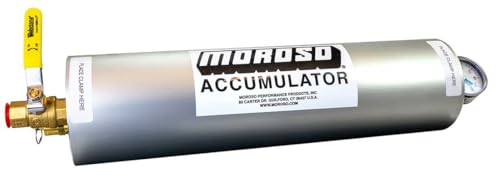
The Moroso 23900 has a nominal 3-quart capacity.
Moroso’s normal charging instructions specify adding an additional three quarts of oil to the engine when using the 23900 if the goal is to maintain the original oil level in the pan once the accumulator fills.
That distinction is important.
When the engine starts and the accumulator fills, some of the lubrication system’s total oil volume is now stored inside the accumulator.
Simply installing the accumulator without accounting for that additional system capacity can leave the oil pan below its intended operating level.
Follow Moroso’s charging procedure and verify the engine’s final operating oil level rather than simply pouring in the original factory quantity.
20-1/8-Inch x 4-1/4-Inch Cylinder
The Moroso 23900 measures approximately:
Length: 20-1/8 inches
Cylinder diameter: 4-1/4 inches
Those dimensions matter because the accumulator needs a protected mounting location with enough room for the cylinder, plumbing and valve.
Possible mounting locations depend heavily on the vehicle and can include areas in the:
- Engine compartment
- Frame area
- Passenger compartment on appropriately prepared race cars
- Trunk or rear area of purpose-built competition vehicles
Moroso allows the accumulator to be mounted in any position when properly secured with the appropriate mounting hardware.
Moroso 23920 Accumulator Mount
Moroso recommends its 23920 Accumulator Mount for the standard 23900 accumulator.
The mounting system is designed to securely support the cylindrical accumulator while allowing considerable flexibility in placement.
That’s important because a three-quart accumulator filled with oil shouldn’t be mounted with improvised hardware.
A couple of hardware-store clamps and optimism aren’t an oil-system mounting strategy.
1/2-Inch NPT Oil Port
The oil side of the Moroso 23900 is tapped for a 1/2-inch NPT fitting.
Moroso offers several plumbing options, including:
- 22706 — 1/2″ NPT to -10AN
- 22708 — 1/2″ NPT to -12AN
- 22709 — -12AN to -10AN adapter
The appropriate line size and plumbing arrangement depend on the engine and installation.
The goal is to provide a low-restriction path between the accumulator and the pressure side of the engine’s lubrication system.
Several Plumbing Methods Are Possible
Moroso describes several ways to connect the accumulator to an engine.
The oil line can be:
- Teed into an oil-cooler or remote-filter circuit
- Connected through an accumulator adapter between the spin-on oil filter and engine
- Connected directly to an appropriate pressure-side oil gallery in the engine block
Regardless of method, the accumulator needs access to the pressurized side of the lubrication system.
This isn’t simply an auxiliary oil tank with a hose running back to the oil pan.
Pressure Gauge Included
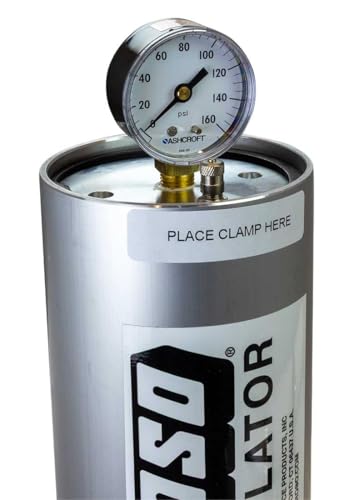
The Moroso 23900 includes an air-pressure gauge on the accumulator.
That gauge allows the user to verify the accumulator’s air charge and confirm that the system is prepared to operate.
Moroso’s standard charging procedure begins by pressurizing the accumulator and then setting the appropriate pre-charge before starting the engine.
Once the engine is running, engine oil pressure pushes oil into the accumulator and raises the pressure displayed on the gauge.
The gauge therefore provides useful information about the accumulator’s operating condition.
Manual Ball Valve Included
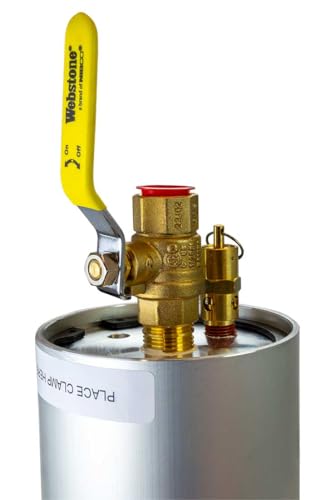
Moroso supplies the 23900 with a manual ball valve.
For pre-oiling, the valve can be opened before starting the engine, allowing stored pressurized oil to enter the lubrication system.
During vehicle operation, the valve remains open so the accumulator can respond to pressure fluctuations.
Before shutting down, the valve can be closed while the accumulator is charged, preserving pressurized oil for the next startup.
This system is mechanically simple and effective, but it does require the driver or technician to operate the valve correctly.
Optional Electric Valve Control
For installations where manual operation isn’t desirable, Moroso offers optional electric valve systems.
These can allow remote control of accumulator operation from inside the vehicle.
Moroso also offers pressure-controlled solenoid valve kits that activate according to oil-pressure thresholds. The company’s pressure-valve systems are designed to release oil when pressure drops below the selected range and allow the accumulator to recharge when normal pressure returns.
For a competition vehicle, that can provide more automated operation than relying entirely on a manual valve.
Charging the Moroso 23900
Moroso’s normal installation instructions specify an initial air pre-charge procedure.
With the accumulator installed and the manual valve open, Moroso instructs the installer to pressurize the air side and then bleed it down to the specified initial setting before normal operation.
For the standard installation procedure, Moroso specifies a 6-psi pre-charge after the initial charging process.
Once the engine starts, oil pressure fills the accumulator and compresses the air behind the piston.
Always follow Moroso’s current installation instructions when setting up the system rather than guessing at accumulator pressure.
Add Oil for the Accumulator’s Capacity
Moroso specifies that a 23900 installation may require three additional quarts of engine oil to maintain the original pan level after the accumulator has filled.
This doesn’t mean blindly overfilling the oil pan by three quarts.
The extra volume becomes part of the total lubrication-system capacity because the accumulator stores oil when the engine is operating.
The final oil level in the pan still needs to be correct.
That’s especially important with aftermarket oil pans and universal dipsticks, where the indicated FULL mark should be calibrated against the actual intended operating level.
Can an Accumulator Fix Low Oil Pressure?
No.
The Moroso 23900 is designed primarily to respond to temporary pressure fluctuations or loss of pickup supply.
It doesn’t repair underlying mechanical problems such as:
- Excessive bearing clearance
- Worn oil pump
- Incorrect pickup clearance
- Cracked pickup tube
- Internal oil leakage
- Severely overheated oil
- Chronic low oil level
- Incorrect oil viscosity
If the engine has continuously low oil pressure, diagnose the problem.
Our oil-pressure troubleshooting coverage on My Pro Street is the more appropriate next step when pressure remains consistently below specification rather than dropping only during acceleration, braking or cornering.
An accumulator can briefly feed a hungry engine.
It cannot negotiate with worn-out main bearings indefinitely.
What Happens After an Engine Failure?
If an engine experiences a serious internal failure, the accumulator needs attention too.
Moroso specifically instructs users to disassemble and thoroughly clean the accumulator following an engine failure.
That’s because metallic debris and contaminated oil can enter the accumulator along with the engine’s pressurized oil supply.
Rebuilding an engine while leaving contaminated oil trapped in the accumulator creates an obvious problem:
The first time the fresh engine needs backup oil pressure, the accumulator may reward it with several quarts of evidence from the previous engine failure.
Clean the entire oiling system.
Moroso 23900 Specifications
Part Number: 23900
Product: Oil Accumulator
Capacity: 3 quarts
Cylinder Length: 20-1/8 inches
Cylinder Diameter: 4-1/4 inches
Oil Connection: 1/2-inch NPT
Construction: Heavy-wall aluminum hydraulic cylinder tubing
Internal Piston: Billet aluminum, double O-ring design
Pressure Gauge: Included
Manual Ball Valve: Included
Mounting Position: Any position when properly secured
Recommended Mount: Moroso 23920
Primary Application: V8 and larger high-performance six-cylinder engines
Fitment: Universal / application-specific
Country of Origin: United States
Package Weight: Approximately 6.95 lb
Package Length: 67.31 cm
Package Height: 11.684 cm
Package Width: 11.938 cm
Universal, Not Vehicle-Specific
The supplied marketplace data identifies the Moroso 23900 as vehicle specific.
That’s misleading.
Moroso describes the accumulator as a universal oil-system component and recommends the 3-quart capacity based primarily on engine size and performance application.
Fitment depends on:
- Available mounting space
- Oil-system plumbing
- Engine oil pressure
- Fitting and hose configuration
- Intended use
- Ability to securely mount the cylinder
For ecommerce purposes, I would list:
Fitment Type: Universal
Recommended Application: V8 and larger high-performance six-cylinder engines
Oil Connection: 1/2-inch NPT
That’s considerably more useful to the customer than claiming the accumulator fits a particular vehicle.
Who Should Buy the Moroso 23900?
The Moroso 23900 is a strong addition to performance vehicles where temporary oil-pressure loss is a legitimate concern.
It makes particular sense for:
- Road-race cars
- Autocross builds
- Drag cars
- High-performance street cars
- Pro Street builds
- Wet-sump race engines
- High-output V8s
- Performance six-cylinder engines
- Fresh engine builds needing pre-lubrication
- Vehicles that sit for extended periods
It isn’t a substitute for correcting a fundamentally inadequate oiling system.
Think of it as insurance for short-duration pressure loss—not permission to ignore the oil-pressure gauge.
Final Verdict
The Moroso 23900 3-Quart Oil Accumulator adds a pressurized reserve of engine oil to a performance wet-sump lubrication system.
When oil pressure falls during hard acceleration, braking or cornering, the accumulator can immediately send stored oil back into the engine. Once normal pressure returns, the engine automatically refills the accumulator.
Its ability to pre-oil an engine before startup adds another useful layer of protection, particularly for expensive race engines and vehicles that spend long periods parked.
For V8 and high-performance six-cylinder builds where maintaining oil pressure is critical, the 23900 is a practical addition to an already properly engineered lubrication system.
Because when the oil-pressure gauge suddenly heads toward zero in Turn 8, discovering that you should have improved the oiling system three months ago is not especially helpful.











There are no reviews yet.