
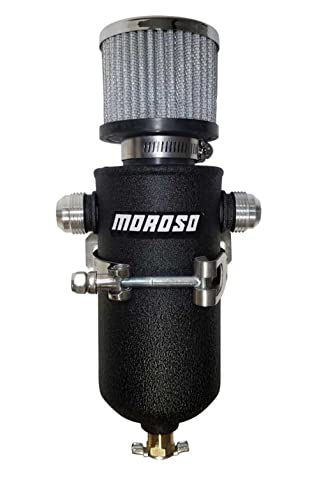
Designed for High-Flow Crankcase Ventilation
Performance engines can move a considerable amount of air through the crankcase.
Some pressure comes from normal piston-ring leakage, commonly called blow-by. As cylinder pressure increases, crankcase ventilation becomes even more important.
That is especially true for:
- High-compression engines
- Large-displacement V8s
- Turbocharged engines
- Supercharged engines
- Nitrous engines
- High-RPM race engines
- Loose-clearance competition engines
The large dual -12AN connections give the 85753 substantially more ventilation capability than a small hose feeding a conventional street-oriented catch can.
If you’re building a boosted engine, crankcase ventilation belongs in the planning stage rather than becoming something you discover after the engine starts pushing oil through every available seal. The turbo build technical coverage on My Pro Street naturally ties crankcase and PCV health into the same pre-boost checks as compression, leak-down testing and oil pressure.
More boost creates more cylinder pressure.
More cylinder pressure has a habit of finding weak ring sealing and inadequate crankcase ventilation very quickly.
Internal Air/Oil Separation
The Moroso 85753 isn’t simply an empty aluminum container with fittings welded into it.
Moroso uses internal baffling and separation media to help separate suspended oil from crankcase vapor.
As the incoming air-and-oil mixture enters the tank, the internal structure encourages oil droplets to separate from the airflow and collect in the bottom of the tank.
Air can then exit through the breather at the top.
This helps reduce:
- Oil mist in the engine compartment
- Breather saturation
- Oil residue around valve covers
- Fluid being expelled from crankcase vents
- Mess associated with open breathers
The system is particularly useful when a performance engine generates enough crankcase airflow to overwhelm conventional valve-cover breathers.
One-Quart Capacity
The Moroso 85753 provides approximately one quart of collection capacity.
That’s substantially more useful for a race-oriented breather system than the tiny reservoir found in many compact street catch cans.
The larger tank provides room for separated oil and other collected fluid without requiring constant draining.
You should still inspect the tank regularly.
If a one-quart breather tank suddenly starts filling rapidly with engine oil, the solution isn’t buying a two-quart tank.
The engine is telling you something.
Bottom Petcock Drain
Moroso equips the 85753 with a bottom petcock drain.
That allows accumulated oil and fluid to be drained without removing the entire tank or disconnecting the -12AN lines.
A drain at the lowest point also makes routine inspection straightforward.
Periodically draining the tank gives you useful information about the condition of the engine.
A small amount of oil mist collection may be normal depending on the application.
A sudden increase can point toward:
- Increased blow-by
- Ring-sealing problems
- Excessive crankcase pressure
- Vacuum-pump configuration problems
- Excessive oil reaching the valve-cover vents
- Engine damage
Treat the catch can as both a collection device and an inspection point.
Non-Hooded Filtered Breather
At the top of the 85753 is a non-hooded clamp-on filtered breather.
The breather allows crankcase air to escape while helping contain oil droplets inside the tank.
Moroso uses a heavy-duty clamp arrangement to keep the filter securely attached in racing environments.
The filtered outlet is important because the entire purpose of the remote tank is to allow the crankcase ventilation system to breathe while separating the oil carried with that airflow.
Blocking or restricting the outlet defeats the purpose.
Crankcase pressure will always look for another exit.
Valve-cover gaskets, dipstick tubes and crank seals are usually happy to volunteer.
Vacuum Pump Applications
The Moroso 85753 is particularly well suited to racing vacuum-pump systems.
A crankcase vacuum pump intentionally removes air from the crankcase, creating negative pressure that can improve ring sealing and reduce windage in appropriate racing combinations.
The discharged air can contain oil mist, which needs to be separated and collected rather than sprayed into the engine compartment.
A remote breather tank gives that vacuum-pump discharge somewhere appropriate to go.
Moroso specifically markets this family of breather tanks as companions for its racing vacuum pumps.
Dry-Sump Applications
The 85753 can also serve as a remote breather tank for a dry-sump oil system.
A dry-sump tank needs adequate ventilation because oil returning from the engine carries entrained air that must be separated from the lubricant.
Routing the tank vent to a properly baffled remote breather provides a controlled location for that air and residual oil mist.
This is different from the compact air/oil separator typically installed in the PCV hose of a street car.
The 85753 is aimed much more directly at high-flow racing ventilation systems.
Dual Valve-Cover Ventilation
Another natural use for the dual -12AN 85753 is connecting both valve covers to one remote breather tank.
Moroso offers performance valve covers with -12AN breather provisions specifically suited to this type of installation.
For example, Moroso’s performance Big Block Chevy valve covers are available with baffled -12AN male breather connections, and Moroso lists the 85753 as a compatible remote breather tank for those covers.
That creates a straightforward system:
LEFT VALVE COVER → -12AN LINE → BREATHER TANK
RIGHT VALVE COVER → -12AN LINE → BREATHER TANK
The large lines provide a relatively unrestricted path for crankcase vapor while the remote tank handles air/oil separation.
Particularly Useful on Big Block Chevy Builds
Large-displacement Big Block Chevy engines are a natural application for this style of breather tank.
A high-output BBC can move substantial crankcase air, especially when displacement, compression and engine speed increase.
A serious 496, 540, 555 or 582-cubic-inch combination can therefore benefit from a ventilation system designed around actual airflow rather than a pair of small push-in breathers.
If the same BBC uses an upgraded wet-sump system, oil control and crankcase ventilation should be considered together. A properly selected oil pan, pickup, windage control and breather arrangement all contribute to keeping oil where it belongs.
The oil-pressure technical articles on My Pro Street are a useful next step when a build is showing pressure fluctuations, while a breather tank addresses the separate but related problem of controlling crankcase airflow and suspended oil.
Oil pressure and crankcase pressure are different measurements.
Both matter.
Excellent for Turbocharged Engines
Forced induction makes crankcase ventilation especially important.
Under boost, cylinder pressure rises dramatically. Even with healthy rings, some combustion pressure passes into the crankcase.
If the ventilation system can’t keep up, pressure can build and push oil through:
- Dipstick tubes
- Valve-cover gaskets
- Front crank seals
- Rear main seals
- Turbocharger drains
- Other engine seals
A large remote breather system can provide additional ventilation capacity on racing applications where an emissions-style closed PCV arrangement isn’t being used.
But a catch can should never be treated as a cure for excessive blow-by.
If the engine suddenly begins filling the 85753 with oil, perform compression and leak-down testing instead of celebrating the tank’s impressive collection abilities.
Helps Keep Oil Away From the Engine Bay
Open valve-cover breathers can work on relatively simple applications, but high crankcase airflow may carry enough oil mist to saturate the breather element.
That oil eventually finds its way onto:
- Valve covers
- Headers
- Firewall
- Engine accessories
- Chassis
- Everything you cleaned approximately eleven minutes earlier
Moving the breather to a remote baffled tank allows much of that oil to collect inside the tank instead.
For race cars, that isn’t merely cosmetic.
Keeping oil away from hot exhaust components and the track surface is an important safety consideration.
Black Wrinkle Powder-Coat Finish
The Moroso 85753 uses a durable black wrinkle powder-coated finish.
That makes it a particularly good visual match for modern performance engine compartments where raw or polished aluminum isn’t desired.
The textured black finish also works well alongside:
- Black valve covers
- Black AN hose
- Black AN fittings
- Powder-coated intake plumbing
- Fabricated race-engine components
Moroso offers the closely related 85469 in raw aluminum, making the 85753 the better choice when a black finish is preferred.
Compact 3-1/8-Inch Diameter
Despite its one-quart capacity, the tank maintains a relatively compact footprint.
Moroso specifies:
Tank diameter: 3-1/8 inches
Tank height: 6-1/2 inches without filter
Overall height: approximately 11-1/2 inches
The narrow diameter makes the tank easier to position vertically in a crowded engine compartment.
When planning installation, remember that the overall height matters more than the bare tank height because space is still required for the breather and bottom drain.
Mounting Hardware Simplifies Installation
Moroso includes mounting hardware with the tank to simplify installation.
Choose a location that:
- Keeps the tank secure
- Allows easy access to the drain
- Provides clearance around the breather
- Keeps hoses away from headers
- Avoids tight bends in -12AN plumbing
- Allows periodic inspection
- Doesn’t interfere with steering or suspension components
The goal is to keep the breather plumbing relatively unrestricted.
A giant -12AN hose loses much of its advantage if it’s routed through a bend that looks like someone tied it in a knot.
Why Hose Routing Matters
Crankcase ventilation works best when vapor has an unrestricted route out of the engine.
Avoid:
- Excessively long hose runs
- Collapsed hose
- Sharp 180-degree turns
- Undersized adapters
- Low spots that fill completely with oil
- Routing directly against exhaust components
Large -12AN lines provide excellent flow potential, but only when the rest of the system maintains comparable capacity.
The smallest restriction in the ventilation system can become the limiting point.
This Is Not the Same as a Street PCV Catch Can
It’s important to distinguish the Moroso 85753 from a typical street-car PCV catch can.
A street air/oil separator is normally installed in a closed PCV circuit to intercept oil vapor before it reaches the intake manifold.
The 85753 is a vented remote breather tank intended primarily for racing-style crankcase ventilation, vacuum-pump and dry-sump systems.
Moroso explicitly notes that this type of component is not legal for sale or use on pollution-controlled vehicles.
For street vehicles retaining factory emissions equipment, use an emissions-compatible closed crankcase ventilation solution appropriate for the specific application.
Moroso 85753 Specifications
Part Number: 85753
Product Type: Breather Tank / Catch Can
Capacity: 1 quart
Inlets: Two
Fitting Size: Dual -12AN male
Fitting Position: Approximately 180 degrees apart
Material: Aluminum
Finish: Black wrinkle powder coat
Internal Design: Baffled air/oil separation
Breather: Non-hooded clamp-on filtered breather
Drain: Bottom petcock
Tank Diameter: 3-1/8 inches
Tank Height: 6-1/2 inches without breather/filter
Overall Height: Approximately 11-1/2 inches
Mounting Hardware: Included
Fitment: Universal / application-specific
Primary Uses: Crankcase ventilation, vacuum pumps and dry-sump systems
Universal Rather Than Vehicle-Specific
The Moroso 85753 shouldn’t be categorized as a conventional vehicle-specific replacement part.
It’s a universal performance plumbing component.
Compatibility depends on:
- -12AN ventilation connections
- Available mounting space
- Crankcase ventilation design
- Hose routing
- Vacuum-pump configuration
- Dry-sump configuration
- Engine airflow requirements
This makes it useful across numerous engine families rather than tying it to one vehicle.
Moroso itself pairs this style of tank with performance components for engines such as Big Block Chevy, illustrating that compatibility is determined by the ventilation system rather than VIN-based fitment.
Who Should Buy the Moroso 85753?
The Moroso 85753 is a strong choice for performance builds requiring high-capacity remote crankcase ventilation with two large -12AN connections.
It’s particularly well suited to:
- Big Block Chevy race engines
- Small Block Chevy builds
- High-output Ford engines
- Mopar race engines
- Turbocharged race cars
- Supercharged engines
- Vacuum-pump systems
- Dry-sump systems
- Drag cars
- Road-race cars
- Pro Street builds
It is not the appropriate substitute for a factory emissions-controlled PCV system on a pollution-controlled street vehicle.
Final Verdict
The Moroso 85753 1-Quart Dual -12AN Breather Tank Catch Can provides a clean, high-flow solution for serious performance-engine crankcase ventilation.
Its lightweight aluminum construction, internal air/oil separation, dual -12AN male fittings, filtered breather, petcock drain and black wrinkle powder coat make it especially useful for vacuum-pump, dry-sump and high-output racing applications.
The dual-inlet configuration is particularly valuable because both valve covers—or multiple ventilation sources—can feed one tank without requiring separate reservoirs.
Just remember what a breather tank can and can’t do.
It can separate oil from crankcase vapor.
It can keep oil mist out of the engine compartment.
It can simplify a high-flow ventilation system.
It cannot convince worn piston rings to stop producing blow-by.
For that, you’re going to need tools rather than another AN fitting.






There are no reviews yet.