
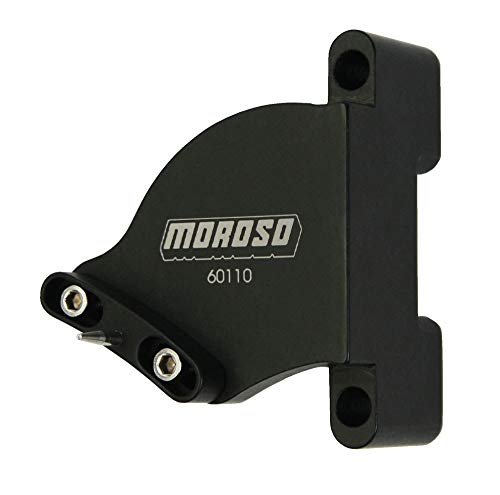
Billet Aluminum Construction
Moroso machines the 60110 from billet aluminum.
That provides a rigid, accurately shaped pointer assembly while keeping weight low.
For a precision reference component, rigidity matters.
The pointer needs to remain in the same position relative to the damper after:
- Engine vibration
- High-RPM operation
- Repeated heat cycles
- Timing adjustments
- Engine servicing
A flimsy pointer that can easily move defeats the purpose of carefully setting ignition timing.
Black Anodized Finish
The billet aluminum body receives a black anodized finish.
That gives the 60110 a clean appearance while helping protect the aluminum surface.
The black body also creates useful visual contrast around the timing pointer and harmonic balancer, particularly in an engine compartment filled with polished or natural-aluminum components.
It’s functional without looking like something removed from a 1978 lawn tractor.
Stainless Steel Mounting Hardware Included
Moroso includes stainless steel mounting hardware with the 60110.
This is one specification where the supplied product information is correct.
Stainless hardware provides corrosion resistance and gives the pointer a finished appearance once installed.
Always verify that the pointer is securely mounted before checking ignition timing.
Even a small amount of movement changes the timing reference.
Up to 4 Degrees of Adjustment
One of the most useful features of the Moroso 60110 is its adjustability.
Moroso allows up to 4 degrees of pointer adjustment.
That gives the engine builder enough movement to accurately align the pointer with the harmonic damper after determining true top dead center.
This is particularly valuable on engines assembled from aftermarket components.
A rebuilt SBC might use:
- Aftermarket harmonic damper
- Aftermarket timing cover
- Different crankshaft
- Replacement timing set
- Performance camshaft
- Non-original accessory drive
Assuming every timing mark still aligns perfectly because the engine is technically a Small Block Chevy isn’t the best way to tune an engine.
Verify it.
Establish True Top Dead Center First
Before relying on any timing pointer, establish true top dead center on cylinder No. 1.
Top dead center, or TDC, occurs when the piston reaches the top of its travel.
For ignition timing purposes, you’re interested in TDC on the compression stroke for cylinder No. 1.
A common engine-building procedure uses a piston stop to accurately determine true TDC.
The general principle is to stop the piston a known distance before TDC from both directions of crankshaft rotation and identify the midpoint between those readings.
That midpoint represents true TDC.
Once true TDC has been established, the Moroso pointer can be adjusted so it aligns precisely with the damper’s zero-degree mark.
Don’t Guess at TDC
Finding approximate TDC by watching a screwdriver move through the spark-plug hole might get you somewhere in the neighborhood.
That’s not the same thing as accurately establishing a timing reference.
Near the top of the bore, piston movement becomes very small relative to crankshaft rotation.
The crankshaft can move several degrees while piston height changes very little.
That’s why a piston stop or another accurate TDC procedure is preferred when calibrating the timing pointer.
You aren’t trying to find “pretty close to the top.”
You’re establishing the reference from which every ignition timing measurement will be made.
How to Set Base Ignition Timing
Once the pointer is calibrated to true TDC, you can use a timing light to set ignition timing according to the engine combination.
The general process on a distributor-equipped Small Block Chevy is:
- Bring the engine to normal operating temperature.
- Connect the timing light to cylinder No. 1.
- Follow the distributor/ignition manufacturer’s procedure for disabling or accounting for vacuum and electronic advance.
- Aim the timing light at the harmonic damper.
- Read the timing mark against the Moroso pointer.
- Loosen the distributor hold-down enough to rotate the distributor.
- Adjust timing to the desired specification.
- Tighten the distributor.
- Recheck timing.
- Verify total advance where appropriate.
The correct timing value depends on the engine.
There is no single magic number for every Small Block Chevy ever built.
Initial Timing vs Total Timing
When tuning a traditional distributor-equipped SBC, it’s important to understand the difference between initial timing and total timing.
Initial timing is the ignition advance present at or near idle before centrifugal advance is added.
Total timing generally refers to initial timing plus the distributor’s mechanical advance at higher engine speed.
Vacuum advance is normally treated separately because it responds to engine load and manifold or ported vacuum depending on the system.
A performance engine can idle perfectly with one initial timing value and still have dangerously excessive total advance.
That’s why checking only idle timing tells you only part of the story.
Why Accurate Ignition Timing Matters
Ignition timing determines when the spark plug fires relative to piston position.
The combustion event needs to begin before the piston reaches top dead center because the flame front requires time to travel through the combustion chamber.
If ignition occurs too late, cylinder pressure peaks too late.
The result can include:
- Reduced torque
- Sluggish throttle response
- Excess exhaust heat
- Poor efficiency
Advance the timing excessively and peak cylinder pressure can occur too early.
That can contribute to:
- Detonation
- Pinging
- Starter kickback
- Excessive cylinder pressure
- Engine damage
The timing pointer is therefore more than engine-bay jewelry.
It provides the physical reference needed to know what the ignition system is actually doing.
Check the Harmonic Damper Before Trusting the Marks
Before setting timing, inspect the harmonic damper.
Many traditional Small Block Chevy dampers use an outer inertia ring bonded to the hub with elastomer.
As the damper ages, that material can deteriorate.
If the outer ring slips relative to the hub, the timing mark moves.
At that point, even a perfectly calibrated pointer can appear to show incorrect ignition timing.
Warning signs include:
- Cracked or deteriorated elastomer
- Visible ring movement
- Wobbling
- Timing marks that don’t correspond with true TDC
- Unexplained timing readings
If the damper has slipped, replace it.
Don’t compensate by moving the pointer until the numbers look comforting.
Verify Timing After Distributor Work
Any time the distributor has been removed or significantly adjusted, recheck ignition timing.
This includes work such as:
- Intake manifold replacement
- Distributor replacement
- Camshaft installation
- Timing-chain replacement
- Engine rebuild
- Ignition-system upgrade
Even if the distributor appears to return to its previous position, verify timing with a light.
Paint marks are useful.
Actual measurements are better.
Useful for Performance SBC Builds
The Moroso 60110 is especially appropriate for Small Block Chevy engines where ignition timing is routinely checked or adjusted.
Typical applications include:
- 283 SBC
- 302 SBC
- 305 SBC
- 307 SBC
- 327 SBC
- 350 SBC
- 383 stroker
- 400 SBC
- Street/strip engines
- Drag cars
- Circle-track combinations
- Pro Street builds
- Restomods
Actual compatibility still depends on the 6.750-inch damper and appropriate timing-cover mounting arrangement.
Engine displacement alone does not guarantee fitment.
Excellent for 350 and 383 Small Block Chevy Builds
The 350 and 383 are particularly common performance applications.
A 383 stroker may combine an aftermarket crankshaft, camshaft, cylinder heads, intake manifold, distributor and harmonic damper.
Once that many components have changed, relying blindly on a factory timing tab makes less sense.
An adjustable pointer allows the engine builder to establish true TDC and create a reliable timing reference for the finished combination.
That’s especially useful during dyno tuning or track testing where small timing changes may be evaluated against actual engine performance.
Timing Lights Need a Reliable Reference
A timing light doesn’t know whether the harmonic balancer or pointer is correct.
It simply flashes when cylinder No. 1 receives its ignition event.
You interpret that flash according to the timing marks.
If the pointer is five degrees off, the timing light will faithfully help you set the engine five degrees wrong.
That’s why establishing true TDC is such an important first step on a freshly built engine.
Precision measuring equipment doesn’t compensate for an inaccurate reference point.
Replaceable Pointer Tip
Moroso supports the 60110 with its 60250 Replacement Timing Pointer Tip Assembly.
The 60250 is specifically listed as compatible with the 60110 along with several other Moroso SBC and BBC billet timing pointers.
That means damage to the pointer tip doesn’t necessarily require replacement of the entire billet assembly.
For a race car or frequently serviced engine, replaceable small components are always preferable to replacing the whole assembly.
Traditional SBC vs LS1 Timing Systems
The Moroso 60110 is for the traditional Gen I Small Block Chevy architecture.
It should not be confused with the later GM LS engine family.
The LS1 represented a major redesign of Chevrolet’s small-block architecture. As explained in our LS1 Specs guide, the LS1 uses a 24X crank reluctor and coil-near-plug ignition system rather than the conventional distributor arrangement found on traditional SBC engines.
That means the Moroso 60110 isn’t an LS1 timing pointer.
But understanding the difference between the two engine families is valuable when shopping for Chevy performance parts, especially because “small block Chevy” is now used casually to describe several very different generations of GM V8.
Why the LS1 Changed How GM Measures Engine Position
A traditional SBC distributor ignition can be mechanically checked and adjusted using the harmonic damper, timing pointer, distributor and timing light.
The LS1 approaches engine position differently.
The Gen III LS architecture uses crankshaft and camshaft position sensors, with the PCM controlling eight individual ignition coils.
Our Ultimate GM LS Engine Guide explains how the LS1 departed from the original Small Block Chevy while retaining the compact pushrod V8 philosophy that made the SBC so successful.
That distinction is useful when building an older Chevy.
A Gen I SBC timing pointer and an LS crankshaft-position system are solving related problems—determining crankshaft position—but in completely different ways.
LS1 Uses a 24X Reluctor
The original LS1 uses a 24X crankshaft reluctor wheel.
That provides the PCM with much more detailed crankshaft-position information than a traditional harmonic-balancer timing mark.
Our LS1 Specs: Bore, Stroke, Compression, Horsepower, and Everything You Need to Know covers the Gen III engine’s 24X system along with its 3.898-inch bore, 3.622-inch stroke and coil-near-plug ignition architecture.
For builders comparing traditional SBC and LS platforms, this is one of the biggest ignition-system differences.
The SBC asks you to look at a mark with a timing light.
The LS1 gives the PCM a crank sensor and lets the computer obsess over it thousands of times per minute.
Progress.
LS1 Builds Still Depend on Accurate Mechanical Measurements
Electronic engine management doesn’t eliminate the importance of mechanical accuracy.
Our How Far Can You Bore an LS1 Block? guide is a good example.
The factory LS1 starts with a 3.898-inch bore, and roughly .030 inch is a practical conventional overbore limit, with sleeve thickness and core shift needing to be checked before machining.
Whether you’re establishing TDC on a Gen I SBC or measuring cylinder-wall thickness on an LS1, the principle is the same:
Measure the engine that’s actually in front of you.
Catalog assumptions get expensive surprisingly quickly.
Building an LS Instead?
If the project has moved beyond the traditional SBC entirely, start with our Chevy LS Engine Build FAQ before buying Gen I small-block ignition components.
For swap projects, How To Plan Your LS1 Swap covers the major components needed to put a Gen III engine into another chassis.
And if you’re putting one somewhere GM definitely didn’t intend, our How to Swap an LS1 Into a 240SX remains a useful example of how dramatically the LS platform changed the engine-swap world.
Those LS resources complement this product page without creating fitment confusion:
Moroso 60110 = traditional Small Block Chevy with 6.750-inch damper.
LS1 = Gen III architecture with electronic crankshaft-position sensing.
They are related branches of Chevrolet performance history, not interchangeable timing systems.
Moroso 60110 Specifications
Part Number: 60110
Product: Adjustable Timing Pointer
Engine Family: Small Block Chevrolet
Damper Diameter: 6.750 inches
Material: Billet aluminum
Finish: Black anodized
Adjustment Range: Up to 4 degrees
Design: Close-fitting pointer hugs harmonic damper for easier alignment
Mounting Hardware: Stainless steel hardware included
Replacement Pointer Tip: Moroso 60250
Fitment: Application-specific
Country of Origin: United States
Package Length: 7.25 inches
Package Width: 5.5 inches
Package Height: 1.5 inches
Package Weight: Approximately 0.2 lb
Application-Specific Rather Than Vehicle-Specific
The supplied marketplace information calls the Moroso 60110 vehicle specific.
That’s not the most useful fitment classification.
Compatibility is primarily determined by:
- Traditional Small Block Chevy architecture
- 6.750-inch harmonic damper
- Compatible timing-cover mounting configuration
- Correct pointer location
A better ecommerce classification is:
Fitment Type: Application-specific
Engine: Gen I Small Block Chevrolet
Damper: 6.750-inch diameter
This is particularly important for classic cars because the engine and harmonic balancer currently installed may be completely different from the original equipment.
Who Should Buy the Moroso 60110?
The Moroso 60110 is a strong choice for builders using a traditional Small Block Chevy with a compatible 6.750-inch harmonic damper who want a precise, adjustable timing reference.
It’s particularly useful for:
- Rebuilt SBC engines
- 350 performance builds
- 383 strokers
- Street/strip cars
- Drag cars
- Circle-track engines
- Dyno-tuned combinations
- Pro Street cars
- Restomods
- Engines with aftermarket harmonic dampers
Before ordering, physically verify the harmonic-damper diameter.
If the engine uses a 7-, 7.25- or 8-inch damper, Moroso offers a different pointer for the application.
Final Verdict
The Moroso 60110 6.750-Inch Small Block Chevy Timing Pointer improves one of the most basic but important measurements on a traditional Chevy V8: ignition timing.
Its billet-aluminum construction, black anodized finish and stainless mounting hardware make it durable, but the real performance features are its close-fitting relationship with the harmonic damper and up to 4 degrees of adjustment.
That adjustability allows the pointer to be calibrated against true TDC rather than simply assuming the timing marks are correct.
For a rebuilt or modified SBC, that’s exactly how it should be done.
Find true TDC.
Set the pointer.
Check initial timing.
Check total timing.
Then make tuning changes based on numbers that actually mean something.
Because “I turned the distributor until it sounded good” has produced enough used pistons already.



There are no reviews yet.