
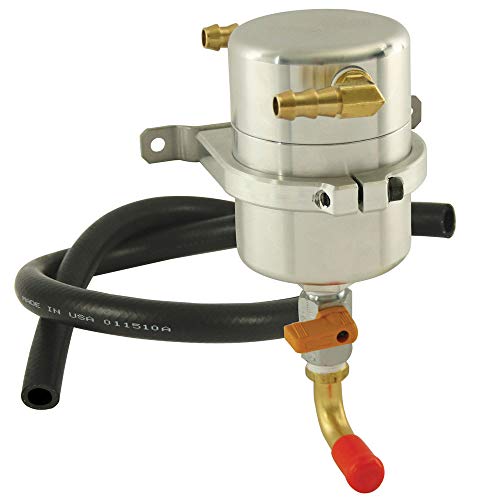
Billet Aluminum Construction
Moroso builds the 85474 around a billet aluminum separator body.
The large-body design provides greater collection capacity than Moroso’s smaller separator configuration.
Moroso states that its large-body separator provides approximately 43 percent more capacity than the small-body version.
That makes the 85474 particularly useful when the vehicle produces enough oil mist that a small catch can would require frequent servicing.
Internal Separation Media
The 85474 isn’t simply an empty aluminum cylinder.
Moroso uses internal media to encourage oil suspended in the PCV airflow to separate from the vapor stream.
The goal is straightforward:
OIL-LADEN VAPOR ENTERS
↓
INTERNAL SEPARATION
↓
OIL COLLECTS IN THE BODY
↓
VAPOR CONTINUES THROUGH THE PCV CIRCUIT
This internal separation is what distinguishes a functional air/oil separator from a basic hollow catch container.
Large-Body Design
Moroso classifies the 85474 as a large-body separator.
Moroso lists the body dimensions at:
Height: 8 inches
Diameter with clamp installed: 3.475 inches
Those dimensions are important when selecting a mounting location.
An 8-inch-tall separator needs substantially more space than many compact catch cans.
Check hood, firewall and accessory clearance before drilling mounting holes.
3/8-Inch NPT Connections
Moroso supplies the 85474 with 3/8-inch NPT 90-degree inlet and outlet fittings.
The angled fittings make hose routing easier in tight engine compartments.
Because this is a universal kit, hose routing isn’t predetermined by a vehicle-specific bracket or molded hose.
The installer chooses the mounting position and then routes the PCV circuit accordingly.
36 Inches of Hose Included
Moroso includes 36 inches of 3/8-inch-diameter rubber hose with the kit.
That gives the installer approximately three feet of hose for integrating the separator into an appropriate PCV circuit.
Keep the hose routing as direct as practical.
Avoid:
- Kinks
- Collapsed hose
- Excessively sharp bends
- Contact with headers
- Contact with moving belts
- Poorly supported long runs
A catch can can’t separate anything useful if the hose feeding it has folded itself in half.
Billet Aluminum Mounting Clamp
Moroso includes a billet aluminum mounting clamp designed to secure the separator body.
The clamp allows the separator to be mounted securely while remaining serviceable.
That’s important because a catch can isn’t a fit-and-forget component.
It needs periodic inspection and draining.
Stainless Steel Mounting Bracket
The universal kit also includes a stainless steel mounting bracket.
Together, the bracket and billet clamp provide the basic hardware necessary to mount the separator in an appropriate engine-compartment location.
Because the kit is universal, some fabrication or drilling may be required depending on the vehicle.
Choose a solid mounting point.
The separator should not be allowed to swing from its PCV hoses.
Bottom Drain
One of the advantages of Moroso’s large-body separator is its bottom drain.
Moroso equips the 85474 with a drain arrangement and elbow designed to make removing collected oil easier.
Instead of removing the entire separator body, the collected fluid can be drained from the bottom.
Moroso lists the 97200 ball valve as the replacement drain component for this separator.
Check the Catch Can Regularly
There is no universal service interval for an air/oil separator.
How quickly it fills depends on:
- Engine condition
- Ring seal
- Engine RPM
- PCV flow
- Ambient temperature
- Driving style
- Boost pressure
- Track use
Inspect the separator frequently after installation until you understand how much fluid your particular engine produces.
That gives you a realistic service interval.
What You Find Inside Matters
Don’t just dump the separator and ignore what comes out.
Collected material can provide clues about engine operation.
Oil
Some oil collection is the entire reason the separator exists.
A sudden major increase can indicate additional blow-by or poor internal baffling.
Water
Condensation can accumulate, particularly in colder weather or on engines that frequently make short trips.
Fuel Smell
Strong fuel contamination can indicate fuel dilution or excessive blow-by.
A catch can isn’t just a trash container.
It can become a crude but useful window into what is happening inside the crankcase.
Helps Keep Oil Out of the Intake
Moroso specifically designed its air/oil separator line to reduce oil mist returning through the PCV system into the intake tract.
Reducing that oil contamination can help keep components such as the following cleaner:
- Throttle body
- Intake piping
- Intake manifold
- Supercharger inlet
- Turbocharger inlet
- Intercooler plumbing
The exact PCV routing depends on the engine.
Particularly Useful on Forced-Induction Engines
Turbocharged and supercharged engines can place additional demands on crankcase ventilation.
Higher cylinder pressures can increase blow-by, especially as power rises.
Oil entering charge plumbing can also coat intercooler surfaces.
That doesn’t mean installing a catch can automatically increases horsepower.
Its primary function is oil separation and crankcase-vapor management.
Any performance benefit depends on the engine and the amount of contamination the separator prevents.
Catch Can vs Breather Tank
This distinction is especially important because Moroso makes both.
Moroso 85474 Air/Oil Separator
A closed inline separator intended to intercept oil mist in an appropriate PCV circuit.
The gases continue through the system after passing through the separator.
Moroso 85469 Breather Tank
A remote racing breather tank with dual -12AN connections and a filtered atmospheric vent.
The two products address crankcase vapor in fundamentally different ways.
Don’t interchange their descriptions.
Closed PCV Separator
The 85474 has an inlet and outlet because crankcase gases pass through it.
Conceptually:
ENGINE → 85474 → INTAKE
The separator removes suspended oil while allowing the PCV airflow to continue.
That’s different from an atmospheric breather where gases simply exit through a filter.
Universal Fitment
Moroso officially classifies the 85474 as a universal kit.
That means it doesn’t bolt into one predetermined year/make/model application.
The installer must determine:
- Appropriate PCV hose
- Inlet location
- Outlet location
- Mounting position
- Hose routing
- Clearance
For ecommerce fitment, use:
Fitment Type: Universal
Do not populate vehicle-specific compatibility merely because the separator can physically be installed in many cars.
Verify PCV Flow Direction
Before cutting hoses, identify the actual PCV circuit.
You need to know which line carries crankcase vapor toward the intake.
Installing the separator in the wrong hose may make it ineffective or interfere with normal crankcase ventilation.
PCV systems vary significantly between engines.
Some use:
- PCV valves
- Calibrated orifices
- Check valves
- Multiple ventilation paths
- Separate fresh-air and dirty-air sides
- Integrated valve-cover separators
Understand the factory system before modifying it.
Some Engines Need More Than One Separator
Moroso notes that some crankcase ventilation systems may require two air/oil separator bodies to properly capture and ventilate the system.
That’s because some engines use more than one meaningful crankcase vapor path.
Don’t assume that installing one separator into whichever hose is easiest automatically addresses the complete PCV system.
Don’t Restrict the PCV System
Crankcase ventilation needs adequate airflow.
A poorly designed installation can increase crankcase pressure rather than control it.
Use the supplied hose and fittings appropriately and avoid routing that creates unnecessary restrictions.
Signs of excessive crankcase pressure can include:
- Oil leaks
- Dipstick movement
- Oil around seals
- Increased oil consumption
- Excessive breather activity
If those symptoms appear after modifying the PCV system, inspect the installation.
A Catch Can Doesn’t Repair Blow-By
An air/oil separator removes oil from crankcase vapor.
It does not repair worn piston rings.
If an engine suddenly begins filling the separator unusually quickly, investigate the cause.
Useful diagnostic tests include:
- Compression test
- Cylinder leak-down test
- Crankcase pressure measurement
- PCV inspection
- Valve-cover baffle inspection
A catch can can contain the symptom.
It cannot rebuild the engine while you’re sleeping.
Moroso 85474 vs 85496
Moroso offers both large- and small-body universal separators.
Moroso 85474
Body: Large
Height: 8 inches
Diameter with clamp: 3.475 inches
Drain: Bottom drain
Best where additional capacity is desirable and mounting space is available.
Moroso 85496
Body: Small
More compact for tighter engine compartments.
Moroso states that the large-body design offers approximately 43 percent greater capacity than its small-body version.
Moroso 85474 vs 85531
Moroso also lists the 85531 as a universal large-body air/oil separator with a black finish.
That makes the basic choice:
85474 — Universal large-body separator
85531 — Universal large-body separator, black finish
The 85474 is the natural choice for a polished/raw aluminum engine-bay appearance.
Not Legal for Pollution-Controlled Vehicles
Moroso’s current product page explicitly states that the 85474 is:
Not legal for sale or use on pollution-controlled vehicles.
That disclaimer should remain visible on the ecommerce product page.
Do not market the 85474 as an emissions-legal upgrade for every street-driven vehicle.
Package Dimensions
The supplied shipping information lists:
Package Length: 13.75 inches
Package Height: 4.5 inches
Package Width: 7.25 inches
Package Weight: 3 pounds
These are package dimensions, not installed separator dimensions.
For installation planning, use Moroso’s actual separator dimensions:
8 inches tall
3.475 inches diameter with mounting clamp
Moroso 85474 Specifications
Part Number: 85474
Product: Universal Large-Body Air/Oil Separator Catch Can
Application: Inline crankcase/PCV oil separation
Fitment: Universal
Body: Billet aluminum
Internal Separation: Internal mesh media
Body Height: 8 inches
Diameter: 3.475 inches with clamp installed
Inlet/Outlet: 3/8-inch NPT 90-degree fittings
Included Hose: 36 inches of 3/8-inch rubber hose
Mounting Clamp: Billet aluminum
Mounting Bracket: Stainless steel
Drain: Bottom drain with elbow
Replacement Drain Valve: Moroso 97200
Package Dimensions: 13.75 × 7.25 × 4.5 inches
Package Weight: 3 pounds
Country of Origin: United States
Emissions Status: Not legal for sale or use on pollution-controlled vehicles
Who Should Buy the Moroso 85474?
The Moroso 85474 makes sense for performance applications requiring a universal, large-capacity inline air/oil separator.
Potential applications include appropriately configured:
- Performance engines
- Turbocharged engines
- Supercharged engines
- Track cars
- Race cars
- Engine swaps
- Custom PCV systems
- Pro Street builds
It is particularly useful when a vehicle-specific Moroso separator kit isn’t available and the builder wants to create a custom installation.
Who Should Choose Something Else?
The 85474 isn’t the right product if you need:
- An open atmospheric breather tank
- Dual -12AN racing ventilation
- Vacuum-pump discharge tank
- Dry-sump breather tank
- Vehicle-specific bolt-on hoses and brackets
- A small separator for extremely tight packaging
For a large, atmosphere-vented dual -12AN racing tank, the Moroso 85469 is the more appropriate type of component.
For a racing crankcase vacuum system, pair the appropriate breather arrangement with components such as the Moroso 22641 4-Vane Vacuum Pump rather than treating the 85474 as a vacuum-pump discharge tank.
Final Verdict
The Moroso 85474 Universal Large-Body Air/Oil Separator gives custom performance builds a substantial inline catch-can solution without requiring a vehicle-specific kit.
Its billet aluminum body, internal separation media, 3/8-inch NPT 90-degree fittings, included 36-inch hose, billet clamp, stainless mounting bracket and bottom drain provide the major components needed to build a clean custom installation.
More importantly, it occupies a very different role from Moroso’s open breather tanks.
The 85474 belongs inline in a properly designed PCV circuit.
Install it in the correct flow path.
Mount it securely.
Check it regularly.
Drain it before it’s full.
And if it’s suddenly collecting enough oil to qualify for its own change interval, investigate the engine instead of congratulating the catch can on its productivity.









There are no reviews yet.