
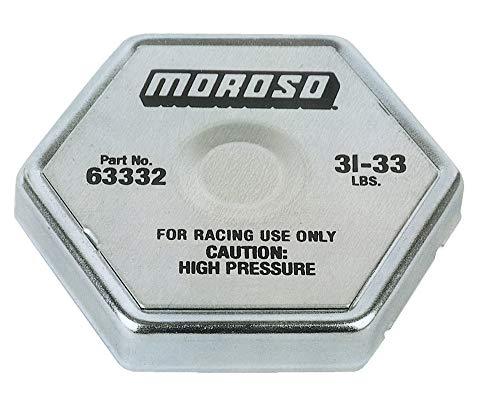
Why Radiator-Cap Pressure Matters
The radiator cap does much more than cover the coolant fill opening.
In a conventional pressurized cooling system, the cap controls how much pressure the system can build before the pressure valve opens.
Increasing cooling-system pressure raises the coolant’s boiling margin.
That can be valuable in a properly designed race cooling system operating under sustained high engine load.
It does not mean that installing a higher-pressure cap automatically makes the engine run cooler.
For a detailed explanation of how pressure interacts with the radiator, thermostat, water pump, fans, hoses and coolant, see the Complete Car Cooling System Guide.
Higher Pressure Does Not Lower Coolant Temperature
This is the most important distinction on this product page.
A higher-pressure radiator cap can help coolant remain liquid at a higher temperature before boiling occurs.
It does not directly:
- Increase radiator airflow
- Increase radiator surface area
- Improve water-pump circulation
- Repair a stuck thermostat
- Turn on failed cooling fans
- Remove trapped air
- Fix a clogged radiator
- Repair a coolant leak
- Correct a blown head gasket
If an engine is overheating, determine why before installing a 31–33 psi cap.
The radiator cap isn’t a thermostat for pressure.
More is not automatically better.
31–33 PSI Is a High-Pressure Cap
A typical production cooling system may use a substantially lower cap pressure than the Moroso 63332.
That means the 63332 should never be installed simply because it physically fits the filler neck.
Raising the pressure setting increases the load placed on cooling-system components.
That includes:
- Radiator tanks
- Radiator seams
- Expansion tanks
- Heater cores
- Heater hoses
- Radiator hoses
- Hose clamps
- Water-pump seals
- Thermostat housings
- Coolant fittings
- Gaskets
- Welded aluminum tanks
Before using the 63332, verify that the entire cooling system is designed and rated for a 31–33 psi operating cap.
Don’t Use a 32 PSI Cap to Hide a Cooling Problem
If a vehicle boils coolant with its correct lower-pressure cap, installing a 31–33 psi cap may increase the boiling margin.
But that doesn’t identify the reason the coolant became excessively hot.
The actual problem could still be:
- Restricted radiator
- Incorrect thermostat
- Failed water pump
- Cooling-fan failure
- Insufficient airflow
- Trapped air
- Low coolant
- Lean combustion
- Excessive engine load
- Head-gasket leakage
- Incorrect ignition calibration
- Undersized cooling system
Use the My Pro Street Complete Cooling System Guide to work through the system rather than using cap pressure as a substitute for diagnosis.
Pressure-Test Before Increasing Cap Pressure
Before installing a high-pressure racing cap, verify the cooling system is healthy.
A cold cooling-system pressure test can expose:
- Radiator leaks
- Cracked tanks
- Hose leaks
- Loose clamps
- Water-pump seepage
- Thermostat-housing leaks
- Expansion-tank leaks
- Heater-core leakage
- Filler-neck problems
- Existing pressure-cap problems
The How to Pressure Test a Car Cooling System and Radiator Cap guide explains how to perform this test safely on a cold engine.
Most importantly:
Never exceed the system’s specified test pressure.
Installing a 31–33 psi cap does not mean you should immediately pump an unknown street cooling system to 33 psi to see what happens.
That would be less of a diagnostic test and more of a search for the weakest component.
Steel Spring Construction
Moroso specifies a:
Steel spring
for the 63332.
According to Moroso, the spring is designed to maintain an accurate pressure setting over time.
That’s important because spring pressure determines when the cap’s pressure valve opens.
Consistent pressure control is particularly valuable in racing applications where cooling-system conditions can repeatedly approach the cap’s operating threshold.
Six-Sided Cap Design
Moroso gives the 63332 a:
Six-sided cap
The hexagonal exterior provides additional grip compared with a completely round cap.
That’s particularly useful in racing applications where caps may need to be inspected or serviced frequently.
It also makes the cap easier to handle with gloved hands.
The hex design does not mean you should attack it with an impact wrench.
It’s still a radiator cap.
How a Pressure Cap Works
As coolant temperature increases, the liquid expands and cooling-system pressure rises.
The radiator cap’s pressure valve remains closed until system pressure reaches its calibrated range.
Once the pressure exceeds the cap’s threshold, the valve can allow coolant or pressure to move into the system’s expansion or recovery circuit, depending on cooling-system design.
As the engine cools, many conventional systems use a vacuum/recovery valve to allow coolant to return.
The cap therefore plays an important role in:
Pressure control
and
Coolant recovery
depending on system design.
Why Pressure Raises the Boiling Margin
Water boils at approximately 212°F at normal atmospheric pressure at sea level.
Increasing pressure raises its boiling point.
Automotive coolant mixtures already have different boiling characteristics from plain water, and system pressure raises the boiling margin further.
That is one reason racing cooling systems may use higher cap pressures.
The advantage isn’t that the engine suddenly generates less heat.
The advantage is that the coolant can remain liquid under more demanding thermal conditions.
Liquid coolant transfers heat much more effectively than localized steam pockets.
Avoid Localized Coolant Boiling
When coolant boils inside hot areas of an engine, vapor pockets can reduce heat transfer.
Potential hot spots include areas around:
- Combustion chambers
- Exhaust valve seats
- Cylinder heads
- Turbocharger coolant passages
Maintaining appropriate cooling-system pressure helps suppress localized boiling.
But again, the pressure rating must remain within the capability of the entire system.
A 33 psi cap on a radiator designed around a much lower pressure isn’t a cooling upgrade.
It’s a stress test with a steering wheel attached.
Ideal for Purpose-Built Racing Cooling Systems
The Moroso 63332 makes the most sense on a cooling system specifically engineered for high-pressure operation.
Potential applications include appropriately designed:
- Circle-track cars
- Road-race cars
- Time-attack cars
- Drag-racing vehicles
- Purpose-built competition vehicles
- Custom racing cooling systems
The important phrase is:
appropriately designed.
Choose cap pressure based on the cooling-system design and component ratings—not because the largest number in the catalog feels faster.
Street Cars Require Extra Caution
Do not assume the 63332 is appropriate for a street vehicle simply because it fits the radiator neck.
Many production cooling systems use plastic:
- Radiator tanks
- Expansion tanks
- Thermostat housings
- Hose fittings
- Heater-core connections
Increasing system pressure can expose already weakened components.
An older heater core that survives happily at its intended pressure may have a considerably less positive opinion of 32 psi.
Use the pressure rating specified for the vehicle unless the cooling system has been deliberately engineered and verified for a different pressure.
Never Remove the Cap When Hot
A 31–33 psi cooling system deserves particular respect.
Never remove the Moroso 63332 while the cooling system is hot or pressurized.
Hot coolant can remain above its atmospheric boiling point while held under pressure.
Removing the cap suddenly reduces pressure and can cause coolant to rapidly boil and discharge as hot liquid and steam.
Wait until the engine is completely cold before servicing the cap.
Your Cooling-System Pressure Test Guide covers the safe procedure for inspecting and testing a cap on a cold system.
Test the Cap, Don’t Guess
A radiator-cap tester can verify whether a cap:
- Holds appropriate pressure
- Opens near its intended range
- Leaks prematurely
- Has a damaged seal
- Has a faulty recovery valve
The cap should not open substantially below its specification.
It also should not remain sealed dangerously above its intended range.
Pressure control works in both directions.
A cap that won’t hold pressure is a problem.
A cap that won’t release pressure can also be a problem.
Inspect the Filler Neck
Even a perfectly calibrated Moroso cap can’t compensate for a damaged filler neck.
Inspect the neck for:
- Corrosion
- Bent locking surfaces
- Damaged sealing surfaces
- Cracks
- Incorrect neck depth
- Debris
- Old gasket material
Verify that the cap locks correctly and that its seals contact the intended surfaces.
Check the Cooling System After Installation
After installing the correct cap on a compatible system, complete a controlled heat cycle and inspect for:
- Coolant leakage
- Hose swelling
- Radiator seam leakage
- Expansion-tank leakage
- Water-pump seepage
- Coolant odor
- Stable operating temperature
After the engine cools completely, verify coolant level again.
Any new leak after increasing system pressure should be investigated immediately.
Bleed the Cooling System Correctly
A high-pressure cap does nothing useful if the cooling system contains trapped air.
Air pockets can interfere with:
- Coolant circulation
- Temperature readings
- Heater-core flow
- Thermostat operation
- Water-pump performance
- Heat transfer
Use the vehicle’s specified bleeding procedure.
The How to Bleed a Car Cooling System and Remove Air Pockets guide explains radiator-cap systems, pressurized expansion tanks, bleed screws, spill-free funnels, vacuum filling and custom cooling-system layouts.
Higher Pressure Won’t Fix Trapped Air
This deserves emphasis because the symptoms can overlap.
A cooling system with trapped air may:
- Overheat intermittently
- Push coolant out
- Lose heater output
- Show unstable gauge readings
- Produce gurgling sounds
- Develop localized hot spots
Installing a 32 psi cap doesn’t remove the air.
Bleed the system correctly and determine why air entered in the first place.
Don’t Use Stop-Leak as a Companion Upgrade
If a high-pressure cap exposes a leak, repair the failed component.
Do not automatically add stop-leak and continue operating the engine.
Your Can Radiator Stop-Leak Cause Damage? article explains how sealing products can potentially restrict small cooling-system passages, heater cores and other components.
Pressure-test.
Find the leak.
Repair it correctly.
Flush Contaminated Coolant Before Racing
If the cooling system contains:
- Rust
- Scale
- Mixed incompatible coolant
- Oil contamination
- Stop-leak residue
- Unknown coolant
correct those problems before expecting a racing radiator cap to improve reliability.
The How to Flush a Car Cooling System Without Damaging It guide explains how to inspect, drain, flush and refill the system without turning a maintenance job into another cooling-system problem.
Moroso Offers Multiple Pressure Ratings
One of the strongest reasons to buy within Moroso’s radiator-cap family is that you can select pressure based on the actual cooling system rather than accepting one universal setting.
Moroso currently offers:
63307 — 6–8 lb
63309 — 8–10 lb
63313 — 12–16 lb
63316 — 14–18 lb
63320 — 19–21 lb
63324 — 23–25 lb
63328 — 27–29 lb
63332 — 31–33 lb
Moroso also offers still higher-pressure caps in its current range.
This product page should therefore target customers who specifically need the 31–33 psi range, rather than presenting the 63332 as the default Moroso cap.
63332 vs Moroso 63324
The Moroso 63324 is rated:
23–25 lb
The Moroso 63332 is rated:
31–33 lb
Both are racing radiator caps designed for compatible standard-size filler necks.
The difference is significant.
Moving from roughly 24 psi to roughly 32 psi increases the pressure the cooling system may experience before the cap opens.
If the system is designed for 24 psi, the 63332 isn’t automatically a better version.
Use the cap pressure the system was engineered to handle.
Compatible Moroso Cooling Components
Moroso specifically lists the 63332 as compatible with standard-size filler necks including these Moroso part numbers:
63420
63465
63466
63467
63485
63486
63650
63651
63656
63730
63740
63745
These make strong ecommerce cross-links when stocked by Pro Street Online.
Compatibility with the filler neck still does not override the pressure rating of the complete cooling system.
Universal Fitment — With an Important Qualification
The 63332 can reasonably be categorized as:
Universal / standard filler-neck specific
It is not selected primarily by vehicle year, make and model.
Compatibility requires:
- A compatible standard-size filler neck.
- A cooling system engineered to safely operate with a 31–33 psi cap.
Both conditions need to be satisfied.
Package Information
Your distributor data lists:
Package Height: 3.048 cm / approximately 1.20 inches
Package Length: 18.288 cm / approximately 7.20 inches
Package Width: 14.986 cm / approximately 5.90 inches
Package Weight: 0.2 lb
These are shipping/package dimensions and should not be confused with the physical dimensions of the radiator cap.
Country of Origin
Your supplied distributor data identifies:
Country of Origin: United States
That can be retained as distributor-supplied country-of-origin information.
Moroso 63332 Specifications
Part Number: 63332
Product: Racing Radiator Cap
Nominal Rating: 32 lb
Official Pressure Rating: 31–33 lb/psi
Filler Neck: Standard-size radiator filler neck
Spring: Steel
Cap Design: Six-sided
Fitment: Universal / filler-neck and pressure-rating specific
Quantity: One cap
Package Height: Approximately 1.20 inches
Package Length: Approximately 7.20 inches
Package Width: Approximately 5.90 inches
Package Weight: 0.2 lb
Country of Origin: United States, according to supplied distributor data
Who Should Buy the Moroso 63332?
The 63332 is appropriate for builders who specifically need:
- 31–33 psi radiator-cap pressure
- Standard-size radiator-neck compatibility
- High-pressure racing cooling system
- Road-race cooling system
- Circle-track cooling system
- Purpose-built performance cooling system
- Compatible Moroso expansion/fill tank
It is particularly useful when the complete cooling system has already been designed around this pressure range.
Who Should Not Buy It?
Don’t choose the 63332 merely because:
- Your engine runs hot
- Your existing cap releases coolant
- 32 psi sounds better than 16 psi
- It physically fits
- Your radiator is aluminum
- The car goes to the track occasionally
First confirm the required pressure rating.
If the correct system pressure is substantially lower, select the appropriate lower-pressure Moroso cap.
Final Verdict
The Moroso 63332 Racing Radiator Cap provides a 31–33 psi pressure rating for compatible high-pressure racing cooling systems using standard-size radiator filler necks.
Its steel spring is designed to maintain the specified pressure setting over time, while the six-sided cap provides an easier surface for installation and removal.
For a purpose-built cooling system designed around approximately 32 psi, it’s a straightforward racing component.
For an ordinary cooling system designed for 13, 16 or 20 psi?
It isn’t an upgrade.
It’s an entirely different pressure specification.
Choose the cap that matches the system rather than turning the radiator into an involuntary pressure-vessel experiment.



There are no reviews yet.