

Android 13 and AICE 13 Interface
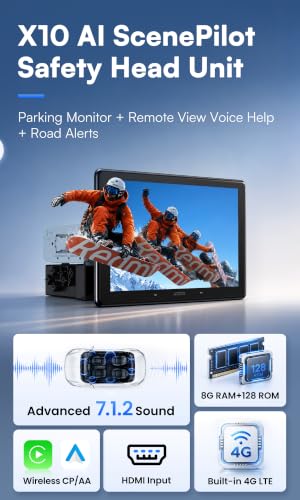
ATOTO’s current X10 specification lists Android 13 with the company’s customized AICE 13 interface.
Because the stereo runs Android independently, compatible applications can operate directly on the head unit.
That means you can use Android-based navigation, streaming, vehicle utilities and other compatible apps without relying entirely on a phone.
Google Play and ATOTO’s FindApps service provide access to downloadable applications for the system.
Wireless CarPlay and Android Auto are still available when you want the familiar smartphone interface.
That gives owners the best part of both architectures:
A standalone Android computer when you want flexibility.
CarPlay or Android Auto when you just want to get in and drive.
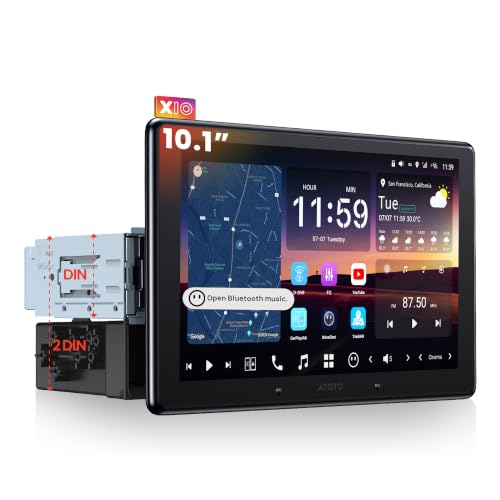
10.1-Inch Floating QLED Display
The X10 uses a 10.1-inch 1280×720 QLED floating display rated at approximately 550 nits brightness with an anti-glare/light-suppression treatment.
That extra screen area can make a major difference for:
- Navigation
- Split-screen applications
- Camera feeds
- Vehicle gauges
- CarPlay
- Android Auto
- OBD-II information
- Multimedia controls
A big display is especially useful once you start combining several of those functions at the same time.
The downside is obvious:
Ten inches is a lot of screen inside an older dashboard.
Measure before buying.
Adjustable Floating Screen
The floating design lets the display be repositioned instead of forcing it into one fixed location.
ATOTO’s current product material describes adjustment for screen height, position and viewing angle so the display can be arranged around the vehicle’s center stack.
That is especially important around:
- Air vents
- HVAC controls
- Hazard switches
- Factory buttons
- Shifters
- Sight lines
A floating stereo might technically fit a vehicle while still blocking something important.
Physical fitment and usable fitment are two different things.
Our Single DIN vs Double DIN guide explains the underlying radio sizes and why vehicle-specific measurements still matter.
Single DIN and Double DIN Installation Flexibility
The X10’s chassis is classified by ATOTO as Single DIN, but its adaptable floating architecture is marketed for compatible Single DIN and Double DIN dash installations.
That gives installers more flexibility than a fixed 10-inch Double DIN design.
Depending on the vehicle, you’ll still likely need some combination of:
- Dash kit
- Wiring harness
- Antenna adapter
- CAN-bus adapter
- Steering-wheel-control interface
- Factory amplifier adapter
- Factory camera interface
A giant screen does not magically exempt the car from wiring.
Unfortunately.
Built-In 4G LTE
The X10 includes an integrated cellular communication module rather than depending exclusively on a smartphone hotspot.
With compatible service, that allows the head unit itself to maintain internet access.
That can be useful for:
- Navigation
- Live traffic
- Streaming
- Online radio
- Vehicle tracking
- App downloads
- AI services
- Cloud-connected features
The stereo also supports dual-band 2.4GHz and 5GHz Wi-Fi.
Use the X10 as a Wi-Fi Hotspot
The cellular connection can also be shared with passenger devices through the X10’s hotspot functionality.
That effectively turns the head unit into an in-car connectivity hub.
For road trips, that can be useful for tablets and other passenger devices without requiring one person’s phone to handle all of the data sharing.
Wireless Apple CarPlay
The X10 supports wireless Apple CarPlay.
Compatible iPhones can provide access to:
- Navigation
- Calls
- Messages
- Music
- Podcasts
- Siri
- Supported CarPlay applications
For daily driving, some owners may spend most of their time in CarPlay even though the X10 itself runs Android.
That’s not wasted capability.
It’s simply nice knowing the stereo can do considerably more whenever you need it.
Wireless Android Auto
Wireless Android Auto is supported as well.
Compatible Android phones can automatically reconnect and present the familiar Android Auto interface without plugging in a USB cable on every drive.
Phone mirroring is also supported for compatible devices.
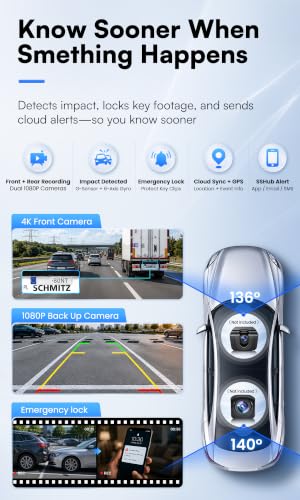
Dual 1080P Camera Recording
Camera integration is one of the X10’s standout features.
The X10 can connect two compatible 1080P cameras simultaneously, allowing combinations such as:
- Front + rear
- Front + cabin
- Rear + cabin
ATOTO’s current product listing confirms synchronized dual-camera recording along with emergency video locking, parking monitoring and GPS-linked playback.
That’s a meaningful distinction from head units that can merely display multiple cameras.
The X10 can actually treat the camera system as part of its recording platform.
Emergency Video Lock
When a significant event occurs, supported recording functions can protect relevant clips from normal loop overwriting.
That can be valuable after:
- Collisions
- Parking incidents
- Insurance disputes
- Road-rage incidents
- Hit-and-run events
A properly installed dash camera is one of those upgrades you hope never becomes important.
When it does, you generally wish you had installed it sooner.
GPS-Linked Video Playback
ATOTO also supports GPS-linked recording playback on the X10 platform.
That allows recorded footage to be associated with vehicle location information.
For reviewing an incident, location context can be much more useful than a video clip floating around without any reference to where the event occurred.
AI Vision Is an Upcoming Feature
ATOTO also advertises upcoming OmniGuard Pro / AI Vision capabilities for the X10 camera ecosystem.
Planned functions include road-condition recognition and rear-seat or baby-monitoring applications.
The important word here is upcoming.
These should not be treated as guaranteed currently active features unless ATOTO confirms they have been released for your exact firmware version.
Future software features are interesting.
They are not something we’d recommend basing the entire purchase decision on until they’re actually available.
Audiophile-Focused 7.1.2 Audio Architecture
Audio is where the X10 separates itself most dramatically from the lower ATOTO lines.
The system supports 10 assignable audio channels that can be configured for components including:
- Midrange speakers
- Tweeters
- Subwoofers
- Surround channels
That allows installers to create a custom 7.1.2-channel audio configuration.
This isn’t simply a radio with four speaker outputs and a subwoofer RCA.
It is closer to an integrated car-audio processor.
36-Band DSP Equalization
The X10’s DSP includes a 36-band equalizer, time alignment and a three-way crossover.
That gives a skilled installer much more control over system tuning.
Time alignment can help compensate for unequal speaker distances.
Crossovers determine which frequencies each driver handles.
The EQ can then address frequency-response problems caused by the cabin and speaker installation.
Done correctly, these tools can dramatically improve imaging and tonal balance.
Done incorrectly, they provide 36 different ways to make the stereo sound worse.
Tuning still matters.
24-Bit DAC
ATOTO also specifies a 24-bit HD DAC as part of the X10 audio architecture.
Combined with FLAC playback and the system’s digital audio architecture, that makes the X10 much more appealing to audio-focused enthusiasts than a basic Android receiver.
For a deeper look at speaker selection, amplifier matching and tuning, see our Car Audio System Guide.
Optical S/PDIF Output
The X10 includes optical S/PDIF digital audio output.
That’s especially useful in high-end aftermarket systems.
Instead of converting the signal to analog inside the head unit, digital audio can feed a compatible external DSP or amplifier.
That can preserve the digital signal path deeper into the system and give an external processor more control.
For serious car-audio installations, this can be more important than the built-in amplifier.
4-Volt RCA Preamp Outputs
Traditional external amplifiers are covered too.
ATOTO specifies 4V RCA preamp outputs on current X10 models.
A stronger preamp signal can allow amplifier gains to remain lower, helping maintain a cleaner signal when the system is installed properly.
This makes the X10 suitable for builds using:
- Multi-channel amplifiers
- Component systems
- Multiple subwoofers
- Active crossovers
- External DSP processors
Stronger Internal Amplifier
The X10 also receives a stronger onboard amplifier than ATOTO’s A5L and S8 platforms.
ATOTO rates it at:
Maximum: 4 × 49 watts
RMS: 4 × 29 watts.
That gives the stereo respectable direct speaker output before an external amplifier is added.
As always, the RMS number is the one worth paying attention to.
Peak power is mostly useful if you’re trying to impress the cardboard box.
Qualcomm Bluetooth With aptX HD
Bluetooth audio is another area where the X10 receives a flagship feature set.
ATOTO specifies Qualcomm Bluetooth with aptX HD support for higher-quality compatible wireless audio.
The platform also supports stable dual-phone operation.
For owners who stream high-quality audio directly over Bluetooth, aptX HD can be an important advantage over basic SBC-only receivers.
Device compatibility still matters, so both ends of the connection need to support the codec.
Two Bluetooth Systems
The X10 also includes a secondary Bluetooth system designed for tethering and compatible BLE accessories.
That turns the receiver into something closer to an in-car IoT hub.
Supported accessories can include functions involving:
- OBD-II data
- Ambient lighting
- Vehicle accessories
- Other compatible BLE hardware
This gives the X10 room to grow as additional accessories are added to the vehicle.
DriveChat AI
ATOTO’s DriveChat platform provides voice-driven AI interaction and stereo control.
ATOTO currently markets DriveChat around conversational assistance, route planning and system interaction.
Because AI services and underlying models can change through OTA updates, buyers should think of DriveChat as a software platform rather than a permanently fixed set of model versions.
That’s the safer way to evaluate it.
What matters most in the vehicle is that voice interaction can reduce how often the driver needs to manually dig through applications and menus.
TrackHU Vehicle Tracking
The X10 also supports ATOTO’s TrackHU GPS tracking system.
Connected vehicle-location functions can provide additional insight into the position and history of your own car.
When combined with LTE connectivity, this can make the stereo part of a much broader connected-vehicle system.
ADS Vehicle Integration Support
Another important flagship feature is ADS protocol compatibility on supported X10 configurations.
That can help integrate certain factory systems such as:
- Steering-wheel controls
- Factory amplifiers
- Vehicle information
- Gauges
- Climate-related data
Compatibility depends heavily on the vehicle and installation hardware.
This is not universal plug-and-play support.
Check the specific vehicle and interface before purchasing.
HDMI Connectivity
The X10 platform also supports HDMI-based display functionality on compatible configurations.
That creates additional options for external video sources and displays.
This is particularly useful in custom installations where the head unit is acting as the central media device rather than simply replacing a radio.
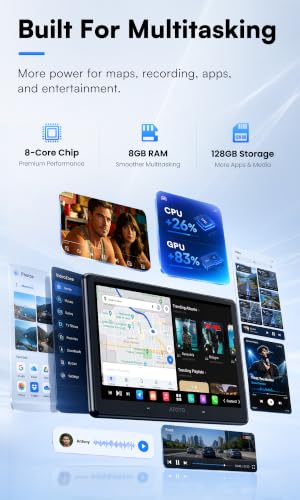
Split-Screen Multitasking
With 8GB of RAM and a larger display, split-screen operation becomes much more practical.
For example, you might display:
- Navigation + music
- Navigation + vehicle data
- Camera + map
- Media + another supported app
This is where a 10.1-inch screen actually earns its space.
Running two applications on a seven-inch display can quickly become an exercise in microscopic interface design.
Dual Microphones and Noise Reduction
The X10 includes dual integrated microphones and noise-reduction processing, with support for compatible external microphones.
That helps improve:
- Hands-free calls
- Voice commands
- DriveChat interaction
- Voice assistant accuracy
Microphone placement still matters.
A good external microphone mounted near the driver’s head will usually outperform one sitting several feet away inside the dashboard.
Physics remains stubbornly resistant to marketing.
OTA Firmware Updates
ATOTO provides OTA firmware support for the X10 platform.
That is particularly important here because many X10 capabilities are software-defined.
Updates can affect:
- Android compatibility
- CarPlay
- Android Auto
- AI features
- Accessory support
- Camera features
- User interface
- System stability
It also means some upcoming functions may become available without replacing the hardware.
ATOTO X10 vs S8 Gen4
The S8 Gen4 is already a capable Android stereo.
The X10 goes considerably further.
Choose the X10 if you want:
- 8GB RAM
- 128GB storage
- Snapdragon 665 hardware
- 10 assignable audio channels
- 7.1.2 system capability
- 36-band DSP
- 24-bit DAC
- aptX HD
- Dual 1080P camera recording
- Advanced vehicle integration
- Flagship expansion capability
Choose the S8 Gen4 if you want:
- Strong Android performance
- LTE connectivity
- DSP tuning
- 4V outputs
- Digital audio
- Lower cost
- Less complicated installation
For a normal daily-driver upgrade, the S8 Gen4 is already more than enough for most people.
The X10 is aimed at someone planning a considerably more ambitious system.
ATOTO X10 vs A5L
The difference is even larger compared with the A5L.
The A5L is a value-oriented Android head unit.
The X10 is a flagship connected-audio platform.
A5L makes sense for:
- Navigation
- Wireless CarPlay
- Android Auto
- Basic Android applications
- Backup camera
- Everyday DSP tuning
X10 makes sense for:
- High-end audio builds
- Multi-camera recording
- Integrated LTE
- Complex DSP systems
- Larger app workloads
- External amplifiers
- Digital audio
- Connected accessories
- Vehicle-data integration
If your plan is factory speakers and Spotify, you probably don’t need an X10.
If your wiring diagram is beginning to resemble the electrical plan for a small airport, the X10 starts making considerably more sense.
What You Need to Install the X10
Despite all of the technology involved, the basic installation rules still apply.
Depending on the vehicle you may need:
- Dash mounting hardware
- Vehicle wiring harness
- Antenna adapter
- CAN interface
- Steering-wheel-control adapter
- Factory amplifier interface
- ADS-compatible interface
- Camera wiring
- Cellular antenna placement
- GPS antenna placement
- External amplifier wiring
Use the correct integration hardware whenever possible.
Factory radios increasingly communicate with multiple modules throughout the car, particularly on newer vehicles.
Cutting wires until the screen turns on is not an integration strategy.
Who Should Buy the ATOTOZONE X10?
The X10 is best suited to someone building a vehicle where the infotainment and audio system are significant parts of the project.
Strong use cases include:
- High-end car-audio builds
- Restomods
- Trucks and SUVs
- Overland vehicles
- Show cars
- Touring builds
- Older performance cars receiving complete infotainment upgrades
- Vehicles needing multiple cameras
- Systems with external DSPs and amplifiers
- Owners wanting standalone LTE connectivity
It can also make sense for an older daily driver if you genuinely intend to use the additional capabilities.
But buying an X10 solely because you need CarPlay is a little like buying a GT3 car because you needed something to drive to Costco.
Technically valid.
Probably more equipment than the mission required.
Is the ATOTOZONE X10 Worth It?
For the right build, the X10 is easily one of the most interesting products in ATOTO’s lineup.
The combination of a Snapdragon 665 processor, 8GB RAM, 128GB storage, Android 13, 4G connectivity, wireless CarPlay and Android Auto, 10.1-inch QLED screen, dual-camera recording and an unusually advanced audio system puts it well above typical aftermarket multimedia receivers.
But audio is what really separates it.
A 36-band DSP, three-way crossover, 24-bit DAC, 10 assignable channels, 7.1.2 capability, optical digital output, 4V RCA outputs and aptX HD support create a legitimate foundation for a sophisticated aftermarket sound system.
The buyer simply needs to be realistic about whether those features will actually be used.
If all you want is wireless CarPlay, ATOTO makes simpler stereos.
If you’re building a system around multiple amplifiers, digital audio, cameras, vehicle data and standalone connectivity, the X10 starts looking far more logical.
It isn’t really competing with the old radio anymore.
It’s competing for control of the entire center console.







There are no reviews yet.