
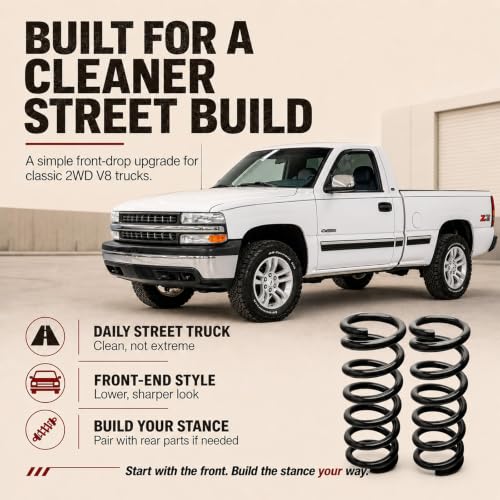
Expected Front Drop
The expected reduction from factory ride height is:
- Extended Cab and Crew Cab: approximately 2 inches
- Regular Cab: approximately 1 inch
Regular Cab trucks are lighter over the front suspension, so the same coils generally produce less drop. This difference should be clearly understood before ordering.
Actual finished height may vary based on:
- Cab and bed configuration
- Engine and accessory weight
- Worn factory springs
- Existing suspension modifications
- Front bumper, winch or added equipment
- Condition of the shocks and bushings
- Normal settling after installation
Measure the truck’s existing ride height on level ground before installation. Record the distance from the wheel-hub center to the fender opening rather than measuring from the ground, which allows tire pressure and diameter to distort the comparison.
Cleaner GMT800 Street-Truck Stance
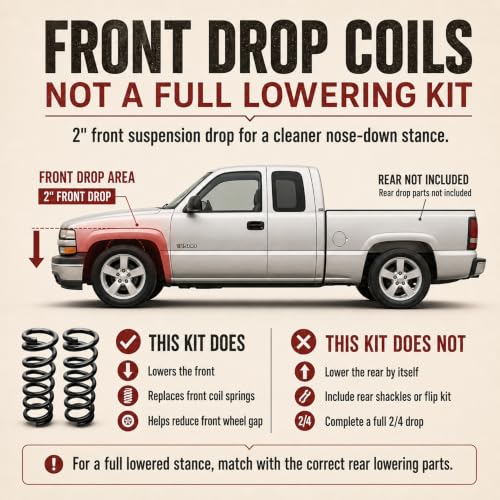
These purpose-built drop coils reduce the large factory front wheel gap and give the truck a more intentional profile. They can be installed as a front-only leveling-style change or used as the front component of a planned 2/4 lowering setup.
Rear shackles, hangers, flip kits, shocks and other lowering components are sold separately. Choose the rear drop based on the final rake you want rather than assuming every GMT800 should sit perfectly level. A slight forward rake remains practical for trucks that still haul cargo.
For more street-suspension planning, visit the My Pro Street How-To library or read the daily-driver suspension guide for a useful discussion of ride height, suspension travel and real-world comfort.
Handling and Ride Quality
Lowering the front reduces the truck’s center of gravity and may deliver a more settled feel during steering transitions. It can also help reduce the disconnected, nose-high appearance common to older stock-height trucks.
Potential benefits include:
- Reduced front wheel gap
- Cleaner street-truck appearance
- More controlled cornering feel
- Reduced body movement
- Better visual balance with rear lowering components
Ride quality will depend on spring rate, shock valving, tire sidewall and remaining suspension travel. Because the springs are shorter than stock, the front suspension may feel firmer over potholes, expansion joints and rough pavement.
A lower center of gravity does not increase payload, gross vehicle weight rating or towing capacity. These springs are a stance and handling modification—not a loophole in physics.
Durable Powder-Coated Construction
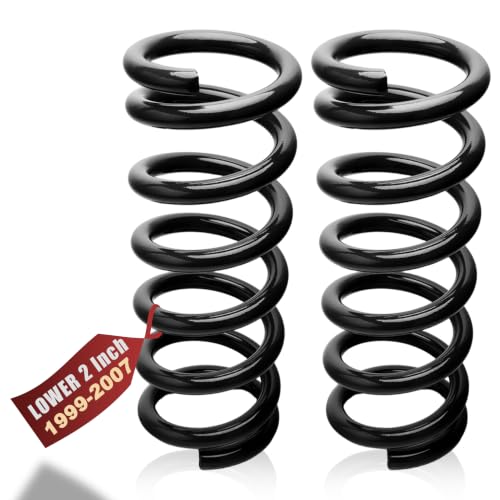
The TOWGUARD drop coils use durable steel construction with a corrosion-resistant powder-coated finish. The coating helps protect the springs from moisture, road grime and surface corrosion during normal street use.
As with any coated suspension component, inspect the springs periodically for:
- Chipped coating
- Surface rust
- Coil-to-coil contact
- Cracks or deformation
- Improper seating
- Uneven ride height
TOWGUARD backs the spring pair with a 24-month warranty and fitment assistance.
Inspect the Existing Suspension First
The newest compatible truck in this range is nearly two decades old. Before installing lowering springs, inspect the complete front suspension rather than assuming every original component is still enjoying its youth.
Check the following:
- Front shocks
- Upper and lower control-arm bushings
- Ball joints
- Inner and outer tie rods
- Sway-bar links and bushings
- Coil-spring isolators
- Bump stops
- Wheel bearings
- Brake hoses
- ABS wiring
Shorter springs place the shocks in a different portion of their operating range. Worn or poorly matched shocks may cause bouncing, bottoming or inadequate rebound control. The My Pro Street guide explaining how lowering springs affect shock wear covers this relationship in greater detail.
Shock and Bump-Stop Considerations
Standard-length shocks may physically install, but they are not always ideal for a two-inch drop. Lowered or shorter-stroke shocks can improve rebound control and help preserve usable travel.
Inspect bump-stop clearance once the truck is sitting at its finished ride height. Do not simply remove the bump stops. They protect the suspension and chassis from metal-to-metal contact at full compression.
If the truck constantly contacts its bump stops, the suspension needs correction. A vehicle that looks excellent while parked but tries to remove your fillings over every pothole is not properly set up.
Wheel and Tire Clearance
Lowering changes the relationship between the tire, fender, control arm and inner wheel well. Confirm clearance with the suspension loaded and the steering turned through its full range.
Inspect:
- Tire-to-fender clearance
- Wheel offset and backspacing
- Brake-hose clearance
- Inner wheel-well contact
- Control-arm clearance
- Full-lock steering clearance
- Clearance during suspension compression
Large wheels and aggressive offsets may require additional attention. A tire that clears in the driveway can still rub during braking, cornering or compression.
Installation and Alignment
Coil springs store substantial mechanical energy. Professional installation is recommended unless the installer has the correct spring-handling equipment and experience.
A proper installation should include:
- Safely raising and supporting the truck.
- Removing the original front coil springs.
- Inspecting spring pockets and isolators.
- Checking shocks, bushings and ball joints.
- Installing both lowering springs as a matched pair.
- Confirming correct spring orientation and seating.
- Checking bump-stop and tire clearance.
- Tightening suspension hardware correctly.
- Settling the suspension at normal ride height.
- Performing a professional wheel alignment.
Alignment is required after changing ride height. Incorrect toe or camber can create poor steering response and accelerated tire wear even if the truck appears to drive straight. The NHTSA tire-safety resource provides additional guidance on inspection and abnormal wear.
Package Contents
The package includes:
- Two front lowering coil springs
The following components are not included:
- Front shocks
- Drop spindles
- Rear lowering components
- Control arms
- Bump stops
- Spring isolators
- Alignment hardware
- Installation tools
Frequently Asked Questions
How much will these springs lower a Regular Cab?
Approximately one inch. The lighter Regular Cab does not compress the springs as far as heavier Extended Cab and Crew Cab models.
How much will they lower an Extended or Crew Cab?
Approximately two inches from factory ride height. Final height can vary with vehicle weight and suspension condition.
Will these springs fit a 4WD Silverado?
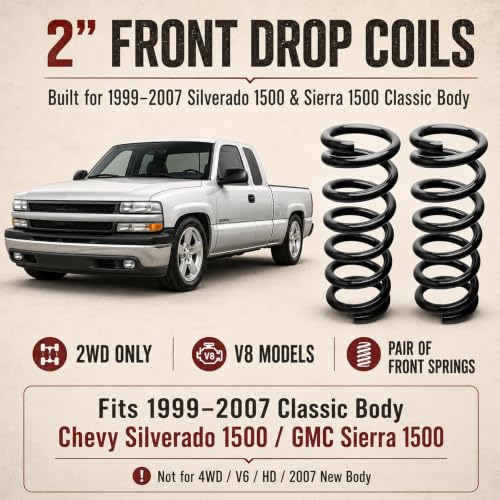
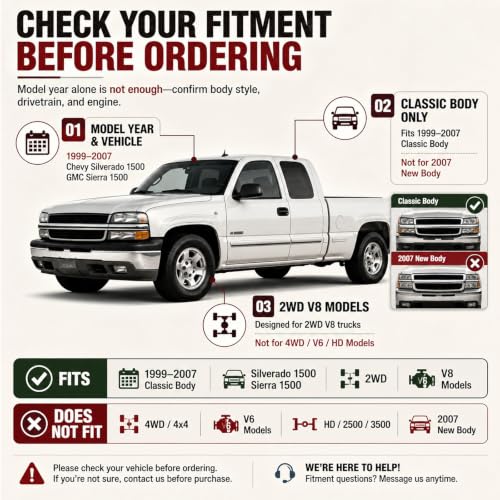
No. They are only for compatible 2WD trucks using front coil springs. Four-wheel-drive GMT800 trucks use a different front suspension arrangement.
Do they fit a 2007 Silverado?
Only the 2007 Silverado 1500 Classic, which retains the earlier GMT800 body and chassis. They do not fit the redesigned 2007 New Body truck.
Will these fit a V6 truck?
No. This kit is specified for V8 applications because engine weight affects spring loading and finished ride height.
Can they be used for a 2/4 drop?
Yes. These springs can provide the front portion of a planned 2/4-style lowering setup on heavier-cab trucks. The appropriate rear lowering components must be purchased separately.
Is an alignment required?
Yes. Have the truck professionally aligned after installation and again if the suspension settles enough to change the measurements.
Final Verdict
TOWGUARD front drop coils provide a straightforward way to reduce wheel gap on compatible GMT800 Silverado and Sierra 1500 trucks. Extended and Crew Cab models should see approximately two inches of front drop, while Regular Cab trucks should expect closer to one inch.
The kit is best for a street-oriented 2WD V8 truck with healthy suspension components and sensible wheel fitment. Confirm the cab, drivetrain, body generation and front suspension before ordering—especially on a 2007 model.
Visit My Pro Street for more automotive installation guides, suspension advice and GMT800 technical content.





There are no reviews yet.