
Likewise, this kit should not automatically be considered compatible with:
- BMW F31 3 Series Touring
- BMW F34 3 Series Gran Turismo
- BMW F33 4 Series Convertible
- BMW F83 M4 Convertible
- BMW xDrive models
- Vehicles with aftermarket coilovers
- Cars with factory or aftermarket air suspension
Confirm the chassis code and production date before ordering. The NHTSA VIN decoder can help identify U.S.-market vehicle information, although suspension configuration should also be inspected directly.
U.S. Model-Year Guidance
The supplied production dates do not line up perfectly with U.S. model years. As a general guide, potential North American applications may include:
- 2012–2018 BMW 3 Series Sedan
- 2014–2020 BMW 4 Series Coupe
- 2015–2020 BMW 4 Series Gran Coupe
These ranges are only a starting point. Engine, drivetrain and chassis configuration must still be verified.
RWD Models Only
These springs are intended for rear-wheel-drive vehicles. They are not listed for BMW xDrive models.
The front suspension and axle loading of an xDrive BMW differ because of the front differential, drive axles and related hardware. Installing RWD springs on an xDrive vehicle can produce an incorrect ride height, poor suspension travel or unsafe handling.
Before ordering, confirm:
- The car is rear-wheel drive
- The chassis code is F30, F32 or F36
- The production date falls within the listed range
- The suspension remains factory-style
- The springs match the vehicle’s axle-load classification
Lowered BMW Stance
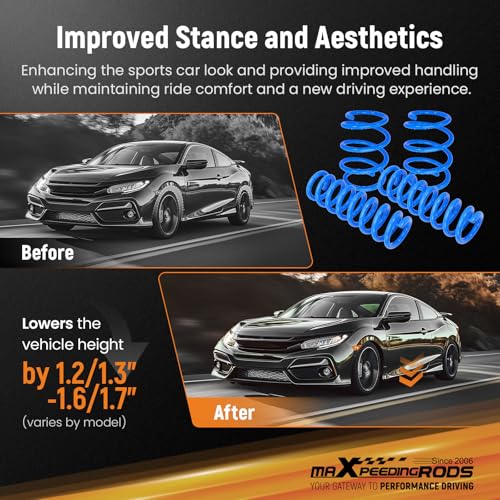
These lowering springs are designed to reduce factory wheel gap and give the vehicle a more planted profile. The finished appearance should be sportier than stock while retaining the original spring-and-damper suspension layout.
The manufacturer information provided does not specify an exact front or rear lowering measurement. Final ride height can vary based on:
- Exact BMW model
- Gasoline or diesel engine
- Engine and transmission weight
- Factory suspension package
- Existing spring wear
- Shock and strut condition
- Wheel and tire configuration
- Vehicle equipment and cargo
- Normal settling after installation
Avoid promising a specific drop unless the manufacturer supplies a measurement for the exact vehicle configuration. A 316i and a diesel-powered 330d do not place identical weight over the front axle.
Improved Handling and Stability
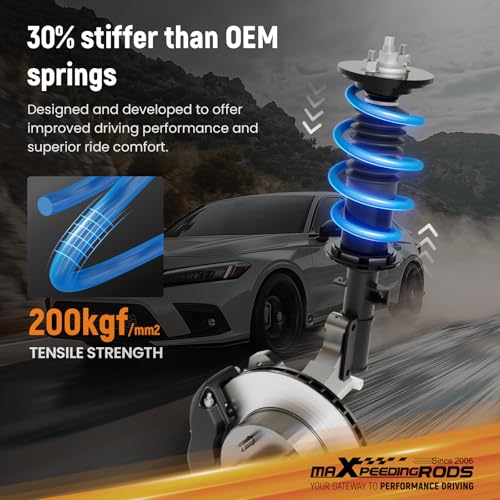
Lowering the chassis reduces its center of gravity. When the springs are properly matched to the dampers, this can provide:
- Reduced body roll
- More immediate steering response
- More controlled transitions
- Less nose dive under braking
- Reduced suspension movement during acceleration
- A cleaner wheel-to-fender relationship
- A more settled highway feel
Lowering springs cannot correct worn suspension components or poor alignment. They also do not automatically increase mechanical grip. Tires, damping and geometry remain critical.
Drivers who want adjustable ride height and damping should compare fixed springs with the options in the My Pro Street daily-driver coilover guide.
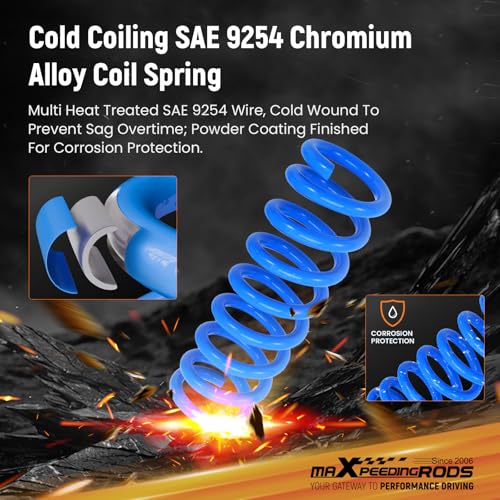
SAE 9254 Cold-Wound Steel Construction
The springs are manufactured from SAE 9254 cold-wound steel. This silicon-chromium alloy is commonly selected for components subjected to repeated compression and cyclic loading.
The construction is intended to provide:
- Consistent coil geometry
- Stable spring response
- Resistance to fatigue
- Predictable compression characteristics
- Long-term structural durability
An anti-corrosion coating protects the steel against moisture, road salt and common automotive chemicals. Additional manufacturer and suspension information is available from maXpeedingrods.
Durability Testing
According to the supplied product specifications, the springs undergo:
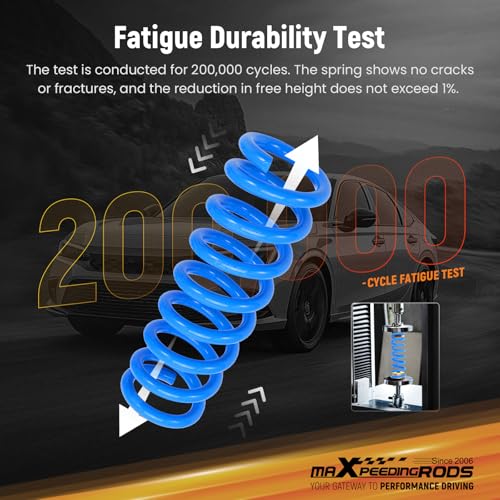
- 200,000-cycle fatigue testing
- 720-hour salt-spray testing
Fatigue testing evaluates how the springs withstand repeated suspension movement. Salt-spray testing evaluates resistance to accelerated corrosion.
These tests support the product’s durability claims, but real-world longevity still depends on installation, road conditions, climate and maintenance. Inspect the coating periodically for chips, abrasion or corrosion.
Factory and Aftermarket Shock Compatibility
These lowering springs are advertised as compatible with OEM-style and suitable aftermarket shocks. However, physical compatibility and optimal performance are not the same thing.
Lowering springs change the shock’s resting position and reduce available compression travel. Factory shocks may struggle if they are:
- Worn or leaking
- Underdamped for the spring rate
- Frequently contacting the bump stops
- Already operating with damaged mounts
- Designed around a substantially taller factory spring
The My Pro Street guide explaining whether lowering springs wear out shocks covers this issue in greater detail.
For a higher-mileage BMW, replacing worn dampers, mounts and isolators during the spring installation may save considerable labor later.
Inspect the Suspension Before Installation
Before installing lowering springs, inspect:
- Front struts
- Rear shocks
- Front upper strut mounts
- Rear shock mounts
- Spring pads and isolators
- Bump stops
- Control-arm bushings
- Ball joints
- Tie-rod ends
- Sway-bar links
- Wheel bearings
- Brake hoses
- ABS wiring
BMW suspension bushings can wear gradually, creating vague steering and uneven tire wear. New lowering springs may expose these problems rather than correct them.
Browse the My Pro Street How-To library for additional repair, installation and suspension guidance.
Wheel and Tire Clearance
Lowering the vehicle changes the available clearance between the tires, fenders, struts and inner wheel wells.
Check:
- Front tire-to-strut clearance
- Rear tire-to-fender clearance
- Wheel offset
- Tire width and diameter
- Full steering lock
- Suspension compression
- Brake-hose routing
- Underbody clearance
This is particularly important on cars equipped with aftermarket wheels or spacers. A wheel that clears while parked may rub when the suspension compresses or the steering reaches full lock.
Installation Requirements
These springs use the factory-style mounting locations, but installation requires suspension disassembly and safe spring compression.
Typical installation includes:
- Confirming chassis and drivetrain compatibility.
- Measuring the original ride height.
- Raising and safely supporting the vehicle.
- Removing the front strut assemblies.
- Compressing and removing the factory springs.
- Inspecting mounts, bearings, boots and bump stops.
- Installing the new front springs correctly.
- Replacing the rear springs.
- Verifying that every spring is properly seated.
- Tightening suspension hardware to BMW specifications.
- Checking wheel and tire clearance.
- Performing a four-wheel alignment.
Professional installation is recommended. Compressed coil springs store enough energy to turn a minor shortcut into a major emergency-room story.
Alignment Is Required
Lowering changes camber and toe. A professional four-wheel alignment should be completed after installation and rechecked if the springs settle noticeably.
The technician should inspect:
- Front toe
- Rear toe
- Front camber
- Rear camber
- Thrust angle
- Steering-wheel position
- Tire clearance
Incorrect toe can rapidly wear the tires even if the car tracks straight. Review the NHTSA tire-safety guide for additional information about tire inspection and abnormal wear.
Package Contents
The package is expected to contain:
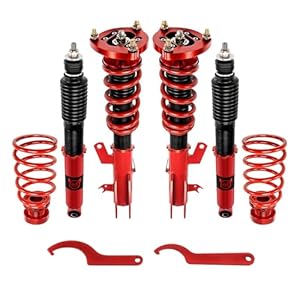
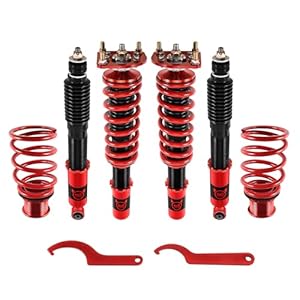
- Two front lowering springs
- Two rear lowering springs
Unless specifically listed by the seller, the following are not included:
- Shocks or struts
- Upper mounts
- Bump stops
- Spring pads
- Adjustable control arms
- Alignment hardware
- Installation tools
Frequently Asked Questions
What BMW models do these springs fit?
They are advertised for select RWD BMW F30 3 Series Sedans, F32 4 Series Coupes and F36 4 Series Gran Coupes produced within the listed date ranges.
Will they fit an xDrive BMW?
No. The stated fitment is for rear-wheel-drive models only.
Will they fit an F80 BMW M3 or F82 BMW M4?
The title references F80 and F82, but the supplied application list does not explicitly name the M3 or M4. Obtain manufacturer confirmation before ordering for an M model.
Do these springs fit an F33 convertible?
The supplied fitment only names the F32 Coupe and F36 Gran Coupe. F33 convertible compatibility should not be assumed.
Can I retain the original shocks?
The springs are advertised for factory-style shocks, but worn dampers or units poorly matched to the shorter springs can reduce ride quality and suspension control.
Is an alignment required?
Yes. Perform a professional four-wheel alignment after installation.
Final Verdict
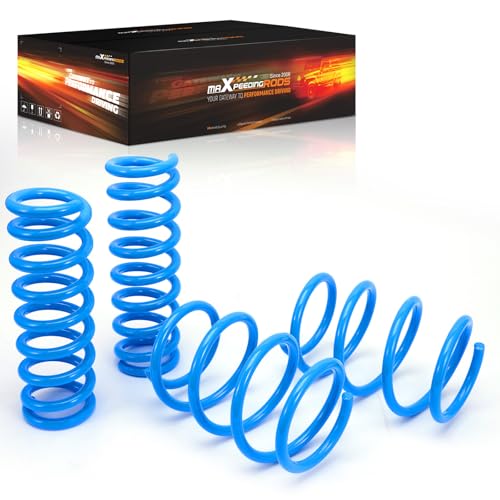
The maXpeedingrods lowering spring kit offers a fixed-height suspension upgrade for select RWD BMW F30, F32 and F36 models. Its SAE 9254 cold-wound steel construction and corrosion-resistant coating are designed for long-term street use, while the lower center of gravity can sharpen response and reduce body movement.
The key is precise fitment. Confirm the chassis, drivetrain, production date and axle configuration before ordering—particularly for xDrive, M3, M4, convertible or wagon models.
Visit My Pro Street for more suspension guides, product reviews and automotive technical information.





There are no reviews yet.