
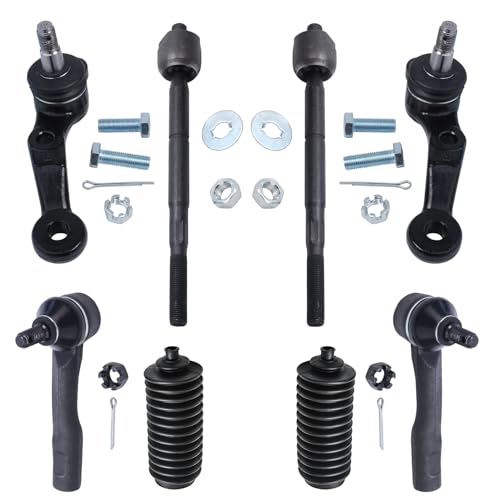
What Comes in the Eight-Piece Kit?
The package includes:
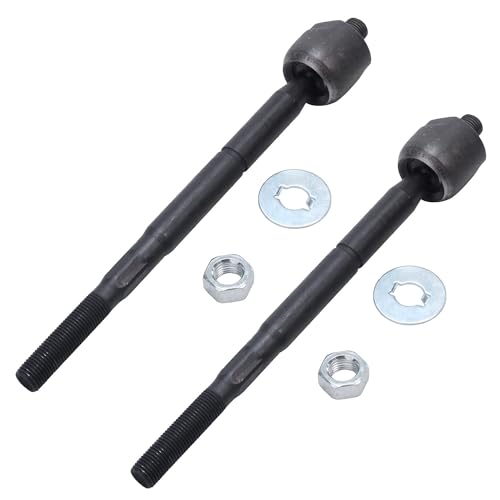
- Two front inner tie rods
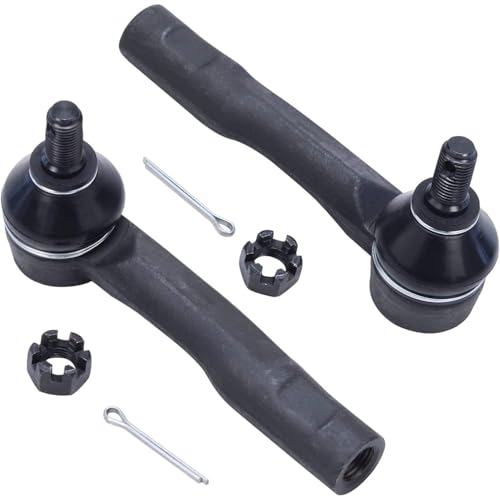
- Two front outer tie-rod ends
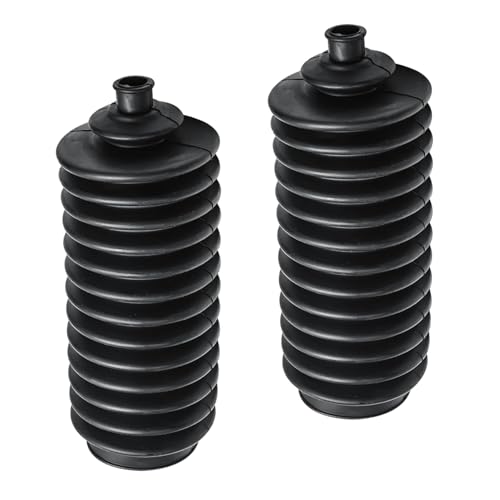
- Two steering-rack boots
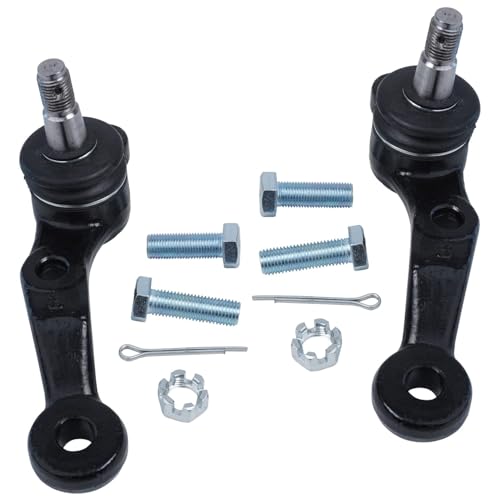
- One driver-side front lower ball joint
- One passenger-side front lower ball joint
That totals eight pieces. The boots count as components, so this isn’t eight steering joints hiding inside the box like some kind of suspension-themed clown car.
What This Kit Replaces
This kit refreshes the connection between the steering rack, steering knuckles and front suspension.
Inner tie rods
The inner tie rods connect directly to the steering rack. They transfer rack movement toward the wheels while allowing the suspension and steering linkage to articulate.
Worn inner joints can cause:
- Loose or delayed steering response
- Steering-wheel vibration
- Front-end knocking
- Excessive movement at the wheel
- Difficulty maintaining alignment
Outer tie-rod ends
The outer tie rods connect the inner rods to the steering knuckles. They are responsible for transferring steering input to the front wheels and provide the primary toe adjustment.
Our tie-rod-end replacement guide explains how these joints work and why worn tie rods can create vibration, clunking and unsafe steering movement.
Steering-rack boots
The bellows-style boots protect the inner tie rods and steering rack from:
- Water
- Dirt
- Road salt
- Sand
- Brake dust
- Road debris
A torn boot doesn’t automatically mean the steering rack has failed, but it gives contamination a direct path into components that strongly prefer not to be packed with road grit.
Front lower ball joints
The lower ball joints connect the lower suspension assemblies to the steering knuckles. They must move through steering and suspension travel while controlling the position of each front wheel.
Worn joints can produce clunks, unstable steering and abnormal tire wear. Read our guide to diagnosing a clunking noise over bumps before ordering parts based on noise alone.
Why Replace the Components Together?
A complete steering and ball-joint kit makes sense when an IS300 has high mileage, several damaged boots or measurable play in multiple joints.
Replacing the related components together offers several benefits:
- Restores more consistent steering response
- Reduces repeated disassembly
- Allows both sides to be serviced evenly
- Replaces aging steering-rack boots
- Provides a better baseline for alignment
- Makes it easier to inspect the remaining suspension
The newest car covered by this kit is already more than two decades old. Even a well-maintained IS300 may have worn control-arm bushings, sway-bar links, wheel bearings or struts. Installing new tie rods won’t magically rehabilitate every rubber component Toyota installed during the dial-up internet era.
Our Lexus suspension upgrade section covers the effect worn bushings can have on steering response and suspension geometry.
Symptoms of Worn IS300 Tie Rods or Ball Joints
Inspect the front suspension if the vehicle exhibits:
- Steering wander
- Loose or vague steering
- Clunking over bumps
- Clicking or popping while turning
- Steering-wheel vibration
- Uneven front-tire wear
- Excessive toe movement
- Torn or grease-covered dust boots
- Play at the steering knuckle
- An alignment that will not remain stable
These symptoms can overlap with bad wheel bearings, worn control-arm bushings, damaged tires or loose mounting hardware. Our guide to steering-wheel shaking can help separate suspension problems from wheel, tire and brake-related vibration.
Product Construction and Testing
Detroit Axle states that its suspension components undergo impact, wear and fatigue testing to support durability in passenger-car, truck and SUV applications.
The kit is marketed as being manufactured under strict quality-control standards. Comparable individual IS300 lower ball joints are listed by Detroit Axle as vehicle-specific replacement components.
The advertised ten-year warranty should be treated according to Detroit Axle’s current warranty terms, exclusions and purchasing requirements. Confirm coverage with the seller before ordering rather than assuming every kind of wear, damaged boot or installation problem is covered.
Installation Considerations
Replacing the complete kit requires more than removing the front wheels and attacking everything with the nearest hammer.
Typical equipment includes:
- Floor jack
- Properly rated jack stands
- Wheel chocks
- Metric socket and wrench set
- Torque wrench
- Tie-rod separator
- Ball-joint separator
- Pry bar
- Pliers for cotter pins
- Steering-rack boot clamps
- Penetrating oil
- Paint marker
- Suitable ball-joint service tools
Support the vehicle at its approved lifting points. Never work under a vehicle held up only by a hydraulic jack. Review our guide on using an automotive jack safely before starting.
Count the number of turns required to remove each outer tie rod or measure its installed position. This can place the new component close enough for a careful drive to the alignment shop, but it does not replace an actual alignment.
Use new cotter pins where required and follow the factory service procedure. For chassis fasteners and related references, consult our complete Lexus IS300 torque-specification guide. Confirm every value against the service information for the exact production date.
Does the IS300 Need an Alignment After Installation?
Yes. A professional four-wheel alignment should be performed after replacing the inner or outer tie rods.
Outer tie-rod position directly affects front toe. Counting turns provides only an approximate starting position. Even a small toe error can create:
- Rapid tire wear
- An off-center steering wheel
- Wandering
- Poor straight-line stability
- Reduced steering response
Ask the alignment technician to inspect the control-arm bushings, wheel bearings and mounting hardware before making adjustments. Aligning a car with another loose suspension component is mostly an expensive way to receive a colorful printout.
Frequently Asked Questions
What years does this Detroit Axle suspension kit fit?
It fits the 2001–2005 Lexus IS300. A 2001 model must have a production date after September 2000.
Does it fit the IS300 SportCross?
The component applications include applicable SportCross models from 2002 through 2005. Confirm the VIN, production date and original parts before ordering.
Does it fit a Lexus IS250 or second-generation IS?
No. This kit is for the first-generation 2001–2005 Lexus IS300. It is not intended for the 2006-and-newer IS250, IS300 or IS350.
Are left and right ball joints included?
Yes. The kit includes one driver-side and one passenger-side front lower ball joint.
Does the package contain new control arms?
No. It includes inner tie rods, outer tie rods, steering-rack boots and lower ball joints. Control arms, bushings, sway-bar links and struts are not listed.
Why does the September 2000 production date matter?
Manufacturers can revise suspension parts during a model-year production run. The date identifies whether a 2001 IS300 uses the components covered by this kit.
Is this a performance upgrade?
This is primarily an OE-style replacement kit. Its purpose is to restore steering and suspension operation rather than alter geometry or increase steering angle.
Is professional installation recommended?
Yes, especially if the installer does not have suitable ball-joint tools, safe lifting equipment or access to factory torque specifications. Steering and suspension failures are not especially forgiving learning experiences.
Final Verdict
The Detroit Axle eight-piece kit is a convenient front-end refresh for a 2001–2005 Lexus IS300 with worn tie rods, damaged rack boots and deteriorated lower ball joints. It replaces related components on both sides and reduces the need to buy each piece separately.
Its biggest fitment detail is the 2001 production-date cutoff. Verify that the car was built after September 2000, inspect the remaining suspension and schedule an alignment immediately after installation.







There are no reviews yet.