
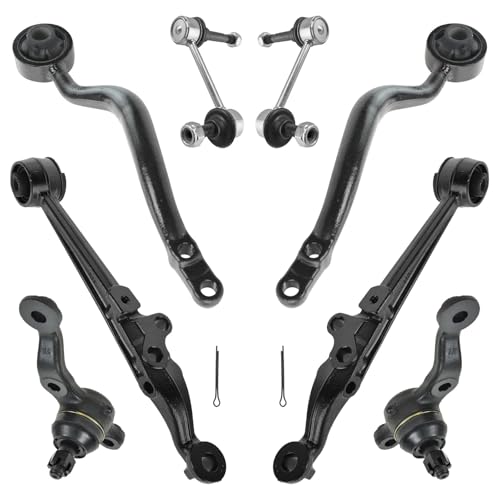
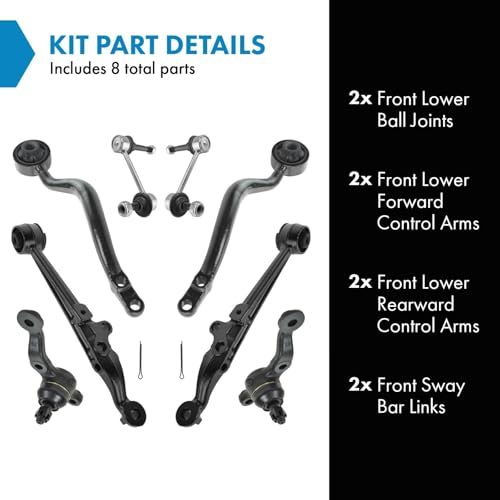

What Comes in the TRQ PSA66437 Kit?
The package contains:
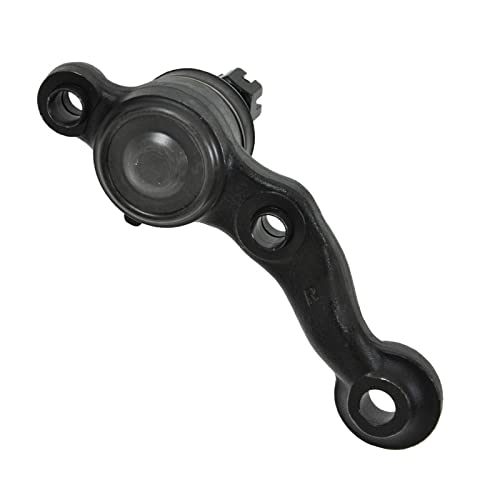
- Two front lower ball joints
- Two front lower forward control arms
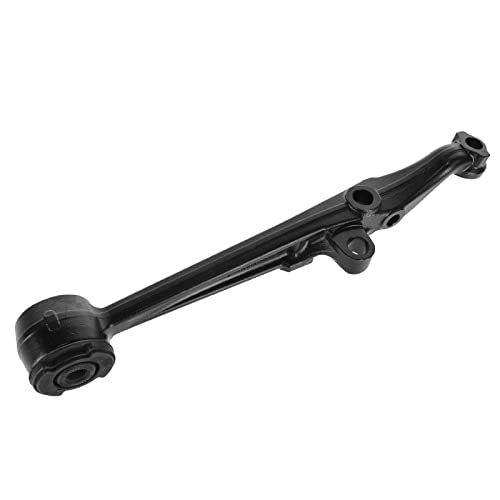
- Two front lower rearward control arms
- Two front sway-bar stabilizer links
The supplied description occasionally calls these “regulate arms.” They are control arms. Spellcheck was apparently working from home that day.
Quick Product Specifications
| Specification | Detail |
|---|---|
| Brand | TRQ |
| Kit number | PSA66437 |
| Position | Front |
| Quantity | Eight pieces |
| Fitment | 2001–2005 Lexus IS300 |
| Installation type | Direct replacement |
| Lubrication | Pre-greased, sealed components |
| Surface treatment | Anti-corrosion coating |
| Modifications required | None for confirmed applications |
| Primary purpose | Restore worn front-suspension components |
A current TRQ PSA66437 retailer listing identifies the package as an eight-piece front control-arm, ball-joint and sway-bar-link kit. Confirm current package contents and warranty terms before purchase.
What Do the Forward and Rearward Control Arms Do?
The first-generation IS300 uses multiple links to position each front steering knuckle. These arms manage wheel movement under acceleration, braking, cornering and suspension travel.
Front lower forward control arms
The forward arms help locate the wheel and maintain suspension geometry as the wheel travels vertically. Their bushings isolate vibration while controlling unwanted movement.
Worn forward-arm bushings can contribute to:
- Vague steering
- Wheel movement under braking
- Alignment instability
- Clunking over rough pavement
- Uneven tire wear
Front lower rearward control arms
The rearward arms—often described as tension, caster or strut arms—help control fore-and-aft wheel movement. Their bushings take significant loads when the driver brakes or hits a pothole.
Failed rearward-arm bushings can produce:
- Clunks during braking
- Steering movement when stopping
- Wandering
- Changes in caster
- A loose or unsettled front end
If you’re refreshing an older IS300 suspension, our Energy Suspension product guide explains how deteriorated rubber bushings affect alignment, braking stability and steering response.
Why Replace the Lower Ball Joints?
The two front lower ball joints connect the lower suspension to the steering knuckles. Each joint must articulate through steering and suspension travel while controlling the wheel’s position.
Common symptoms of worn IS300 lower ball joints include:
- Clunking over bumps
- Popping while turning
- Steering looseness
- Uneven front-tire wear
- Damaged dust boots
- Grease leakage
- Excessive movement at the steering knuckle
A loose lower ball joint is a safety issue, not merely an annoying noise. Complete separation can allow the wheel and knuckle to move out of position.
That said, don’t diagnose the car using sound effects alone. Worn sway-bar links, control-arm bushings, tie rods and shock mounts can produce similar noises. Our guide to diagnosing a clunking noise over bumps covers the usual suspects.
What Do the Sway-Bar Links Replace?
The two included sway-bar links connect the front stabilizer bar to the suspension. They transfer load into the bar during cornering, helping resist excessive body roll.
Worn links commonly produce:
- Light metallic rattling over broken pavement
- Clunks from one front corner
- Noise when entering angled driveways
- Loose or torn link boots
- Reduced stabilizer-bar effectiveness
New sway-bar links won’t transform a stock IS300 into a time-attack car. They can, however, eliminate play that prevents the factory bar from working properly. Our article on how sway bars affect handling explains what the stabilizer bar can—and cannot—change.
TRQ Construction and Product Features
TRQ describes these components as direct, maintenance-free replacements manufactured from application-specific materials and protected with corrosion-resistant coatings.
Product features include:
- Vehicle-specific geometry
- Pre-installed bushings where applicable
- Pre-greased and sealed joints
- Corrosion-resistant exterior coatings
- Direct-replacement mounting points
- No routine grease service required
- Left- and right-side components packaged together
TRQ states that its suspension products are fit- and road-tested through its Massachusetts research and development operation. The TRQ/1A Auto product listing also describes the company’s suspension components as sealed, pre-greased and designed for direct replacement.
Note that the referenced 1A Auto page may represent a closely related kit configuration. Use PSA66437 and the eight-piece contents—not merely the product photograph—to identify this exact package.
Important Reference Numbers
The following numbers are supplied for cross-reference. Some are OE numbers, while others represent aftermarket interchange numbers or individual kit components:
Lower ball joints
- 43330-59065
- 43330-59066
- 43330-59135
- 43340-59065
- 43340-59066
- 43340-59135
- K500066
- K500067
Lower control arms
- 48068-53010
- 48069-53010
- 48069-59025
- 48660-53010
- 48670-53010
- 48670-53101
- 522-103
- 522-104
- 522-843
- 522-844
- RK641525
- RK641526
- RK642103
- RK642104
Front sway-bar links
- 48820-22041
- K750062
- 101-5489
Reference numbers should be treated as fitment clues, not interchangeable guarantees. Match the original component’s mounting points, dimensions and VIN application before installation.
Signs Your IS300 Needs a Front Suspension Refresh
This kit may be appropriate when several of these conditions are present:
- More than one control-arm bushing is cracked
- Both lower ball-joint boots are damaged
- Sway-bar links are loose or rattling
- The car wanders under braking
- The steering feels inconsistent
- Front alignment changes repeatedly
- Tires show irregular wear
- The vehicle has high or unknown mileage
- Several original components remain installed
Our steering-wheel vibration diagnostic guide can help distinguish suspension looseness from wheel, tire, brake and bearing problems.
Components This Kit Does Not Include
This package does not list:
- Upper control arms
- Upper ball joints
- Inner tie rods
- Outer tie-rod ends
- Steering-rack boots
- Wheel bearings
- Shocks
- Springs
- Front stabilizer-bar bushings
- Steering knuckles
Inspect those parts before ordering. Installing eight new components beside two worn upper arms can leave the front end feeling exactly as disappointing as before, only with fewer excuses.
Installation Considerations
Replacing all eight components is an advanced DIY project. The work involves separating suspension joints, supporting the steering knuckle and correctly tightening high-load fasteners.
Useful tools include:
- Floor jack and rated jack stands
- Wheel chocks
- Metric socket and wrench set
- Breaker bar
- Torque wrench
- Ball-joint separator
- Pry bar
- Penetrating oil
- Suitable joint or arm service tools
- Replacement cotter pins and specified hardware
Always raise the vehicle from approved lift points and support it securely. Review our guide on using an automotive jack safely before crawling underneath the car.
Do not allow the brake caliper to hang from its hose. Protect the ABS sensor wiring, note the orientation of every arm and compare each replacement component before removing the original.
Some suspension-bushing fasteners must receive final torque with the suspension at normal ride height. Tightening a bonded-rubber bushing while the suspension hangs can preload the rubber and shorten its life. Follow the Lexus service procedure for the exact chassis and production date.
Torque Specifications and Alignment
Do not guess at suspension torque values. The IS300 uses several heavily loaded connections, including lower-arm hardware that requires substantial clamping force.
Use the Pro Street Lexus IS300 torque-specification guide as a supporting reference and confirm the final specifications through the appropriate factory service information.
A professional four-wheel alignment is strongly recommended after installation. Replacing lower control arms can affect:
- Caster
- Camber
- Toe
- Steering-wheel position
- Straight-line tracking
The alignment should be performed only after all remaining steering and suspension components have been inspected.
Frequently Asked Questions
What year Lexus IS300 does the TRQ PSA66437 kit fit?
It fits the 2001, 2002, 2003, 2004 and 2005 Lexus IS300.
Does this kit fit the Lexus IS300 SportCross?
Retailer catalogs list applicable 2002–2005 IS300 SportCross models. Confirm the VIN and compare the original control arms before ordering.
Does it fit the 2001 IS300?
Yes, although early-production 2001 vehicles should be verified carefully by VIN and production date because related IS300 suspension kits can have a September 2000 cutoff.
Does it fit the 2006 Lexus IS250 or IS350?
No. This kit is designed for the first-generation 2001–2005 IS300 and does not fit the second-generation 2006 IS chassis.
Are tie rods included?
No. This kit includes control arms, lower ball joints and sway-bar links. Inner and outer tie rods are not listed.
Are the control arms preassembled?
The replacement arms arrive as direct-replacement assemblies with their applicable bushings already installed. Verify the actual package before dismantling the vehicle.
Do the ball joints need to be greased?
TRQ identifies these as pre-greased, sealed components that do not require routine grease service.
Will the car need an alignment afterward?
Yes. A four-wheel alignment is recommended after replacing the lower control arms and ball joints.
Is this a performance suspension kit?
No. It is an OE-style replacement kit intended to restore worn suspension operation. It does not add adjustable geometry, stiffer performance bushings or altered ride height.
Final Verdict
The TRQ PSA66437 kit is a practical option for refreshing several common front-suspension wear points on a 2001–2005 Lexus IS300. It replaces both lower ball joints, four lower control-arm sections and both sway-bar links in one package.
It is best suited to a high-mileage street car that needs a broad OE-style suspension repair. Confirm the 2001 production date, inspect the upper arms and steering linkage, follow the correct torque procedure and finish the job with an alignment.






There are no reviews yet.