
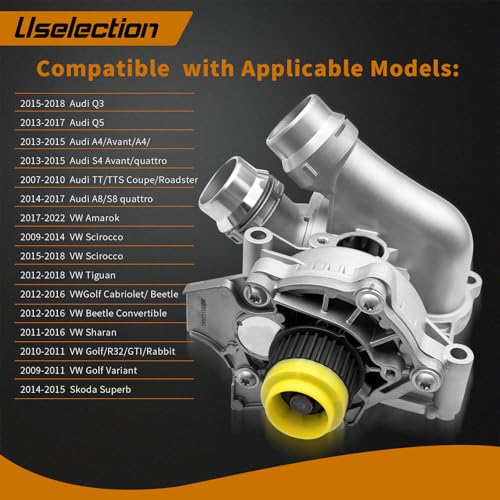
Engine-Code Compatibility
The most reliable applications use these 2.0T engine codes:
- CCTA
- CAEB
- CAED
The Deutsche Auto Parts catalog identifies this water-pump family for CCTA, CAEB and CAED engines. It also confirms that later revisions replace earlier numbers including 06H121026AB.
This pump should not automatically be listed for:
- EA113 2.0T engines
- EA888 Gen 3 engines
- Diesel TDI engines
- 1.8T applications without part-number verification
- Audi TTS applications using a different engine configuration
- Vehicles with a different pump connector or housing
Confirm the engine code on the vehicle-information label, emissions label or through a VIN-specific parts catalog.
OE and Interchange Numbers
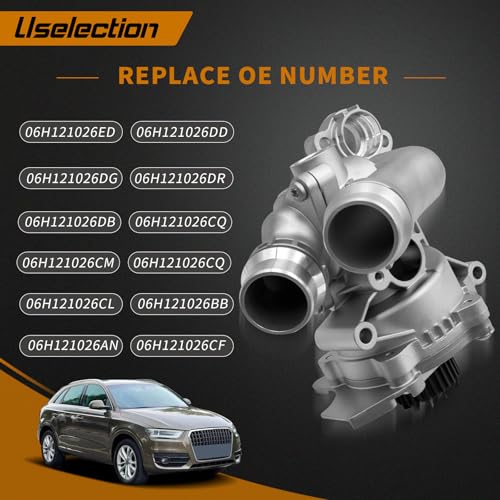
This pump may replace or cross-reference:
- 06H121026AB
- 06H121026AE
- 06H121026AF
- 06H121026AM
- 06H121026BB
- 06H121026CF
- 06H121026CM
- 06H121026CQ
- 06H121026DD
- 06H121026T
- 06J121026G
- 06J121026R
- 131-2460
- 152-2701
Some catalogs identify newer revisions such as 06H121026DR or 06H121026ED as later replacements. Compare the complete assembly, connector, thermostat, sensor and belt arrangement before ordering.
Audi’s parts catalog identifies 06H121026AB as an engine water pump used across several Audi and Volkswagen 2.0L applications.
Package Contents
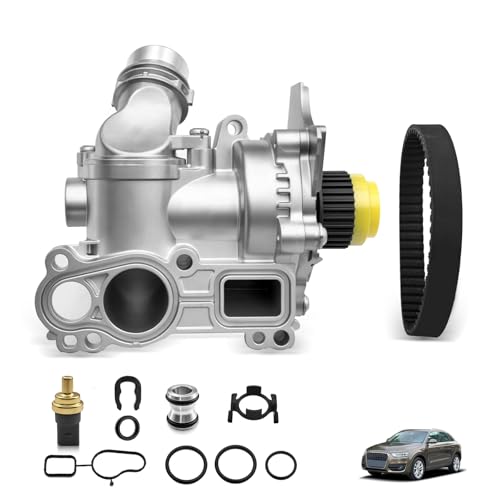
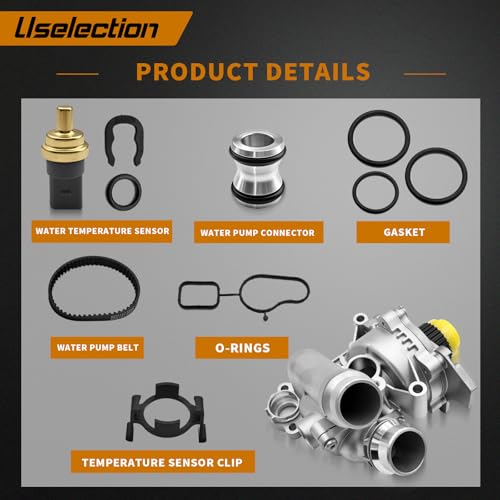
- One aluminum water-pump assembly
- One integrated thermostat
- One coolant-temperature sensor
- One water-pump gasket
- One water-pump drive belt
Confirm that every pictured seal and fastener is included before removing the original pump. Replacement mounting hardware may still be required depending on the repair procedure.
Product Specifications
- Product type: Engine water-pump module
- Housing material: Aluminum
- Drive type: Toothed belt
- Thermostat included: Yes
- Coolant-temperature sensor included: Yes
- Pump belt included: Yes
- Gasket included: Yes
- Engine family: EA888 Gen 1/Gen 2
- Engine size: 2.0L turbocharged four-cylinder
- Installation type: Vehicle-specific replacement
This is not an electric water pump. It is mechanically driven by a small toothed belt from the engine’s balance-shaft system.
Why Use an Aluminum Housing?
Many original and early replacement EA888 water-pump modules use a composite housing. Heat cycling, age, incorrect installation and contamination from engine-oil leaks can contribute to housing or seal failure.
An aluminum replacement housing offers:
- Greater resistance to heat-related deformation
- Improved rigidity around sealing surfaces
- Better resistance to oil contamination
- Durable mounting points
- Reduced dependence on aging plastic structure
- OE-style coolant routing
Aluminum construction does not make the pump indestructible. The gasket, shaft seal, thermostat, sensor and belt still need proper installation and compatible coolant.
How the EA888 Water Pump Works
The pump circulates coolant through the:
- Engine block
- Cylinder head
- Turbocharger cooling circuit
- Radiator
- Heater core
- Thermostat housing
The integrated thermostat regulates when coolant flows through the radiator. The temperature sensor provides data used by the engine-management system to monitor cooling-system operation.
For a broader explanation of coolant circulation, pressure and airflow, review the Complete Car Cooling System Guide.
Common Water-Pump Failure Symptoms
A leaking or damaged EA888 water-pump module may cause:
- Low-coolant warning
- Coolant odor
- Pink or white residue below the intake manifold
- Coolant collecting on the engine or transmission
- Engine overheating
- Temperature fluctuations
- Weak cabin heat
- Coolant dripping beneath the vehicle
- Thermostat-related trouble codes
- Unusual pump or belt noise
Start with our guide explaining why a car overheats before assuming that every temperature increase requires a pump.
If overheating occurs primarily while driving or under boost, follow Why Does My Car Overheat While Driving? to check airflow, coolant loss, radiator condition and engine calibration.
Inspect for Oil Leaks Above the Pump
The EA888 pump sits in an area where engine-oil leakage can reach the housing and seals. Oil contamination can damage composite components and may shorten the life of surrounding rubber seals.
Before installing the replacement, inspect:
- Upper timing-cover area
- Camshaft bridge or cam-adjuster area
- Vacuum-pump area
- Valve-cover seals
- Oil-filter housing
- Intake-manifold region
- Oil residue around the pump
Repair any active oil leak before installing the new assembly. Replacing the pump without correcting contamination leaves the new component sitting beneath the same problem, patiently awaiting its turn.
Find the Source of Coolant Loss
Coolant discovered beneath the intake manifold may originate from:
- Water-pump housing
- Pump-to-engine seal
- Thermostat housing
- Temperature sensor
- Coolant hose
- Quick-connect fitting
- Coolant pipe
- Cylinder-head connection
Follow our step-by-step coolant-leak diagnostic guide before ordering. Pressure-test the system while cold and look for dried pink or white residue around the housing.
Do not open the cooling system while it is hot or pressurized.
Water Pump or Thermostat?
Because the thermostat is integrated into the assembly, pump and thermostat symptoms can overlap.
| Symptom | Possible cause |
|---|---|
| Visible leak from the module | Housing, gasket, sensor or pump seal |
| Engine warms too slowly | Thermostat stuck open |
| Engine overheats rapidly | Thermostat stuck closed, poor pump flow or low coolant |
| P0128 without overheating | Thermostat or temperature-sensor problem |
| Pump or belt noise | Pump bearing, belt or drive system |
| Weak heat with rising engine temperature | Low coolant, trapped air or poor circulation |
Read our bad thermostat versus bad water pump guide before replacing unrelated cooling components.
A stored P0128 coolant-thermostat code generally means the engine is not reaching its expected operating temperature quickly enough.
Coolant-Temperature Sensor Diagnosis
The included sensor monitors coolant temperature, but an electrical fault can produce misleading readings even when the cooling system is mechanically functional.
Check:
- Sensor connector
- Terminal tension
- Wiring insulation
- Sensor ground
- Signal voltage
- Coolant intrusion
- Scan-tool temperature data
- Temperature response during warm-up
Our P0115 coolant-temperature sensor circuit guide explains how to distinguish an electrical circuit failure from actual overheating.
For a temperature signal that changes implausibly as the engine warms, use the P0116 temperature-sensor performance guide.
Intermittent readings should be diagnosed with the [P0119 intermittent coolant-temperature circuit guide
06H121026AB Aluminum Water Pump Kit for Audi and Volkswagen 2.0T TSI
This aluminum water-pump module replaces the factory-style pump and thermostat assembly found on select Audi and Volkswagen vehicles equipped with early-generation EA888 2.0T TSI/TFSI engines. The kit includes the aluminum pump housing, thermostat, coolant-temperature sensor, gasket and dedicated water-pump belt.
Primary applications include certain Audi A3, A4, A5, Q5 and TT models, plus Volkswagen Beetle, CC, Eos, GTI, Golf, Jetta, Passat and Tiguan models.
Fitment must be confirmed through the engine code and original part number. “Audi 2.0T” narrows the search about as effectively as “silver German car.”
Vehicle Fitment
The following table covers commonly cataloged North American applications. Exact coverage depends on engine code, production date and original pump revision.
| Approximate years | Make | Model | Engine requirement |
|---|---|---|---|
| 2009–2013 | Audi | A3 | 2.0T EA888 |
| 2009–2016 | Audi | A4 | 2.0T EA888 |
| 2010–2016 | Audi | A5 | 2.0T EA888 |
| 2011–2017 | Audi | Q5 | 2.0T EA888 |
| 2009–2015 | Audi | TT | Compatible 2.0T EA888 |
| 2012–2017 | Volkswagen | Beetle | Compatible 2.0T TSI |
| 2009–2017 | Volkswagen | CC | 2.0T TSI |
| 2009–2016 | Volkswagen | Eos | 2.0T TSI |
| 2008–2014 | Volkswagen | GTI | EA888 2.0T TSI |
| 2010–2014 | Volkswagen | Golf | 2.0T TSI applications |
| 2008–2014 | Volkswagen | Jetta/GLI | EA888 2.0T TSI |
| 2008–2010 | Volkswagen | Passat | 2.0T TSI |
| 2009–2017 | Volkswagen | Tiguan | Compatible 2.0T TSI |
These years should be treated as a starting point—not universal coverage. Some models changed from EA113 to EA888 engines or between EA888 generations during the same production run.
Confirm the Engine Code
This pump family is commonly associated with the following 2.0T engine codes:
- CCTA
- CAEB
- CAED
Deutsche Auto Parts identifies the 06H121026DD pump family for CCTA, CAEB and CAED engines. Its catalog also shows that several earlier 06H revisions were superseded by later versions.
Do not assume compatibility with:
- EA113 2.0T FSI engines
- Third-generation EA888 engines
- Volkswagen VR6 engines
- Audi supercharged V6 engines
- TDI diesel engines
- Every Audi or Volkswagen carrying a 2.0T badge
Check the emissions label, VIN decoder, service records or engine stamping before ordering.
Replacement Part Numbers
This pump may replace or cross-reference:
- 06H121026AB
- 06H121026AE
- 06H121026AF
- 06H121026AM
- 06H121026BB
- 06H121026CF
- 06H121026CM
- 06H121026CQ
- 06H121026DD
- 06H121026T
- 06J121026G
- 06J121026R
- 131-2460
- 152-2701
Later catalogs may list additional superseding numbers such as 06H121026DR or 06H121026ED. Match the pump housing, thermostat configuration, sensor connector, drive pulley and engine code—not merely one character from a long string of German part-number revisions.
Audi’s parts catalog identifies 06H121026AB as an engine water pump used in several Audi and Volkswagen applications. ShopDAP lists 06H121026AB among the earlier revisions superseded within the later EA888 pump family.
Kit Contents
- One aluminum water-pump assembly
- One integrated thermostat
- One coolant-temperature sensor
- One housing gasket or seal
- One water-pump drive belt
Compare the received kit with the product photographs before disassembling the vehicle. Confirm whether mounting hardware, O-rings and the balance-shaft pulley bolt are included or must be purchased separately.
Product Specifications
- Product type: Mechanical engine water-pump module
- Drive type: Toothed belt
- Housing material: Aluminum
- Engine family: Early-generation EA888
- Engine size: 2.0L turbocharged four-cylinder
- Thermostat included: Yes
- Coolant-temperature sensor included: Yes
- Water-pump belt included: Yes
- Housing gasket included: Yes
- Installation type: Vehicle-specific replacement
Despite the word “belt,” this pump is not normally driven by the engine’s external serpentine accessory belt. It uses a separate toothed belt inside the engine-side pump-drive arrangement.
Why Use an Aluminum Water-Pump Housing?
Many original EA888 water-pump modules use substantial composite construction. An aluminum replacement housing may offer:
- Greater housing rigidity
- Improved resistance to heat cycling
- Better resistance to cracking
- Reduced vulnerability to external oil contamination
- Stable sealing surfaces
- Longer service potential when manufactured correctly
Aluminum construction does not automatically make every replacement superior. Casting quality, bearing alignment, thermostat calibration, seals and impeller design still matter.
A metal housing also cannot repair an oil leak dripping onto the pump. It merely survives the abuse longer while the neglected seal continues decorating the engine.
How the EA888 Water Pump Works
The pump circulates coolant through the:
- Engine block
- Cylinder head
- Turbocharger cooling circuit
- Heater core
- Thermostat module
- Radiator
The thermostat regulates when coolant moves through the radiator, while the temperature sensor reports cooling-system data to the engine computer. The dedicated belt transfers mechanical drive from the engine to the pump.
For a complete explanation of coolant circulation, system pressure and airflow, start with our Complete Car Cooling System Guide.
Common Water-Pump Failure Symptoms
A leaking or failing EA888 water-pump module may cause:
- Low-coolant warning
- Coolant odor
- Pink or white residue near the pump
- Coolant collecting beneath the intake manifold
- Puddles beneath the vehicle
- Engine overheating
- Unstable operating temperature
- Weak cabin heat
- Thermostat-related fault codes
- Pump-bearing noise
- Damaged or loose pump belt
Begin diagnosis with our guide explaining why a car overheats.
If temperature rises primarily while driving or under boost, use Why Does My Car Overheat While Driving? to separate coolant-flow problems from inadequate airflow, tuning faults or radiator restriction.
Check for Oil Leaks Above the Pump
Oil leaking from the upper timing-cover area, cam bridge, valve cover or another component can run onto the water-pump housing. Prolonged oil exposure may damage composite housings, seals and rubber components.
Before installing the replacement:
- Inspect the engine above the pump.
- Locate any oil residue.
- Clean the area.
- Repair the source of the oil leak.
- Replace oil-soaked seals or hoses.
- Confirm that the new belt remains dry.
ShopDAP specifically warns that unresolved oil leakage can accelerate failure of this pump assembly. Replacing the water pump while leaving the oil leak is less a repair and more an expensive subscription plan.
Diagnose the Coolant Leak First
Coolant around the pump does not always prove that the pump housing is leaking. Inspect:
- Water-pump housing seam
- Thermostat housing
- Temperature sensor and seal
- Hose connections
- Coolant pipe
- Radiator
- Expansion tank
- Pressure cap
- Turbocharger coolant lines
- Heater hoses
Follow our step-by-step coolant-leak diagnostic guide and pressure-test the system when cold.
Coolant may collect in the engine undertray and drip far from the original source. Look for fresh wetness and dried pink or white residue above the puddle.
Water Pump or Thermostat?
Because the thermostat is integrated into the module, pump and thermostat faults are often repaired together.
| Symptom | Possible cause |
|---|---|
| Coolant leaking from module seam | Housing, gasket or seal |
| Grinding or drive noise | Pump bearing or belt |
| Engine overheats quickly | Pump, thermostat, low coolant or trapped air |
| Engine warms too slowly | Thermostat stuck open |
| Temperature drops at highway speed | Thermostat regulation problem |
| Little radiator flow when hot | Pump or thermostat stuck closed |
| P0128 without overheating | Thermostat or temperature-sensor issue |
Use our bad thermostat versus bad water pump guide before replacing unrelated cooling components.
A P0128 thermostat code usually indicates that the engine is not reaching the expected operating temperature. It does not necessarily mean that the pump impeller has failed.
Temperature-Sensor Diagnosis
Because this kit includes a coolant-temperature sensor, diagnose the sensor circuit before assuming every temperature-related code requires a complete pump module.
Inspect:
- Sensor connector
- Terminal tension
- Signal wiring
- Sensor ground
- Coolant contamination
- Harness routing
- Live temperature data
- Cold-start temperature plausibility
Our P0115 coolant-temperature sensor circuit guide covers open circuits, shorts and connector faults.
For inaccurate or implausible warm-up behavior, use the P0116 coolant-temperature performance guide. Intermittent readings should be compared with the checks in our P0119 diagnostic guide.
Installation Overview
This repair requires access beneath or around the intake-manifold side of the engine. The exact procedure depends on the chassis and engine orientation.
A general installation process includes:
- Let the engine cool completely.
- Disconnect battery power when required.
- Raise and safely support the vehicle.
- Remove the engine undertray.
- Drain the coolant into a suitable container.
- Remove components blocking pump access.
- Disconnect the coolant hoses and temperature-sensor connector.
- Release belt tension according to the service procedure.
- Remove the pump module and belt.
- Clean and inspect the sealing surfaces.
- Compare the original and replacement assemblies.
- Install the new thermostat, pump, seal and belt.
- Replace specified one-time-use hardware.
- Reassemble all removed components.
- Refill with approved coolant.
- Bleed the system completely.
- Clear applicable fault codes.
- Pressure-test and inspect for leaks.
Follow the correct factory procedure for the specific engine. Incorrect belt installation or pulley timing can damage the belt and stop coolant circulation.
Replace the Belt With the Pump
The supplied pump belt should be installed unless inspection and manufacturer instructions indicate otherwise. A worn, contaminated or damaged belt can compromise an otherwise healthy replacement pump.
Inspect the drive pulley for:
- Tooth damage
- Corrosion
- Oil contamination
- Misalignment
- Excessive play
- Damaged fastener threads
Confirm whether the pulley bolt is reusable. Some applications specify new mounting or pulley hardware.
Refill and Bleed the Cooling System
Air trapped after installation can produce:
- Temperature spikes
- Weak heater output
- Gurgling
- Pump cavitation
- False temperature readings
- Low-coolant warnings
- Immediate overheating
Use the coolant specification and bleeding procedure required for the exact Audi or Volkswagen application. Do not select coolant solely by color.
If the previous coolant is contaminated or incompatible, follow our guide to flushing a cooling system without damaging it.
If the engine overheats while the heater blows cold, review Car Overheats but Heater Blows Cold Air. That combination commonly points toward low coolant, trapped air or poor circulation.
Check the Radiator and Cooling Fans
A new pump will not correct:
- Restricted radiator tubes
- Damaged radiator fins
- Failed cooling fans
- Incorrect fan direction
- Poor fan control
- Blocked airflow
- Weak pressure cap
- Combustion gas entering the coolant
Our guide to seven signs of a failing radiator can help determine whether the radiator is contributing to the temperature problem.
For modified turbocharged vehicles, the turbo-car cooling-system upgrade guide explains how radiator capacity, intercooler restriction, fan performance and tuning affect heat rejection.
When to Stop Driving
Stop driving if:
- A red temperature warning appears
- Steam is visible
- Coolant is pouring out
- Cabin heat suddenly becomes cold
- The temperature continues climbing
- The engine begins misfiring or losing power
- Severe mechanical noise develops
Continuing can warp the cylinder head, damage the head gasket or turbocharger and turn a water-pump repair into an engine-replacement article.
See When Should You Stop Driving Your Car? for other warning signs that require immediate attention.
Features and Benefits
- Aluminum replacement housing
- Integrated thermostat
- Coolant-temperature sensor included
- Dedicated water-pump belt included
- Housing gasket included
- Compatible with select EA888 2.0T engines
- Replaces numerous earlier 06H pump revisions
- OE-style mounting and hose connections
- Designed to restore coolant circulation
- Helps address leaks from damaged pump housings
“Direct replacement” means the assembly is designed to match confirmed applications. It does not eliminate the need to verify the engine code, production date and original pump number.
Frequently Asked Questions
What vehicles use the 06H121026AB water pump?
It is commonly used on select Audi A3, A4, A5, Q5 and TT models and Volkswagen Beetle, CC, Eos, GTI, Golf, Jetta, Passat and Tiguan models with compatible early-generation EA888 2.0T engines.
Does this pump fit every Audi or Volkswagen 2.0T?
No. EA113 and later EA888 engines may use different water-pump designs. Confirm the engine code and original pump number.
Is this an electric water pump?
No. This is a mechanically driven pump module using a dedicated toothed belt. The temperature sensor and thermostat are electrical or electronically monitored components, but the pump itself is belt-driven.
Does the kit include the thermostat?
Yes. The supplied description lists the thermostat as part of the assembly.
Is the coolant-temperature sensor included?
Yes, according to the supplied kit description.
Does the kit include the pump belt?
Yes. A replacement water-pump belt is included.
Why replace a plastic pump with aluminum?
An aluminum housing may resist heat cycling, cracking and external oil exposure better than some composite designs. Internal component quality still determines overall reliability.
Can oil cause the original water pump to leak?
Oil contamination can damage seals and composite materials. Repair any oil leak above the pump before installing the replacement.
Does 06H121026DD replace 06H121026AB?
06H121026DD is one of several later revisions in the same pump family, but the latest replacement can vary by VIN and engine code. Verify through a current vehicle catalog.
Is a gasket included?
Yes, the product description lists a housing gasket. Confirm all seals shown in the photographs are included.
Final Verdict
This aluminum water-pump kit provides a more complete repair package than a bare pump because it includes the thermostat, temperature sensor, gasket and dedicated drive belt. It is designed for select CCTA, CAEB and CAED EA888 2.0T engines used across several Audi and Volkswagen models.
Confirm the VIN, engine code, pump revision, thermostat configuration and connector before ordering. Repair any oil leak above the pump, install the new belt correctly and bleed the cooling system completely. Aluminum is durable; it remains stubbornly unable to correct poor diagnosis.



There are no reviews yet.