


2012–2013 BMW 328i Warning
BMW sold different vehicles wearing the 328i badge during this period:
- An F30 328i sedan with an N20/N26 turbocharged four-cylinder may use this kit.
- An E92 coupe or E93 convertible with an N51/N52 naturally aspirated six-cylinder uses a different water pump.
- Market-specific variants may differ.
Confirm the chassis and engine instead of relying on the trunk badge.
Water-Pump Reference Numbers
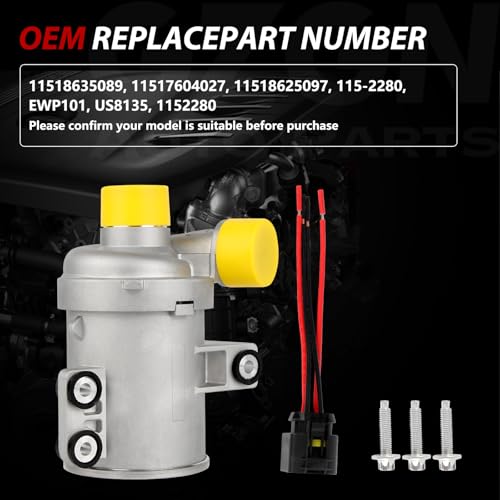
This electric pump replaces or cross-references:
- 11518635089
- 11-51-8-635-089
- 11517604027
- 11-51-7-604-027
- 11518625097
- 115-2280
- 1152280
- EWP101
- US8135
BimmerWorld identifies 11518635089 as the N20/N26 electric pump used on the F22 228i, F30 328i, F32 428i, F10 528i and compatible X and Z models.
Turner Motorsport also catalogs 11518635089 for N20-powered applications and recommends confirming the exact vehicle through its fitment selector.
Thermostat Reference Numbers
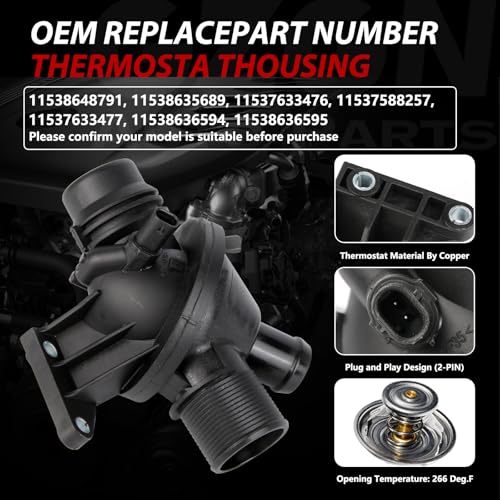
The included thermostat housing may replace or cross-reference:
- 11538635689
- 11-53-8-635-689
- 11538648791
- 11537633476
- 11537633477
- 11538636595
- 11538636594
- 11537588257
Turner Motorsport identifies 11538635689 as a thermostat-with-housing application for the BMW N20 engine.
Thermostat revision, sensor configuration and coolant-port orientation should still be compared with the original component.
Package Contents
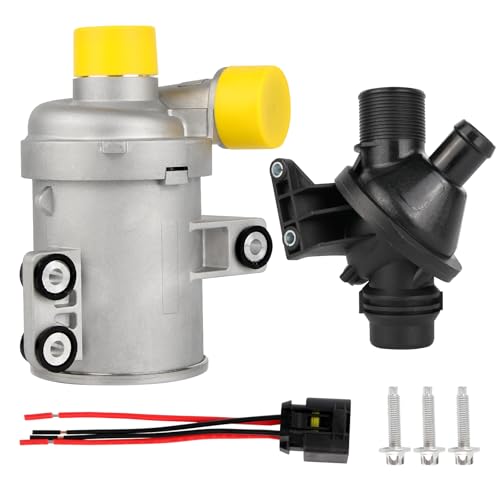
- One electric engine water pump
- One thermostat and housing assembly
- One replacement wiring harness
- Three mounting bolts
- Necessary seals where pictured
Verify all package contents before taking the vehicle apart. The description does not specifically promise replacement coolant hoses, clamps or coolant.
Product Specifications
- Brand: GZGN
- Pump type: Electric engine coolant pump
- Engine family: BMW N20/N26
- Intended output configuration: 180 kW
- Housing material: Aluminum
- Impeller material: Composite
- Drive type: Electric
- Back housing included: No
- Thermostat included: Yes
- Wiring harness included: Yes
- Mounting bolts included: Three
- Fitment type: Vehicle-specific replacement
- Warranty: One year
How the BMW Electric Pump Works
Unlike a belt-driven mechanical pump, the N20/N26 electric pump operates independently of engine speed. The engine computer adjusts operation according to:
- Coolant temperature
- Engine load
- Turbocharger heat
- Warm-up strategy
- Cabin-heating demand
- Vehicle speed
- Air-conditioning operation
- Post-shutdown cooling requirements
This arrangement can reduce mechanical drag and provide more precise temperature control. The less charming side is that electronic failure can stop circulation with very little warning.
For an overview of pump circulation, radiator heat transfer, cooling-system pressure and airflow, start with the Complete Car Cooling System Guide.
Common Failure Symptoms
A failing N20/N26 electric pump may cause:
- Engine overheating
- Yellow or red temperature warning
- Cooling fan running continuously at maximum speed
- Reduced-power or limp-mode operation
- Pump communication faults
- Pump-speed plausibility codes
- Coolant leakage
- Whining or unusual electrical noise
- Weak cabin heat
- Unstable engine temperature
- Pump that will not activate during bleeding
Begin with Why Is My Car Overheating? before assuming every temperature warning proves pump failure.
When temperature rises primarily while driving or under boost, follow Why Does My Car Overheat While Driving? to inspect radiator capacity, coolant flow, airflow and engine condition.
Diagnose Before Replacing the Pump
A complete diagnosis should include:
- Scan the BMW with a compatible diagnostic tool.
- Record stored, pending and shadow codes.
- Compare commanded pump speed with actual operation.
- Activate the pump with the scan tool when supported.
- Check pump power and ground under load.
- Inspect fuses and power distribution.
- Examine the connector for heat or coolant damage.
- Inspect the harness for chafing and corrosion.
- Check coolant level when cold.
- Pressure-test the cooling system.
- Inspect thermostat operation.
- Confirm cooling-fan operation.
- Check for trapped air.
- Verify battery and charging voltage.
- Consider engine-computer failure only after other tests pass.
Do not test the pump by randomly applying battery voltage to connector terminals. The pump contains control electronics, and incorrect power application can damage it.
Why the Wiring Harness Is Included
A harness may be required when the original connector is:
- Corroded
- Heat damaged
- Coolant contaminated
- Missing its locking tab
- Mechanically broken
- Previously repaired incorrectly
- Different from the updated pump connection
Before cutting the vehicle harness, confirm that the supplied update applies to the exact pump revision.
Use:
- Verified pin identification
- Correct wire gauge
- Sealed automotive connections
- Heat-resistant insulation
- Proper strain relief
- Factory-style routing
- Protection from abrasion and exhaust heat
Do not connect wires by color alone. Previous repair work and aftermarket harnesses may use different insulation colors.
Find the Coolant Leak First
Inspect the:
- Water-pump housing
- Pump hose connections
- Thermostat housing
- Cylinder-head coolant flange
- Expansion tank
- Radiator
- Turbocharger coolant lines
- Heater hoses
- Quick-connect fittings
- Lower splash shield
Coolant can travel along the engine or underbody panel before reaching the ground. Follow our step-by-step coolant-leak guide to locate the highest fresh evidence.
Never remove the expansion-tank cap while the cooling system is hot or pressurized.
Water Pump or Thermostat?
The pump and thermostat can create overlapping symptoms.
| Symptom | More likely source |
|---|---|
| Pump communication or speed fault | Pump, harness or power supply |
| No operation during scan-tool activation | Pump or electrical circuit |
| Engine consistently warms too slowly | Thermostat stuck open |
| P0128 without overheating | Thermostat or temperature sensor |
| Rapid overheating with poor circulation | Pump, thermostat or trapped air |
| Coolant around thermostat housing | Thermostat assembly or connection |
| Fan runs constantly at high speed | Pump fault, sensor fault or genuine overheating |
Use our bad thermostat versus bad water pump guide before replacing parts based solely on one symptom.
A P0128 thermostat-regulation code usually indicates slow warm-up rather than complete loss of pump circulation.
Check Coolant-Temperature Data
The engine computer uses coolant-temperature data to control pump speed and cooling-fan operation.
Inspect the sensor circuit if scan data shows:
- Implausibly high temperature
- Implausibly low temperature
- Sudden temperature changes
- Readings that disagree with actual engine temperature
- Open or short-circuit codes
- Intermittent warning lights
Our P0115 coolant-temperature sensor circuit guide covers electrical testing before expensive cooling components are replaced.
Use the P0116 coolant-temperature performance guide when the sensor has a signal but behaves incorrectly during warm-up.
For intermittent readings, follow our P0119 diagnostic guide.
Installation Overview
Professional installation is recommended because pump access is limited and the cooling system requires proper electronic bleeding.
A general procedure includes:
- Let the engine cool completely.
- Disconnect battery power as specified.
- Raise and safely support the vehicle.
- Remove the lower shields and braces.
- Drain the coolant into an approved container.
- Disconnect pump and thermostat wiring.
- Remove the coolant hoses.
- Remove the thermostat and electric pump.
- Compare every port and connector.
- Install new seals and mounting bolts.
- Install the replacement harness if required.
- Reconnect all hoses and wiring.
- Refill with BMW-approved coolant.
- Perform the electronic bleeding procedure.
- Clear applicable diagnostic codes.
- Confirm pump operation through scan data.
- Check for leaks.
- Recheck the coolant level after cooling.
Transmission, chassis and xDrive configuration may change access and hose routing. Use service information matched to the VIN.
Cooling-System Bleeding
Air trapped after service can cause:
- Rapid temperature spikes
- Weak cabin heat
- Pump cavitation
- Gurgling
- False sensor readings
- Low-coolant warnings
- Immediate overheating
- Premature pump damage
Many applicable BMWs use an electric bleeding procedure that runs the pump with the engine off. Maintain battery voltage with a suitable charger and follow the correct sequence for the vehicle.
If the coolant is contaminated or its history is unknown, use our guide to flushing a cooling system safely.
Engine Overheats but Heater Blows Cold
Overheating combined with cold air from the heater may indicate:
- Low coolant
- Trapped air
- Failed pump operation
- Restricted heater core
- Thermostat failure
- Incorrect hose routing
Our guide to an engine that overheats while the heater blows cold explains how cabin heat can help diagnose circulation.
Turbocharged-Engine Cooling
N20 and N26 engines add turbocharger heat to the cooling system. A replacement pump cannot compensate for:
- Restricted radiator
- Failed cooling fan
- Blocked airflow
- Incorrect coolant mixture
- Trapped air
- Coolant loss
- Damaged pressure cap
- Poor engine calibration
- Internal engine leakage
Read our turbo-car cooling-system upgrade guide before treating a larger radiator or new pump as a universal fix.
Our guide covering seven signs of a failing radiator can help determine whether the radiator is contributing to the problem.
When to Stop Driving
Stop driving if:
- A red temperature warning appears
- Steam is visible
- Coolant is pouring out
- The engine enters reduced-power mode
- The heater suddenly turns cold
- Temperature continues rising
- Severe noise develops
Continuing can damage the cylinder head, head gasket, turbocharger or complete engine. See When Should You Stop Driving Your Car? for other warning signs that require immediate action.
Features and Benefits
- Complete pump-and-thermostat repair package
- Intended for compatible 180 kW N20/N26 engines
- Electric pump operation independent of engine speed
- Aluminum pump housing
- Composite impeller
- Thermostat housing included
- Replacement wiring harness included
- Three mounting bolts included
- Tested for balance and leakage
- One-year GZGN warranty
- Manufacturer customer support
“Direct replacement” describes intended fit and operation after proper verification. It does not make 135 kW and 180 kW pumps interchangeable.
Frequently Asked Questions
What vehicles use this water pump?
It fits select BMW 228i, 328i, 428i, 528i, X1 28i, X3 28i, X4 xDrive28i, X5 xDrive40e and Z4 sDrive28i models with the matching N20/N26 180 kW pump configuration.
Does it fit every 2012–2016 BMW 328i?
No. Confirm the N20/N26 engine, F30 chassis and original pump number. N51/N52-powered E9x models use another pump.
Does it fit a BMW 320i?
Generally not if the vehicle uses the 135 kW pump referenced as 11517597715. Verify by VIN.
Does it fit the BMW X3 sDrive20i?
Not universally. Many sDrive20i applications use the lower-output 135 kW configuration. Confirm the original pump number before listing or ordering.
What is the difference between 11517604027 and 11517597715?
The supplied fitment data associates 11517604027 with 180 kW applications and 11517597715 with 135 kW applications. The pumps should not be assumed interchangeable.
Is the thermostat included?
Yes. The package includes a thermostat housing assembly.
Are mounting bolts included?
Yes. Three bolts are included.
Is a wiring harness included?
Yes. Install it only when its connector and pin arrangement match the applicable update.
Does the system require bleeding?
Yes. Use the BMW electronic bleeding procedure after pump or thermostat replacement.
Is this a genuine BMW pump?
No. It is a GZGN aftermarket replacement that cross-references BMW part numbers.
Final Verdict
The GZGN 11518635089 kit combines the electric pump, thermostat, wiring harness and mounting bolts for a more complete N20/N26 cooling-system repair. Its key requirement is the 180 kW engine configuration.
Verify the VIN, engine output, original pump number, thermostat connections and housing shape before ordering. Exclude 135 kW applications unless catalog data confirms compatibility. Preventing one incorrect order is considerably more useful than writing “fits BMW” seventeen additional times.



There are no reviews yet.